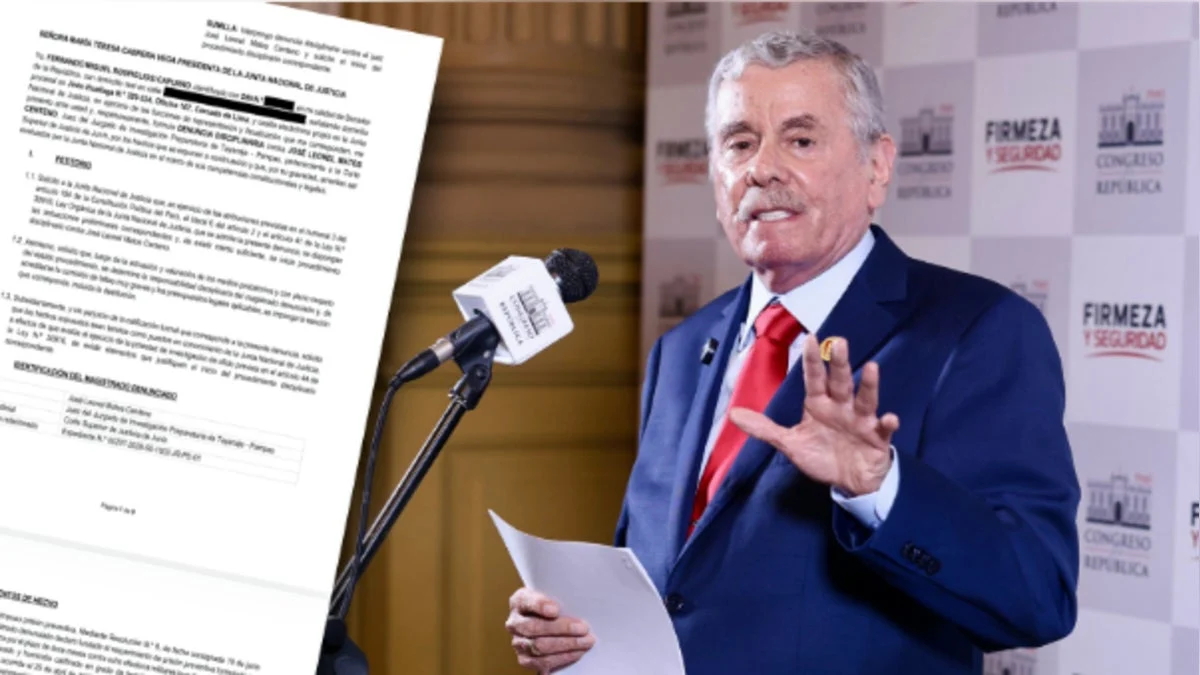
The ongoing friction between the Peruvian legislature and the judicial branch reached a new boiling point this week as Senator Fernando Rospigliosi (Fuerza Popular) escalated his campaign against members of the magistracy. In a move that has sent shockwaves through the country’s legal institutions, Rospigliosi formally lodged a complaint with the National Justice Board (JNJ) against Judge José Matos Centeno, the magistrate of the Preparatory Investigation Court of Tayacaja-Pampas.
This latest action brings the senator’s tally to four judicial officials targeted within his first month in office—a rapid-fire series of legal challenges that critics describe as an attempt to exert political pressure on independent judges, while supporters view it as a necessary correction against "judicial overreach."
The Case of the Colcabamba Incident
At the heart of the current dispute is the case of eight military personnel who were previously subjected to 12 months of preventive detention. The soldiers are currently under investigation for their alleged involvement in the deaths of five civilians and the attempted homicide of three others during an operation on April 25 in the Colcabamba-Ayacucho corridor, located in the Huancavelica region.
Judge Matos Centeno had originally ordered the preventive detention of these soldiers, a decision that Rospigliosi has vehemently decried as "politicized and prevaricating." According to the senator, the military members were engaged in a legitimate operation against narcotics traffickers when the fatalities occurred.
In his filing to the JNJ, Rospigliosi argues that the magistrate committed grave errors in his decision-making process. The senator asserts that the court’s ruling suffered from significant flaws in motivation and that the judge incorporated legal foundations into his verdict that had never been part of the oral debate. Rospigliosi is calling for the JNJ to launch a full disciplinary investigation, with the ultimate objective of securing the judge’s dismissal.
"A superior court in Junín has already set these men free, which demonstrates that the judge committed prevarication," Rospigliosi stated via his social media channels. "The National Justice Board must take immediate action in the face of such a flagrant case. We need radical solutions."
Chronology of the Conflict
The legal drama unfolded in several distinct phases:
- April 25, 2026: A military operation in the Colcabamba area of Huancavelica results in the deaths of five civilians and injuries to three others.
- June 20, 2026: Judge José Matos Centeno dictates 12 months of preventive detention for the eight military personnel involved, citing charges of qualified homicide and attempted qualified homicide.
- August 7, 2026: The First Penal Chamber of Appeals of Junín overturns the detention order, finding that the initial ruling lacked sufficient justification. The court orders that a new judge evaluate the Prosecutor’s Office request.
- August 11, 2026: Senator Rospigliosi announces a complaint against three Supreme Court judges for failing to apply the controversial Law 32107 (concerning the definition of crimes against humanity) and Law 32419 (granting amnesty to security forces in counter-insurgency operations).
- August 16, 2026: Rospigliosi formally submits his complaint against Judge Matos Centeno to the JNJ, escalating his crusade against the judiciary.
The Broader Legislative Strategy
The move against Judge Matos Centeno is not an isolated incident but part of a broader, more aggressive legislative strategy spearheaded by Rospigliosi. Since assuming his seat in the Senate, the lawmaker has become the primary antagonist of judges who interpret or apply international human rights standards in ways that conflict with his party’s legislative agenda.
The senator’s previous filing against three Supreme Court judges was rooted in their alleged refusal to enforce recent laws passed by the Congress. These laws—specifically the legislation defining the scope of "crimes against humanity" and the amnesty bill for security personnel—have been the subject of intense debate. Supporters of the laws argue they provide necessary protection for soldiers and police who fought against terrorism, while human rights organizations and segments of the judiciary argue they violate international treaties to which Peru is a signatory.
Rospigliosi’s rhetoric remains uncompromising. In his public statements, he frequently labels the judges he targets as "defenders of terrorists" and "enemies of the National Police and the Armed Forces." This framing has galvanized his base but has simultaneously triggered a crisis of confidence between the branches of government.
Official Responses and Judicial Independence
The Judiciary has not remained silent in the face of these challenges. On August 13, the Council of Superior Court Presidents across Peru issued a formal statement, calling for an "absolute respect for the criterion and independence of the judicial function."
The statement was a thinly veiled rebuke of Rospigliosi’s tactics. The judiciary warned that the "interposition of complaints against magistrates" serves to undermine the rule of law. The judicial leaders urged politicians and public authorities to refrain from acts of "intimidation, interference, or instrumentalization of public institutions" against judges who are tasked with ruling according to the Constitution and international law.
"Any questioning of judicial decisions must be channeled through the legal remedies provided by the procedural codes," the statement emphasized, underscoring that the proper venue for disagreement is the courtroom—via appeals and revisions—rather than the political arena or the National Justice Board.
Implications for the Rule of Law
The ongoing confrontation carries significant implications for the stability of Peru’s democratic institutions. The primary concern among legal scholars is the potential for "judicial chill," where judges may fear issuing unpopular rulings against the military or the government for fear of being investigated or dismissed by the JNJ.
The Role of the JNJ
The National Justice Board is now placed in an uncomfortable position. As the body responsible for the appointment, ratification, and removal of judges, it is being forced to mediate between a powerful legislative faction and an independent judiciary. If the JNJ yields to the demands of the senator, it could be perceived as losing its own institutional independence. Conversely, if it rejects the claims, it risks a further political backlash from the legislative majority.
The Human Rights Dimension
The debate also touches upon the long-term legacy of Peru’s internal conflict. By attempting to codify definitions of crimes against humanity and amnesty that conflict with international norms, the legislature is effectively challenging the oversight of the Inter-American Court of Human Rights. The judges who have been targeted are often those who prioritize these international obligations, setting the stage for a constitutional crisis that may eventually require the intervention of international bodies.
Future Outlook
As of this writing, there is no sign of de-escalation. Senator Rospigliosi continues to utilize social media to publicize his complaints, effectively turning each legal filing into a public campaign. The judicial branch, meanwhile, is attempting to consolidate its position by emphasizing the separation of powers.
The resolution of the case against Judge Matos Centeno will likely serve as a barometer for the independence of the Peruvian judiciary in the coming months. If the JNJ decides to proceed with the disciplinary action requested, it would mark a significant shift in the balance of power, potentially signaling a new era of legislative oversight over judicial decisions. However, if the board holds firm on the principle of judicial independence, the conflict between the Congress and the courts is likely to intensify, leaving the nation to grapple with the fundamental question of who holds the final authority in interpreting the laws of the land.
In conclusion, the situation remains fluid. While the senator frames his actions as a fight against corruption and institutional bias, the judiciary views the same actions as a direct threat to the independence of the courts. As the JNJ prepares to deliberate, the eyes of the legal community and the public remain fixed on the outcome, knowing that the precedent set here will dictate the boundaries of political power and judicial autonomy for years to come.