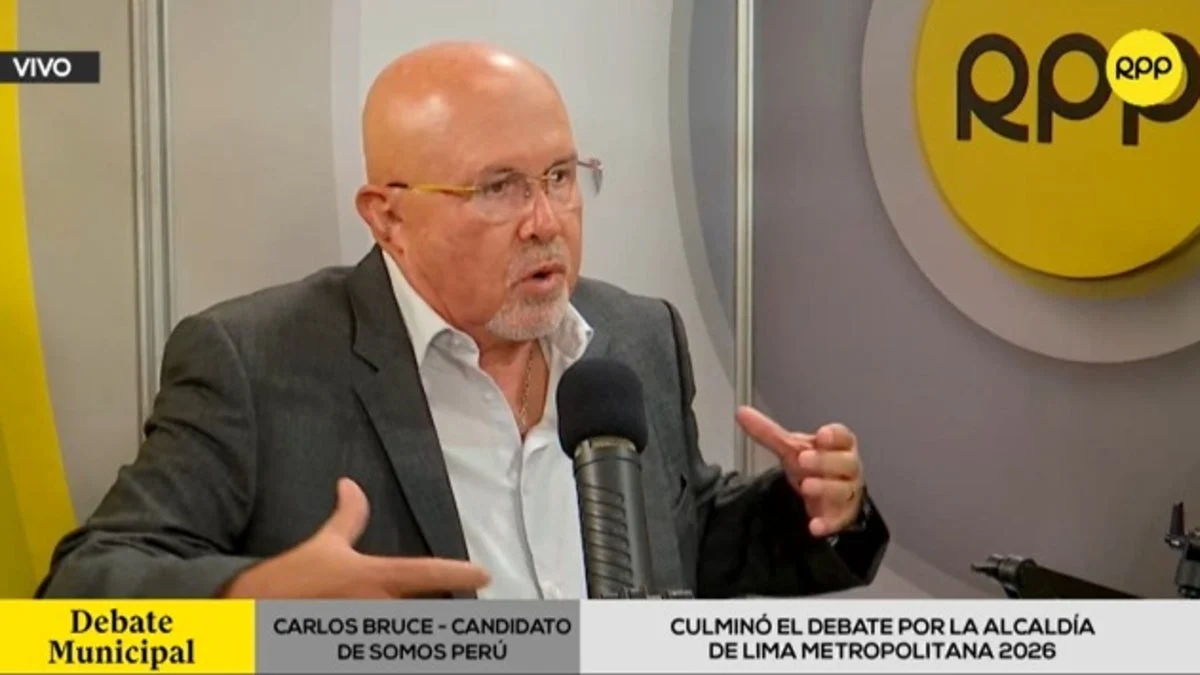
Following the conclusion of the first round of debates for the mayoral candidates of Lima, Carlos Bruce, the standard-bearer for the Somos Perú party, has emerged as a central figure in the discourse surrounding the capital’s future. In a comprehensive interview with Fernando Carvallo at the Mario Vargas Llosa library, broadcast via RPP, Bruce pivoted away from traditional campaign rhetoric to focus on what he considers the most critical deficit in Peruvian public administration: the gap between identifying urban problems and possessing the executive capability to solve them with limited fiscal resources.
The Core Challenge: Execution Over Diagnosis
For Bruce, a former government minister with extensive experience in the public sector, the current electoral landscape is characterized by a shared consensus on the problems facing Lima. Whether it is insecurity, traffic congestion, or the lack of formal housing, most candidates are aligned on the diagnosis. However, Bruce argues that this alignment is deceptive.
"The problem is not knowing what needs to be done," Bruce stated during the interview. "Everyone knows what needs to be done. The real challenge is having the capacity to execute those solutions using scarce resources."
This emphasis on "executive efficiency" forms the cornerstone of his campaign. Bruce posits that Lima’s municipal government has historically suffered from a lack of technical expertise and the inability to navigate the bureaucratic hurdles that delay public works. His platform is built on the premise that a municipal leader must function more like a project manager than a politician, prioritizing cost-benefit analyses and rapid implementation cycles to deliver tangible improvements to citizens’ quality of life.
Chronology of the Mayoral Campaign Context
To understand the weight of Bruce’s proposals, one must look at the timeline leading up to this point in the municipal race:
- Early Campaign Phase: The primary focus was on the identification of systemic failures in public transport and the rising tide of urban insecurity. Candidates began to distance themselves from traditional party lines to focus on "citizen-first" initiatives.
- The Debate Period: The inaugural debate highlighted a fragmentation of proposals. While many candidates offered broad, idealistic goals, Bruce positioned himself as the "pragmatic technocrat," focusing on the how rather than the what.
- The RPP Interview: This milestone served as a formal consolidation of his policy pillars: the municipal police force, the prioritization of segregated transport corridors over expensive subway expansions, and a shift toward formalizing housing through social programs.
Supporting Data and Strategic Pillars
Bruce’s campaign is backed by specific, data-driven proposals that attempt to address the city’s bottlenecks through legislative and administrative restructuring.
1. Reforming Public Safety: The Municipal Police Initiative
One of Bruce’s most controversial yet concrete proposals is the creation of a municipal police corps. He argues that this does not require a constitutional amendment, but rather a specific law passed by the Congress of the Republic.
The strategy involves creating a force dedicated specifically to common, daily offenses and traffic control. This force, which would undergo a one-year training program, is designed to act as a force multiplier for the National Police. Bruce contends that it is a "misuse of public resources" to have highly specialized National Police officers—trained for complex criminal investigations, kidnapping, and extortion—spending their shifts directing traffic. By offloading these routine duties to municipal officers, the National Police could redirect their resources toward high-level criminal intelligence, geolocating illicit actors, and dismantling organized crime rings.
2. Transport Infrastructure: Corridors vs. Subways
In the realm of urban mobility, Bruce has introduced a stark economic contrast. While acknowledging that subway lines are an important long-term component of a modern city, he argues that Lima cannot afford the 15-to-20-year timeline required for such massive infrastructure projects.
"One kilometer of subway costs approximately $200 million," Bruce pointed out. "A kilometer of a segregated transport corridor, similar to the existing Metropolitano, costs around $10 million and can be completed in two to three years."
His proposal advocates for the rapid expansion of these segregated bus lanes, equipped with air conditioning and modern technology, to provide immediate relief to a commuting public currently trapped in gridlock. This pragmatic approach emphasizes providing a functional service in the short term rather than promising a futuristic, yet distant, subway expansion.
3. Housing and Urban Planning
Addressing the chaotic growth of Lima, Bruce has sharply criticized the state’s historical inertia regarding land use. He argues that the lack of affordable, formal housing options leaves low-income families with little choice but to participate in the illegal occupation of land or "invasions" on high-risk slopes.
His solution is the massification of social housing through the "Techo Propio" scheme. By facilitating access to formal housing with basic services from day one, he aims to undercut the business model of land traffickers. His goal is to replace the cycle of land invasion and years of fighting for basic water and electricity with a streamlined process that allows families to own their homes with full legal title and infrastructure, supported by government-subsidized initial payments.
Official Responses and Political Implications
The reaction to Bruce’s proposals from rival camps has been mixed. Critics within the municipal sphere have questioned whether a municipal police force could lead to jurisdictional conflicts with the National Police, or if the "fast-track" transport solutions would simply lead to substandard infrastructure that would need to be replaced later.
However, political analysts observe that Bruce’s strategy is a calculated appeal to a segment of the electorate tired of empty promises. By focusing on the "scarcity of resources," he is acknowledging the fiscal reality that many other candidates avoid discussing. This approach positions him as a "grown-up in the room," appealing to voters who prioritize stability and administrative competence over populism.
The implications for the election are significant. If the electorate views the current municipal crises as a failure of management rather than a failure of vision, Bruce’s platform of efficiency could prove to be the deciding factor. Conversely, if voters demand radical structural changes rather than administrative improvements, his technocratic approach may struggle to capture the imagination of those who feel marginalized by the current system.
Conclusion: The Path Forward
Carlos Bruce’s campaign represents a shift toward a "management-first" style of governance for Lima. By emphasizing the legislative viability of his proposals—such as working with Congress to create a municipal police force—and highlighting the economic necessity of cost-effective transit, he is framing the upcoming mayoral term as a rescue mission for the city’s administration.
Whether these proposals can survive the political friction of the municipal council and the challenges of national-level coordination remains to be seen. However, Bruce has succeeded in shifting the conversation. The question for Lima’s voters is no longer just which candidate has the best vision for the city, but which candidate possesses the executive discipline to turn that vision into a reality within the constraints of a limited budget. As the race enters its final stages, the focus on "how to do it" is likely to remain the defining characteristic of the 2024 Lima municipal election.