Executive Summary: A Milestone for Regional Development
In a significant stride toward bridging the socio-economic divide in northern Peru, the Ministry of Energy and Mines (MINEM) has announced that a massive rural electrification project in the Piura region has reached a critical 91.87% completion milestone. This infrastructure initiative is designed to provide reliable electricity to over 30,000 residents across 345 remote localities, fundamentally altering the trajectory of development in one of the country’s most historically underserved regions.
The project, which represents a cornerstone of the current administration’s commitment to rural development, focuses on the expansion and modernization of electrical distribution networks. By integrating these communities into the national power grid, the government aims to catalyze local economies, improve educational outcomes, and enhance public health standards.
The Path to Energization: A Chronological Overview
The journey toward universal electrification in Piura has been a multi-year effort involving rigorous engineering, complex logistics, and strategic coordination between central government bodies and regional distributors.
Project Inception and Planning
The initiative began with an exhaustive diagnostic survey of the Piura, Sullana, Talara, Morropón, and Huancabamba provinces. Planners identified a significant disparity between urban and rural access to electricity, noting that while the coastal cities enjoyed robust infrastructure, the hinterlands remained largely reliant on costly and inefficient off-grid power solutions.
Execution and Coordination
The project was formally structured under the direction of the General Directorate of Rural Electrification (DGER). A key success factor has been the synergy established between the DGER and ENOSA (Empresa Regional de Servicio Público de Electricidad del Norte). This partnership allowed for the rapid scaling of the "Ampliación de Redes de Distribución de Piura" (Expansion of Distribution Networks of Piura) project, ensuring that technical standards were met while navigating the challenging terrain of the northern Andes and the arid desert landscapes of the coastal provinces.

Current Status: The 91.87% Milestone
As of the latest reporting period, the project has successfully reached 91.87% of its total projected completion. Crucially, 201 individual localities have already been fully energized. This progress has been steady, overcoming logistical hurdles such as the remote nature of the Huancabamba highlands and the need for specialized equipment to navigate rural road networks.
Technical Scope and Supporting Data
The sheer scale of this electrification drive is evidenced by the specific metrics released by the Ministry of Energy and Mines.
- Total Beneficiaries: Approximately 30,000 citizens.
- Geographic Reach: 19 districts spanning 5 provinces.
- Connectivity: A total of 7,281 new household connections are being integrated into the system.
- Infrastructure: Installation of high-tension lines, sub-stations, and secondary distribution networks.
The Shift to Three-Phase Technology
Beyond simple connectivity, the project is notable for its forward-thinking approach. Minister Guillermo Shinno has confirmed that the government is prioritizing the implementation of three-phase power technology in these rural zones. Unlike single-phase systems, three-phase power is capable of supporting heavy machinery, irrigation pumps, and small-scale industrial processing equipment. This is a critical distinction, as it allows rural families to transition from subsistence farming to value-added agricultural production, effectively turning electricity into a direct tool for poverty reduction.
Official Responses and Ministerial Oversight
Minister Guillermo Shinno, representing the administration of President Keiko Fujimori, recently traveled to the district of Tambogrande to witness the physical transformation of the community of San Felipe de Malingas.
The Human Element: A Symbolic Moment
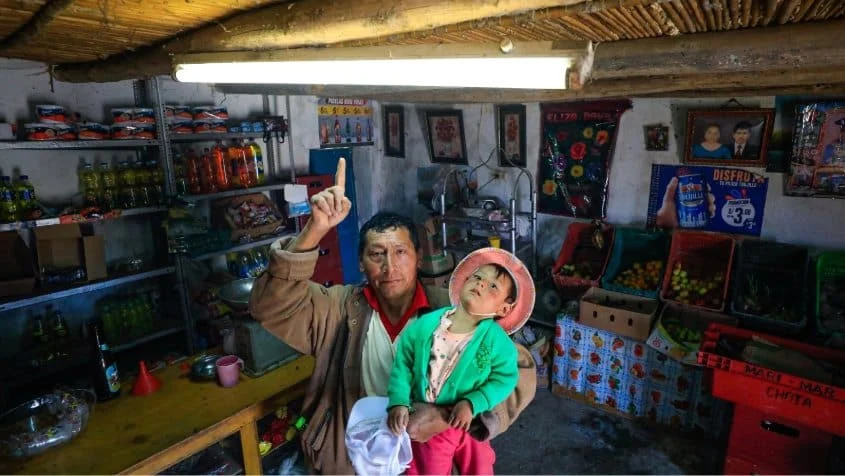
The visit was highlighted by a ceremonial "first light" event at the home of Guillermo Arévalo. Joined by his granddaughter, Greidy Moreno, the family experienced the activation of their home’s lighting system for the first time. For the Minister, this was more than a photo opportunity; it was a testament to the government’s promise to close social gaps.

"Electricity is the foundation upon which modern life is built," Minister Shinno stated during the event. "By bringing power to these 345 localities, we are not just providing light; we are providing the tools for education, health, and economic independence. This administration remains steadfast in its mandate to ensure that no Peruvian, regardless of how remote their home, is left behind in the development of our nation."
The Socio-Economic Implications of Electrification
The impact of this project extends far beyond the convenience of a lightbulb. International development experts have long noted that rural electrification is a prerequisite for sustainable development.
Economic Development and Industrialization
With the arrival of stable electricity, the potential for agro-industrial growth in the Piura region increases exponentially. Small businesses—such as cold-storage facilities for agricultural produce, carpentry shops, and local retail stores—can now operate with extended hours and more efficient equipment. The aforementioned transition to three-phase power is specifically intended to lower the cost of doing business in rural areas, making local products more competitive in regional markets.
Educational and Healthcare Benefits
For the youth of these 345 localities, the availability of electricity changes the academic landscape. Students can now study after sunset, access digital resources, and benefit from modern educational technologies. Similarly, local healthcare clinics, which were previously limited by their inability to store vaccines or operate sophisticated diagnostic equipment, will now be able to provide a higher standard of care, significantly reducing the need for patients to travel to larger, distant urban centers.
Quality of Life and Security
Public safety is another critical benefit. Street lighting in town centers and around communal spaces creates a safer environment for citizens, particularly women and children, during the evening hours. Furthermore, the reliance on kerosene or biomass for lighting and cooking is being phased out, leading to improved indoor air quality and reduced respiratory issues among the rural population.

Future Outlook and Sustainability
While the 91.87% completion rate is a cause for celebration, the Ministry of Energy and Mines has signaled that the work does not end with the installation of poles and wires. A comprehensive maintenance and monitoring program is being established in collaboration with local authorities to ensure the long-term reliability of the grid.
Furthermore, the government is looking at the lessons learned from the Piura project to refine its "National Rural Electrification Plan." The success of the DGER-ENOSA model serves as a blueprint for upcoming projects in other regions, such as those recently proposed for Tacna and Moquegua. By standardizing the procurement process and focusing on high-tech, scalable infrastructure, the government aims to accelerate the timeline for achieving 100% universal energy access across the country.
Conclusion
The transformation of San Felipe de Malingas and the surrounding regions is a tangible success story in the broader narrative of Peru’s infrastructure development. As the project enters its final phase, the focus will shift from construction to long-term impact evaluation. For the 30,000 residents now gaining access to the grid, the lights coming on represents the dawn of a new era—one where geographic isolation no longer dictates the limits of their potential. Through the consistent application of policy, private-public partnership, and a clear vision for regional equity, the government is proving that the path to a more prosperous Peru is, quite literally, being lit one community at a time.