Executive Summary: A Crisis of Unprecedented Proportions
Since October 4, the native community of Tsyapo, located in the Rio Tambo district of the Satipo province, Junín, has been under siege by an aggressive and persistent forest fire. This environmental and humanitarian catastrophe has already consumed over 1,000 hectares of primary rainforest and essential agricultural lands, threatening the very survival of the indigenous Asháninka people who have called these lands home for generations.
As of mid-October, the flames continue to advance, having already destroyed 11 family homes and displaced approximately 50 families. The situation is critical, with local authorities, community leaders, and national defense units engaged in a desperate race against time, extreme heat, and rugged terrain to prevent the fire from encroaching upon protected national reserves.
Chronology of the Disaster: From Initial Spark to Widespread Crisis
The tragedy began on October 4, when initial reports of smoke and flames emerged from the Tsyapo region. What began as a localized threat quickly escalated due to favorable wind conditions and the tinderbox state of the forest floor, which had been dried out by an prolonged lack of rainfall.
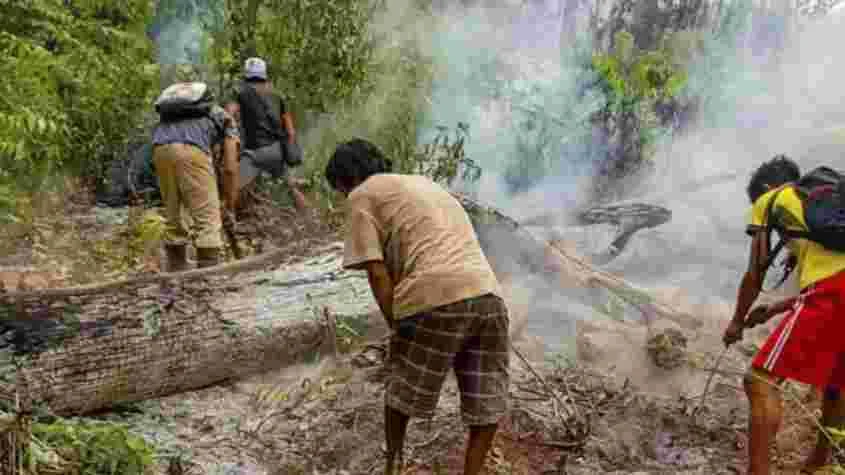
- October 4–7: The fire initiates in Tsyapo. Initial response is limited to local community members and volunteer brigades from the Asháninka Federation of the Ene River (FARE).
- October 8–10: The fire expands beyond initial containment lines, spreading toward neighboring communities including Tincareni, Tarobeni, Cobeja, Saboroshari, and Alto Cobeja.
- October 11–13: The crisis gains national attention. The municipal government of Rio Tambo issues an urgent appeal for federal intervention. The COEN (National Center for Emergency Operations) officially reports the fire as active, prompting the deployment of the 31st Infantry Brigade of the Peruvian Army.
- October 14–Present: Ongoing efforts are hampered by the extreme heat and the physical exhaustion of the first responders. While humanitarian flights have successfully deployed specialized forest firefighters to key sectors, the fire remains a fluid, dangerous threat.
The Humanitarian Toll: Asháninka Families at a Crossroads
The human impact of this disaster cannot be overstated. For the 50 families affected, the fire is not merely an environmental event; it is a total disruption of their livelihood and cultural heritage.
The destruction of 11 homes represents more than just a loss of property; it is the loss of the foundational stability of these families. Many of those impacted were subsistence farmers, and the loss of agricultural land means a loss of food security for the coming seasons. The psychological toll on the community, which has had to abandon ancestral lands to escape the encroaching heat and smoke, is immense.

Health officials have noted an alarming number of cases involving smoke inhalation, exhaustion, and heat-related illness among the local volunteer brigades. The lack of adequate medical facilities in the immediate vicinity of Tsyapo has made the treatment of these conditions particularly difficult, necessitating the reliance on emergency transport that is often delayed by the challenging jungle topography.
Environmental Implications: A Threat to Biodiversity
The fires are currently advancing toward the perimeter of the Asháninka National Reserve and the Otishi National Park. These areas represent some of the most biodiverse regions in the Peruvian Amazon.
The potential loss of these protected zones would be a catastrophic blow to regional ecology. These forests serve as critical carbon sinks and habitats for endangered species. If the fire breaches the boundaries of the national park, the damage could be irreversible, leading to a permanent change in the local microclimate and the loss of rare flora and fauna that exist nowhere else on the planet.
Challenges to Containment: Nature and Logistics
The battle against the flames is being fought under conditions that would challenge even the most experienced international fire-suppression teams. Several factors have combined to create a "perfect storm" for the fire’s persistence:
1. Extreme Climatic Conditions
Temperatures in the region have soared to 43°C (109°F). This intense heat dries out vegetation rapidly, turning the forest into a highly combustible fuel source. The high heat also poses a significant risk to the health of the firefighters, who are working in full gear under a relentless sun.

2. Geographical Isolation
The terrain in the Rio Tambo district is characterized by steep ridges and dense, inaccessible jungle. Many of the fire fronts are located in areas where motorized equipment cannot reach. Consequently, firefighters must trek for hours through treacherous terrain just to reach the front lines, leaving them physically depleted before they even begin the work of digging firebreaks or applying retardants.
3. Resource Constraints
While there is a valiant effort by the FARE brigades and local municipality workers, they lack the heavy machinery and specialized aviation assets required for large-scale forest fire suppression. The reliance on human-powered firebreaks is a heroic but ultimately insufficient strategy against a blaze of this magnitude.
Official Response and Inter-Institutional Coordination
The complexity of the emergency has necessitated a multi-level response. The municipal government of Rio Tambo has been at the forefront of the coordination, but their resources are insufficient for the scale of the destruction.
The Role of the Military and National Government
The involvement of the Ministry of Defense and the Special Command of the VRAEM (Valley of the Apurímac, Ene, and Mantaro Rivers) has been crucial. By providing air support and personnel from the 31st Infantry Brigade, the government has been able to bridge the gap in logistics that previously hindered the response.
Humanitarian Aid and Logistics
Humanitarian flights have been the most effective tool in the current arsenal. These flights have not only delivered supplies but have also served as the primary means of moving exhausted, injured, or sick personnel out of the danger zone while rotating in fresh teams. However, authorities continue to call for a more robust, long-term intervention that includes modern fire-fighting technology and sustained medical support for the affected families.

Looking Forward: A Call for Sustainable Prevention
As the situation in Rio Tambo remains critical, the broader implications of these wildfires highlight a systemic vulnerability in the Amazonian region. The frequency and intensity of forest fires in Peru have been increasing, linked to climate change and the expansion of agricultural frontiers.
Immediate Needs
- Medical Support: Immediate establishment of field clinics to treat respiratory issues caused by the thick, toxic smoke blankets currently hovering over the affected communities.
- Infrastructure: The development of better access routes to enable rapid response teams to reach remote communities before small fires become uncontrollable infernos.
- Resource Allocation: A permanent increase in the budget for regional disaster management offices, specifically for forest fire prevention and rapid response training.
Long-Term Sustainability
The protection of the Asháninka people and their environment requires more than just reactive firefighting. It requires a policy shift that prioritizes:
- Community-Led Monitoring: Empowering indigenous communities with the satellite technology and training to detect fire threats in their early stages.
- Reforestation and Recovery: Once the fire is extinguished, an urgent program for the reforestation of the 1,000+ hectares lost, coupled with direct economic aid to rebuild the 11 homes and support the 50 displaced families.
- Climate Adaptation: Integrating the traditional knowledge of the Asháninka people with modern climate science to build more resilient agricultural and land-management systems that can withstand the increasingly severe dry seasons.
Conclusion
The wildfire in Rio Tambo is a stark reminder of the fragile balance between human development and the preservation of the Amazon. The courage displayed by the Asháninka people and the first responders is a testament to the resilience of the community, but courage alone cannot extinguish 1,000 hectares of forest.
The national government, alongside international environmental agencies, must now pivot toward a strategy that ensures this catastrophe does not repeat itself. Until then, the eyes of the nation remain fixed on Tsyapo, waiting for the news that the fire has finally been contained and that the process of healing and rebuilding can begin for the families who have lost so much. The preservation of the Amazon is not just a local duty; it is a global imperative that begins with protecting those who live on the front lines of this climate emergency.