Introduction: A Period of Robust Expansion
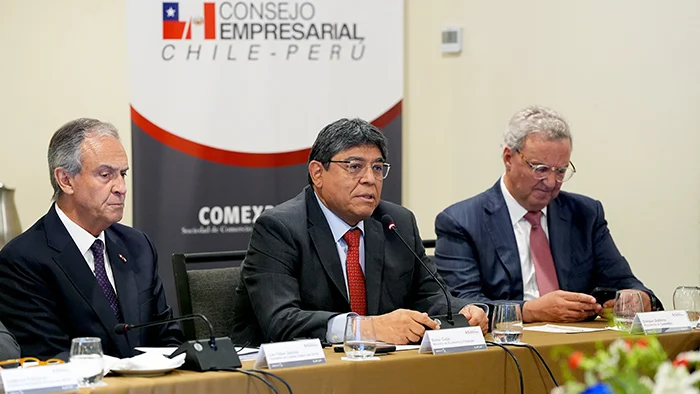
The Peruvian economy is currently navigating a transformative phase, characterized by strong macroeconomic indicators and a renewed commitment to private sector engagement. During the XXI Meeting of the Chilean-Peruvian Business Council, organized by ComexPerú, the Minister of Economy and Finance (MEF), Elmer Cuba, presented a compelling vision for the nation’s future. Amidst a global landscape of volatility, Peru stands out as a beacon of fiscal discipline and structural potential, with the government forecasting a steady GDP growth of 3.4% for both 2026 and 2027.
The gathering, which brought together high-ranking officials including Minister of Foreign Affairs Carlos Espá and Minister of Energy and Mines Guillermo Shinno, served as a platform to solidify the economic bridge between two of the Pacific Alliance’s most vital partners. As Peru aims to solidify its position as a global export powerhouse, the message from the MEF is clear: structural reform, coupled with unwavering fiscal responsibility, is the key to unlocking the nation’s full potential.
Main Facts: Record Exports and Investment Growth
The fiscal performance of the Peruvian economy in 2026 has exceeded initial expectations. According to official data provided by Minister Cuba, the country experienced a 15.5% real growth in private investment during the first half of the year. This surge is not merely a statistical rebound but reflects a deepening of confidence among both domestic and international stakeholders.
Perhaps the most striking figure shared at the summit was the performance of the export sector. Between January and September 2026, Peru recorded a historic US$83 billion in goods exports. This figure represents the highest level ever achieved for such a period in the nation’s history. Consequently, the Ministry of Economy and Finance has upwardly adjusted its projections, aiming for an unprecedented US$100 billion in total exports by the end of the calendar year. This trajectory is supported by the diversified nature of Peruvian exports, which span from high-value mineral concentrates to advanced agro-industrial products.
Chronology of Economic Recovery and Strategy
The current economic trajectory is the result of a deliberate policy framework implemented over the last several years.
- Early 2026: The government prioritized the stabilization of the fiscal deficit, ensuring that the volatility of political cycles did not impact the country’s credit rating or investor perception.
- Q1 & Q2 2026: Focused initiatives to streamline public investment and foster an environment conducive to private capital inflow began to yield results, culminating in the 15.5% growth in private investment.
- Q3 2026: The focus shifted toward consolidating trade partnerships. The interaction with the Chilean-Peruvian Business Council served as a critical milestone to align regional trade agendas.
- Q4 2026 and Beyond: The government’s roadmap now focuses on the implementation of long-term structural reforms aimed at tackling informal labor markets and increasing tax efficiency.
Supporting Data: The Chilean Investment Footprint
The relationship between Peru and Chile serves as a microcosm of regional economic integration. Minister Cuba highlighted that Chile remains a cornerstone of foreign direct investment (FDI) in Peru. With a cumulative investment of US$4.548 billion, Chile currently holds the third position among the largest sources of FDI in the country, accounting for 13.3% of the total.
Sectoral Distribution of FDI
The concentration of these investments is highly strategic:
- Mining: Representing the largest share, as Chilean firms leverage technical expertise to tap into Peru’s vast copper and precious metal reserves.
- Energy: A growing sector where cross-border collaboration is facilitating the modernization of the electrical grid and renewable energy initiatives.
- Industry and Infrastructure: Chilean companies continue to play a pivotal role in the construction and retail sectors, contributing to the modernization of Peruvian urban hubs.
Minister Cuba emphasized that the constitutional protections afforded to foreign investors, combined with Peru’s historical adherence to free-market principles, provide the necessary legal certainty for these companies to continue expanding their operations.
Official Responses and Strategic Vision
During the summit, Minister Cuba addressed the elephant in the room: the structural challenge of informality. He noted that in the micro-enterprise sector outside of Lima, informality rates remain as high as 90%. This, he argued, is not just a regulatory failure but a massive hurdle to productivity and tax collection.
The Reform Agenda
The government’s strategy, as outlined by the MEF, relies on three pillars:
- Tax Recalibration: Creating simpler, more attractive regimes for small businesses to transition from the informal to the formal sector without being stifled by excessive bureaucratic costs.
- Financial Inclusion: Expanding access to credit for SMEs. By integrating these businesses into the formal financial system, the government aims to catalyze investment at the grassroots level.
- Public Investment Efficiency: Reforming the mechanisms through which public funds are deployed, ensuring that infrastructure projects—ranging from road networks to irrigation systems—are completed on time and within budget.
Minister Shinno, representing the Ministry of Energy and Mines, echoed these sentiments, stressing that the mining sector remains the engine of the economy and that the government is committed to clearing the regulatory bottlenecks that have historically slowed down exploration and development.
Implications for the Future
The implications of the data presented by Minister Cuba are significant for both the Andean region and the global market.
Resilience Against External Shocks
Despite the constant looming threat of climate phenomena like El Niño, which historically poses a risk to Peruvian agriculture and infrastructure, the MEF remains confident. The projection of 3.4% growth for 2026 and 2027 suggests that the economy has developed a degree of "shock-absorbency." This resilience is attributed to a combination of high international reserves, a flexible exchange rate, and a diversified trade portfolio that is no longer solely reliant on a single commodity or market.
Strengthening Regional Trade
The partnership with Chile is illustrative of the broader Pacific Alliance strategy. By aligning regulatory frameworks and deepening the integration of capital markets, Peru and Chile are setting a standard for intra-regional cooperation. For investors, the message is clear: Peru is open for business, and the government is actively removing barriers to entry.
Addressing the Social Gap
While the macroeconomic indicators are overwhelmingly positive, the Minister’s focus on the 90% informality rate indicates a government that is acutely aware of the social-economic divide. The success of the "formalization agenda" will likely be the definitive factor in determining whether Peru can sustain this growth in the long term. If the government succeeds in bringing these micro-enterprises into the formal economy, it will not only broaden the tax base but also empower millions of citizens, thereby reducing the volatility that stems from economic inequality.
Conclusion: A Nation on the Move
As the 2026 fiscal year draws to a close, Peru finds itself in an enviable position. With record-breaking export levels and a surge in private sector confidence, the nation is successfully navigating the transition from a post-pandemic recovery to sustainable, structural expansion.
The commitment shown by Ministers Cuba, Espá, and Shinno at the XXI Meeting of the Chilean-Peruvian Business Council underscores a unified governmental approach: one that respects fiscal orthodoxy while aggressively pursuing the reforms necessary for modern, inclusive growth. For global investors watching the Andean region, Peru’s recent performance confirms that the country remains one of the most stable and promising destinations for capital in Latin America. As long as the government remains committed to its reform agenda and the maintenance of its institutional framework, the target of US$100 billion in exports may well be just the beginning of a new era of prosperity for the nation.