Overview: A Significant Judicial Pivot
In a landmark development for the former President of Peru, Pedro Pablo Kuczynski (PPK), the Peruvian judiciary has officially lifted the long-standing travel ban (impedimento de salida del país) that had constrained the former leader for nearly a decade. The ruling follows the archiving of a criminal case concerning alleged financial irregularities in his 2016 presidential campaign.
For Kuczynski, now in his mid-80s, this decision represents more than just a legal victory; it marks the end of an eight-year period of isolation from his immediate family and the beginning of a chapter focused on both medical rehabilitation and a rigorous defense of his legacy. His legal counsel, the prominent defense attorney César Nakazaki, has framed this outcome as a long-overdue correction to a judicial system that he argues had veered into excessive restrictiveness during the height of the anti-corruption investigations that swept through Peruvian politics.
Chronology of a Prolonged Legal Battle
To understand the gravity of the recent ruling, one must look back at the trajectory of the investigations that paralyzed Kuczynski’s post-presidential life.
- 2016-2017: Kuczynski serves as President of Peru. During this period, the political climate in the country begins to shift under the weight of the Lava Jato scandal, which implicated multiple former presidents in corruption schemes involving the Brazilian construction firm Odebrecht.
- 2018: Kuczynski resigns from the presidency amid political pressure. Almost immediately, the judicial system begins imposing severe restrictions, including the first iterations of travel bans and house arrest orders.
- 2019-2021: The legal situation intensifies. Kuczynski faces multiple probes related to money laundering and the financing of his 2016 campaign. During this time, he is largely confined to his residence, citing significant health concerns that require specialized treatment—treatment that his defense team argued was inaccessible due to his legal status.
- 2023-2024: A shift occurs in the judicial landscape, influenced by rulings from the Constitutional Tribunal regarding the legal standards for campaign financing. Several cases against Kuczynski are archived.
- Late 2024: The Judiciary formally lifts the final travel restriction related to the 2016 campaign investigation, clearing the path for Kuczynski to travel to the United States.
The Defense’s Perspective: Challenging the Jurisprudence
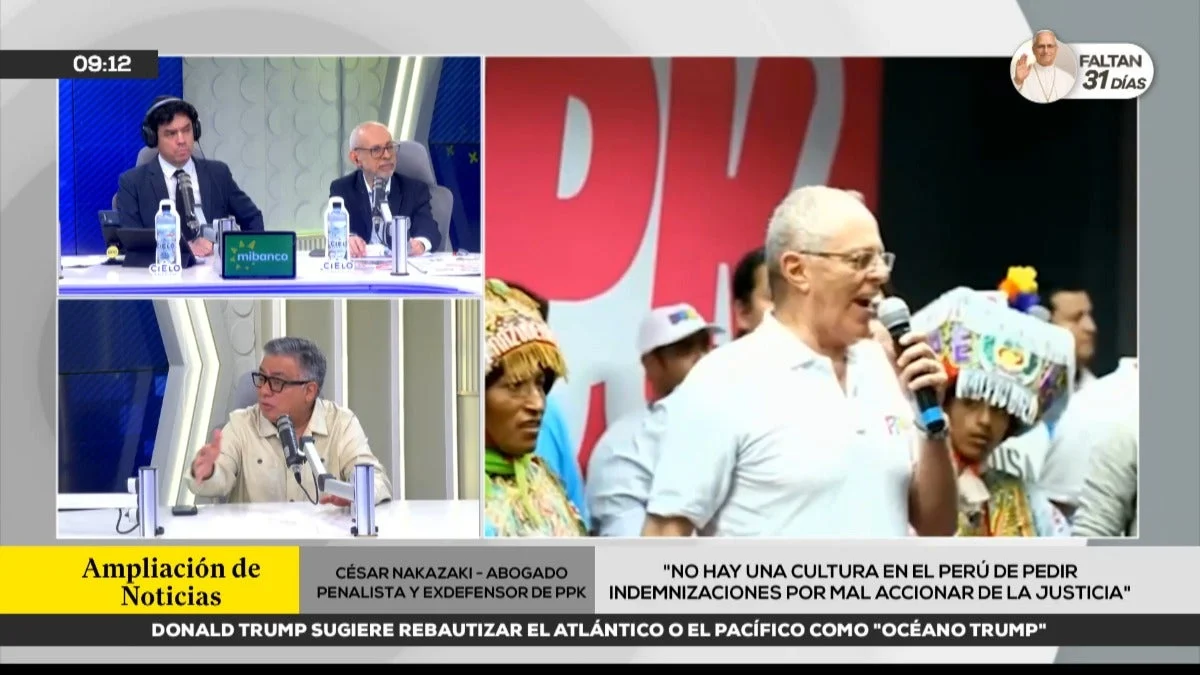
César Nakazaki, in his appearance on Ampliación de Noticias, did not mince words regarding the methods used by the judiciary over the last eight years. He characterized the travel ban imposed on Kuczynski as a departure from traditional Peruvian legal practice.
"Justice that is delayed is not justice," Nakazaki asserted. "In 2018, we saw a rupture in established jurisprudence. Traditionally in Peru, travel permits were granted even in the midst of ongoing processes, provided the accused was not a flight risk. With Kuczynski, that standard was broken."
Nakazaki emphasized that the medical necessity for the former president was "evident," yet the state repeatedly denied requests for travel for health reasons. He noted that the decision to maintain these restrictions for eight years resulted in a profound humanitarian toll, effectively separating a man in his final years from his family members residing abroad.
Supporting Data: The Legal Basis for the Archiving
The lifting of the ban is rooted in the broader legal trend regarding the prosecution of political campaign contributions in Peru. Following recent rulings by the Constitutional Tribunal (TC), the legal definition of "illicit campaign financing" has been narrowed.
Nakazaki explained that the legal team’s strategy relied on the principle that if the act in question is not defined as a crime under the current interpretation of the law, the prosecution cannot proceed. "All the campaign contribution cases that have been concluding—and I believe there is only one left—are the result of the Constitutional Tribunal’s rulings. If the act is not a crime, that principle applies equally to all political parties."
While Kuczynski still faces other ongoing investigations, his defense team is optimistic. They maintain that these remaining probes are fundamentally flawed and lack the evidentiary weight necessary to justify the previous years of confinement and restriction.
Official Responses and Human Rights Implications
The case of Pedro Pablo Kuczynski has opened a debate within the Peruvian legal community regarding the responsibility of the state when judicial measures are deemed excessive or erroneous.
The Question of Indemnification
Nakazaki raised the possibility of seeking reparations from the state, citing international standards established by the Inter-American Court of Human Rights (IACHR). He noted that in many democratic nations, judicial errors—particularly those involving preventive detention or cautelary measures that lack a legal basis—trigger an obligation for the state to indemnify the affected individual.
"In other countries, it is standard practice that judicial errors generate indemnification," Nakazaki observed. "However, in Peru, there is not yet a culture of holding the state accountable for these types of judicial excesses." While he did not confirm that a lawsuit for damages would be filed immediately, he signaled that the discussion is now on the table as a matter of institutional principle.
Personal Implications: A Focus on Restoration and Legacy
Beyond the legal arguments, the personal dimension of this ruling is significant. After nearly a decade of being confined to the reach of Peruvian authorities, Kuczynski is finally preparing for a trip to the United States to reunite with his family.
The Commitment to Innocence
Perhaps most telling is the shift in focus for the former president. According to Nakazaki, the primary motivation for Kuczynski is not merely obtaining freedom of movement, but the total clearing of his name.
"His desperation was never about the fear of being condemned," Nakazaki noted. "He knew that the cases brought against him were baseless and that the years would eventually prove it. His true desperation was to have the opportunity to prove his innocence in a definitive manner."
Kuczynski views the recent judicial decisions as the first steps toward a full public exoneration. He intends to continue his medical treatments in the U.S. while his legal team works to finalize the closure of the remaining files on his desk.
Conclusion: The Road Ahead
The lifting of the travel ban on Pedro Pablo Kuczynski serves as a poignant case study on the intersection of anti-corruption efforts and individual rights. While the fight against corruption remains a cornerstone of Peruvian political discourse, the Kuczynski case highlights the tensions inherent in a system that often relies on long-term preventative measures before a conviction is secured.
As Kuczynski prepares to travel, the legal community remains divided on the long-term impact of these judicial decisions. Supporters of the former president see this as the restoration of due process and a victory against "judicial activism." Critics, however, argue that the fight against systemic corruption requires a firm hand that may, at times, appear overly restrictive.
Regardless of one’s political stance on his tenure as president, the case of PPK remains one of the most complex legal sagas in modern Peruvian history. With the travel ban now in the rearview mirror, the former president enters a new phase: one where his health, his family, and his reputation become his absolute priorities. Whether this leads to a total clearing of his legal status remains a question that only the future court proceedings will answer.
For now, the man who once led a nation finds himself in a position of reclaimed personal liberty, seeking what he has pursued for eight long years: the chance to live his life without the shadow of the state looming over his every move.