In a landmark move that could reshape how regional development is financed across Peru, the province of Jorge Basadre in Tacna has become the first in the nation to leverage "canon" (resource extraction royalties) funds to directly subsidize social housing. This pioneering initiative, finalized through a tripartite agreement between the Ministry of Housing, Construction and Sanitation (MVCS), the Fondo Mivivienda, and the Jorge Basadre Provincial Municipality, marks a significant shift in national policy toward decentralized housing solutions.
Main Facts: A New Paradigm for Social Housing
The agreement, signed by Minister of Housing Mauricio Arnillas, Jorge Basadre Mayor Julio Dávalos, and Fondo Mivivienda General Manager Joan Carbajal, allocates S/ 3.3 million from the province’s canon resources to provide 100 families with the "Bono Familiar Habitacional" (BFH).
Each of the 100 beneficiaries will receive a subsidy of S/ 33,000, complemented by an individual family savings contribution of S/ 2,475. The program operates under the "Construcción en Sitio Propio" (Construction on Own Land) modality, ensuring that the 35-square-meter homes are built directly on plots of land already owned by the residents. By tapping into local royalties—funds typically reserved for infrastructure projects like roads or public buildings—the municipality is effectively transforming idle or underutilized capital into immediate social relief.
Chronology: From Negotiation to Execution
The path to this agreement began as part of a broader ministerial strategy to combat the national housing deficit by identifying non-traditional funding streams.

- Initial Engagement: The MVCS identified that several regional governments held significant unspent canon balances. Minister Arnillas initiated a series of dialogues with provincial authorities, proposing that these funds be redirected toward the housing sector to accelerate the reduction of the housing gap.
- The Agreement Signing: Following months of technical coordination, the tripartite agreement was finalized in October 2026. This formal ceremony served as a pilot launch for the national program.
- The Pilot Implementation: Following the signing, the municipality began the process of vetting the first 100 families. The project is expected to proceed rapidly, given that the beneficiaries already hold land titles, a common bottleneck in urban development projects.
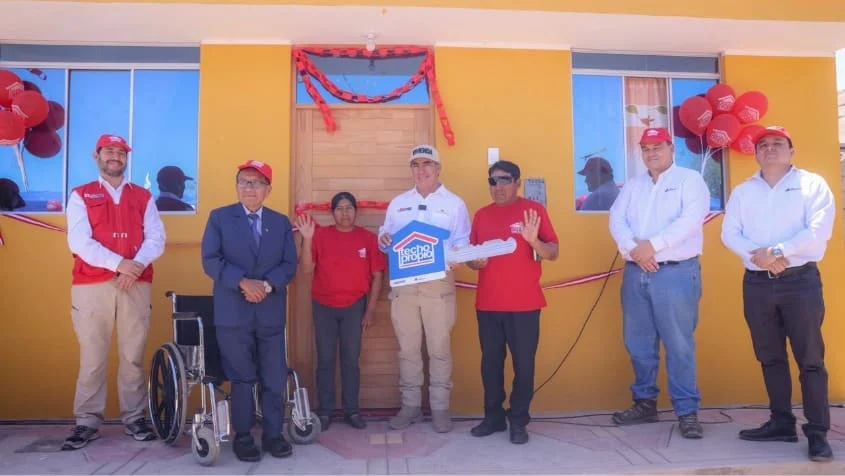
- Ministerial Visit: Concurrent with the announcement, Minister Arnillas traveled to Tacna to oversee current projects, including the inspection of the Magollo Wastewater Treatment Plant and the delivery of a completed unit to a beneficiary, Pedro Chagua Clemente.
Supporting Data and Technical Specifications
The scope of this project is rooted in the specific needs of the Jorge Basadre province. The technical requirements for the 100 new homes include:
- Unit Dimensions: Each house will span 35 square meters, optimized for small to medium-sized families.
- Investment Breakdown: The total investment per unit is balanced between the S/ 33,000 municipal subsidy and the S/ 2,475 family contribution.
- Economic Impact: Beyond the immediate construction, this injection of S/ 3.3 million into the local economy is expected to stimulate the regional construction sector, creating jobs for local laborers and increasing demand for building materials in the Tacna region.
To put this in perspective, the pilot is part of a larger national effort to address the housing deficit. The Ministry of Housing has successfully "unlocked" 56 of the 252 projects that were previously stalled due to bureaucratic or financial impediments. This recovery involves a total investment of S/ 3.7 billion, aimed at providing essential services to 2.6 million people across 21 departments.
Official Responses: A Model for National Replication
The atmosphere surrounding the signing was one of cautious optimism and strategic vision. Minister Mauricio Arnillas was clear about his intentions to scale this model nationwide.
"We are going to enter into agreements with all municipalities to ensure that canon funds that have not been fully utilized are redirected toward social housing," Minister Arnillas stated during the event. "We will reach out to all elected mayors to explain this new model. By doing this, we are not just going to triple; we are going to quadruple the number of homes built under the ‘Construction on Own Land’ program."

Mayor Julio Dávalos emphasized the importance of local autonomy in solving social issues. For the Jorge Basadre municipality, the ability to address the housing needs of the most vulnerable using local resources—rather than waiting exclusively for central government budget allocations—is seen as a victory for local governance.
Implications: The Future of Decentralized Infrastructure
The implications of the Jorge Basadre model are profound. For decades, the "canon" has been a source of both wealth and frustration in Peru, with many provinces unable to spend their allocations effectively, leading to either the return of funds to the central treasury or the misallocation of resources into "white elephant" projects.
1. Financial Sustainability
By formalizing the use of canon funds for BFH subsidies, the government is creating a sustainable financial pipeline. Unlike general budget increases, which are subject to the volatility of the national economy, canon funds are tied to the mining and energy sectors, providing a consistent (though fluctuating) revenue stream that can be ring-fenced for social development.
2. Addressing the Housing Gap
The "Construcción en Sitio Propio" model is particularly effective in provinces where land is available but the capital for materials and technical labor is missing. By providing the subsidy, the government helps families who own land but live in precarious conditions—such as the wooden structures mentioned in the case of Pedro Chagua Clemente—transition to safe, permanent housing.

3. Scaling the Strategy
The Minister’s promise to "quadruple" the output of housing units hinges on the success of this pilot. If Jorge Basadre proves that administrative hurdles can be cleared and that the funds can be spent transparently, it will provide a blueprint for other provinces in mineral-rich regions like Cusco, Arequipa, and Moquegua to follow suit.
4. Broader Infrastructure Priorities
The Ministry’s focus extends beyond housing to the foundational infrastructure of water and sanitation. The inspection of the Magollo Wastewater Treatment Plant and the formation of a technical roundtable with the Provincial Mayor of Tacna, Pascual Güisa, reflect a holistic approach. It is not enough to build homes; the government recognizes that these homes must be served by modern, functional sanitation systems to be truly viable.
Conclusion: A Turning Point for Tacna
The agreement in Tacna is more than just a housing project; it is a proof-of-concept for a new era of decentralized social policy. By empowering municipalities to take the lead in solving their own housing deficits, the Ministry of Housing is attempting to move past the traditional, slow-moving centralized model.
As the 100 homes in Jorge Basadre begin construction, the eyes of the nation will be on this province. If successful, the model will likely be presented as a flagship policy in the upcoming national legislative cycle, potentially changing the lives of hundreds of thousands of families who are currently waiting for a path to homeownership. For the citizens of Jorge Basadre, the wait is over, and for the rest of the country, a new standard for local development has been set.