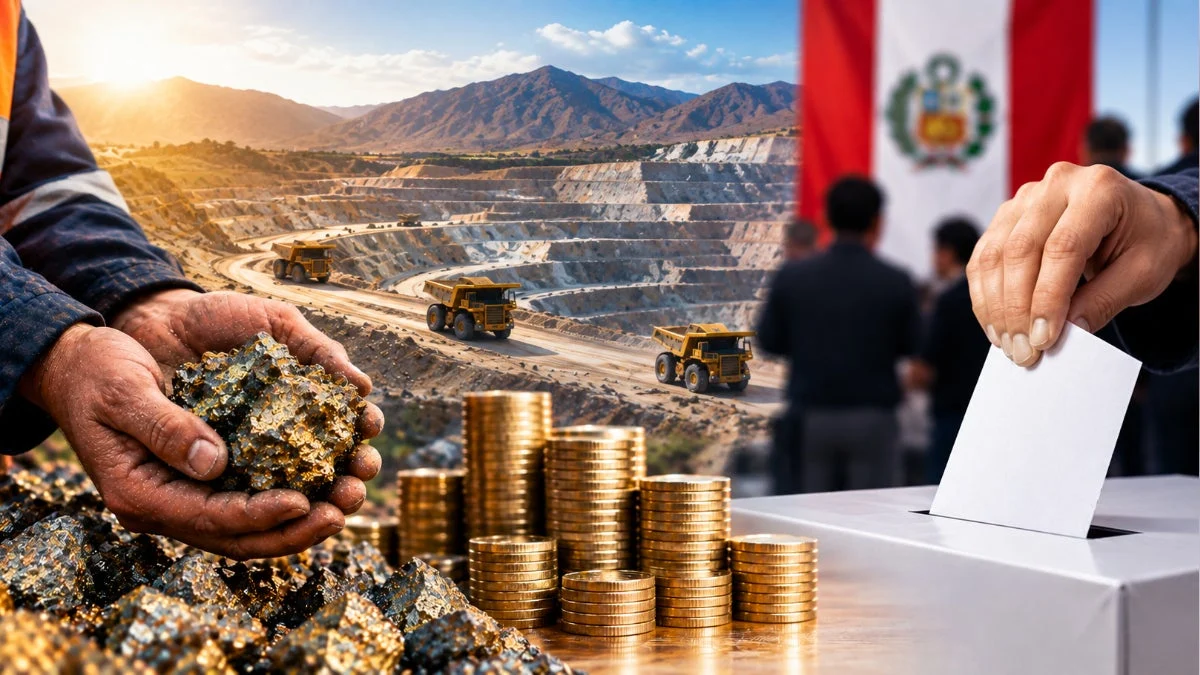
In an economic landscape defined by a robust super-cycle of metal prices, Peru has reached a historic milestone in fiscal transfers. As of 2026, the nation has seen mining-related transfers—comprising canon, royalties, and legal fees—soar to an unprecedented S/13.223 billion (approximately USD 3.5 billion). However, this influx of capital arrives at a critical political juncture: as the country navigates the 2026 Regional and Municipal Elections, the vast majority of the regions generating these funds remain in a state of political transition, with their future governors yet to be determined.
The stakes could not be higher. The next cohort of regional and municipal authorities will inherit the responsibility of managing this historic surplus, tasked with translating raw mining wealth into sustainable infrastructure and social development. With 66% of these national resources concentrated in just six regions—Áncash, Arequipa, Apurímac, Cajamarca, Moquegua, and Tacna—the ballot box has effectively become the primary mechanism for deciding the fate of Peru’s mining-driven prosperity.
The Economic Context: A Record-Breaking Year
The S/13.223 billion figure is not merely a statistical anomaly; it is the culmination of sustained global demand for copper and gold, which has kept prices at levels favorable for the Peruvian economy. This "super-cycle" has solidified the importance of mining as the bedrock of regional public investment.
The revenue is primarily composed of:
- Canon Minero (S/9.588 billion): Representing 50% of the Income Tax paid by mining corporations, this is the largest component and is distributed among regional governments, municipalities, and public universities.
- Mining Royalties (S/3.327 billion): Split between legal (S/2.901 billion) and contractual royalties (S/425 million), these funds provide a direct stream of revenue based on the value of extracted minerals.
- Rights and Penalties (S/307 million): Derived from the administrative maintenance of mining concessions.
Regional Snapshots: The Battle for Governance
As the results of the 2026 elections trickle in, a clear trend has emerged: political fragmentation. While most regions are heading toward a runoff on November 29, the composition of these contests reflects deep-seated local preferences and the influence of regional political movements.
Áncash: The Mining Giant at a Crossroads
Áncash remains the jewel of the mining crown, largely due to the massive output of the Antamina project, the nation’s premier copper producer. In 2026 alone, the region received over S/2.229 billion, accounting for 16.9% of total national transfers.
The political landscape here is highly competitive. Antonio Casana Alencastre (Alianza para el Progreso) leads the polls with 21.2%, but he faces a tight squeeze for the second spot between Betto Barrionuevo (Podemos Perú, 16%) and Enrique Alejandro Ocrospoma (Partido Demócrata Verde, 15.8%). The complexity of this race is underscored by the candidates’ profiles: Casana, an industrial engineer, has drawn attention for naming his mother, former congresswoman Norma Alencastre, as his vice-governor candidate.
Arequipa and the Cerro Verde Influence
Arequipa follows closely with S/1.499 billion (11.34% of the national total), fueled by the Cerro Verde copper complex and the operations of Buenaventura. Florentino Zegarra Tejada (Fuerza Arequipeña) currently leads with 25.3%, while Jenry Federico Huisa Calapuja (Ahora Nación) holds 14.5%. With neither candidate reaching the 30% threshold, a runoff appears inevitable, forcing both to pivot their platforms toward the management of the significant fiscal windfall currently sitting in regional coffers.
Cajamarca: The Gold Frontier
Home to Yanacocha, one of South America’s largest gold mines, Cajamarca has seen S/1.251 billion in transfers. The race here is the most suspenseful: Edison Carrasco Olivera (Somos Perú) sits at 29.7%—a hair’s breadth from the 30% threshold that would grant him a first-round victory. Moises González Cruz (Alianza para el Progreso) trails at 22.9%. The final official count from the National Office of Electoral Processes (ONPE) will determine whether the region moves to a runoff or shifts immediately to the transition phase.
Moquegua and Tacna: Southern Mining Hubs
In Moquegua, where Southern Perú Copper’s Cuajone and Anglo American’s Quellaveco operate, the race is a virtual dead heat. Abraham Alejandro Cárdenas Romero (Acción Popular) holds 26%, while Juan Luis Herrera Chejo (Somos Perú) follows at 25.2%.
Similarly, in Tacna, Segundo Mario Ruiz Rubio (Alianza para el Progreso) is hovering at 29.3%, just short of the mandate required to avoid a second round against Walter Anchapuri Zapata (Ahora Nación, 17.6%). Both regions underscore the reality of modern Peruvian politics: high mineral wealth does not necessarily equate to political stability.
Chronology of the 2026 Electoral Cycle
- Early 2026: Mining transfers reach historic monthly peaks as global metal prices remain elevated.
- Mid-2026: Regional election campaigns intensify, with candidates explicitly linking their fiscal platforms to the administration of the record-breaking S/13.2 billion windfall.
- October 2026: Initial election day concludes; results show a high degree of fragmentation, with most top-tier candidates falling short of the 30% threshold.
- November 2026: Final official counts are finalized, confirming a second round of voting for November 29 in at least five of the six major mining-intensive regions.
Implications for Public Policy
The incoming administrations face a "paradox of plenty." While these regions are now wealthier than at any point in their history, they have historically struggled with the execution of public investment projects. The challenge for the 2027–2031 period is two-fold:
- Efficiency and Transparency: With S/13 billion at their disposal, the incoming governors will be under intense scrutiny. The public demand for hospitals, schools, and irrigation infrastructure has never been higher, and the failure to spend these funds efficiently will likely lead to social unrest.
- Long-term Sustainability: Mining is a finite industry. Economists argue that these record revenues must be invested in diversifying the regional economies beyond extraction. The incoming governors must decide whether to continue the cycle of infrastructure-heavy public works or pivot toward innovation, digital transformation, and regional agricultural industrialization.
Official Responses and Expert Outlook
The ONPE has emphasized the integrity of the ongoing vote count, noting that the narrow margins in regions like Cajamarca and Tacna require absolute precision. Meanwhile, regional analysts caution that the delay in defining leadership creates a "lame duck" period that could paralyze budget execution during the final quarter of 2026.
"The money is there, but the capacity to spend it is the real bottleneck," says an economist specialized in regional finance. "The next governors don’t just need political capital; they need technical teams capable of navigating the bureaucratic hurdles of the National System of Multiannual Programming and Investment Management (Invierte.pe)."
As November 29 approaches, the eyes of the nation remain fixed on these regions. For the people of Áncash, Arequipa, Apurímac, Cajamarca, Moquegua, and Tacna, the ballot is more than a choice of personnel—it is a choice regarding the economic future of their communities in an era of unprecedented mineral abundance. Whether this wealth becomes a catalyst for structural change or simply another period of missed opportunity remains the defining question of the 2026 electoral cycle.