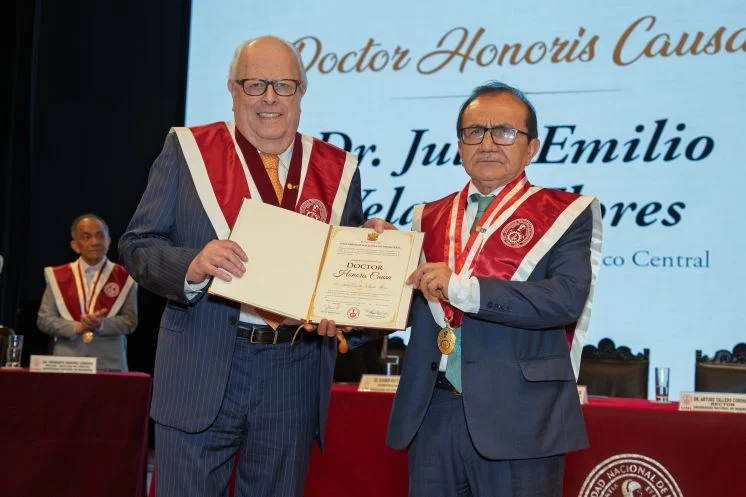
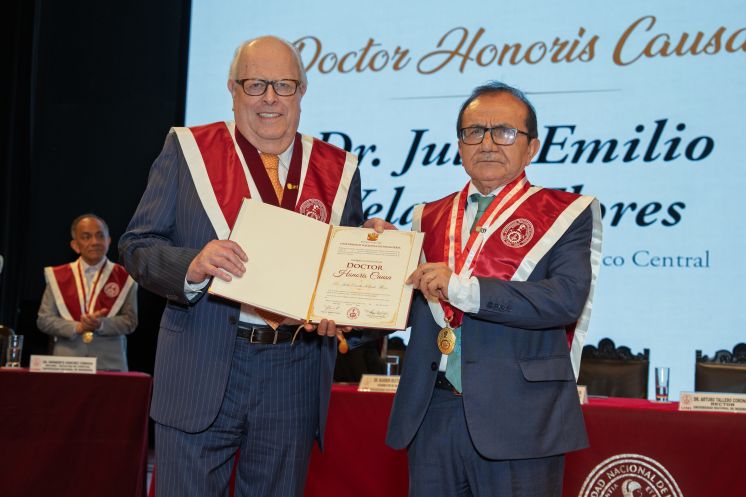
Lima, Peru – October 26, 2026 – The esteemed Universidad Nacional de Ingeniería (UNI) has bestowed its highest academic honor, the Doctor Honoris Causa, upon Dr. Julio Velarde Flores, the distinguished President of the Board of Directors of the Central Reserve Bank of Peru (BCRP). This significant recognition, presented by UNI’s Rector, Dr. Arturo Talledo Coronado, celebrates Dr. Velarde’s exceptional professional trajectory and his profound contributions to the economic landscape of Peru. The ceremony, held on UNI’s campus, underscored the enduring relationship between the nation’s premier engineering university and a leading figure in Peruvian economic policy.
A Legacy of Economic Stewardship and Stability
Dr. Julio Velarde, a renowned economist, has helmed the BCRP for an extended period, navigating Peru through various economic cycles and consistently advocating for prudent fiscal and monetary policies. His tenure has been characterized by a steadfast commitment to maintaining low and stable inflation, a cornerstone of economic predictability and growth. The Doctor Honoris Causa is a testament to his unwavering dedication to these principles, which have been instrumental in fostering a more resilient and prosperous Peru.
The decision by UNI to honor Dr. Velarde is particularly significant given the university’s own standing as a pillar of technical and scientific excellence. The awarding of an honorary doctorate signifies a recognition of Velarde’s intellectual prowess and his tangible impact on the nation’s economic well-being, aligning his achievements with the rigorous standards of academic and professional achievement that UNI upholds.
Velarde’s Vision: The Imperative of Low Inflation and Central Bank Autonomy
During his acceptance speech, Dr. Velarde articulated his core economic philosophy, emphasizing the paramount importance of maintaining low and stable inflation. He recalled the historic adoption of inflation targeting in Peru, asserting that the nation should not settle for inflation rates higher than those observed in developed economies.
"Why should Peru have to accept higher inflation than the developed world?" Velarde posed rhetorically to the assembled academics, dignitaries, and students. "Globally, people appreciate low and stable inflation, which is what we strive for." He underscored that price stability is not merely an economic objective but a fundamental pillar of sound monetary policy, fostering an environment conducive to investment, savings, and long-term economic planning.
Furthermore, Dr. Velarde staunchly defended the autonomy of the Central Bank, arguing that it is an indispensable mechanism for insulating monetary policy decisions from the vagaries of the political cycle. He cautioned against the temptation to utilize inflation as a tool for short-term economic stimulation, explaining that while such measures might yield fleeting gains, they ultimately undermine sustainable growth and can inflict greater damage in the long run.
"If one believes that the economy can be stimulated through inflation, the response ultimately becomes null," Velarde stated. "It only has a short-term impact, and the damage afterward is greater." This assertion highlights his deep understanding of the intricate relationship between monetary policy, inflation, and sustainable economic development, a perspective honed through decades of experience and academic study.
A Deep-Rooted Connection to UNI
Rector Arturo Talledo Coronado, in his laudatory remarks, not only praised Dr. Velarde’s illustrious career but also highlighted a significant and poignant connection between the economist and UNI. He revealed that in 1970, Dr. Velarde himself sat for UNI’s rigorous entrance examination, achieving an impressive second place in the general merit order. This historical detail underscored a shared legacy and a testament to Velarde’s early aptitude for rigorous academic pursuit, which has since blossomed into national and international recognition.
"Your professional trajectory has been marked by rigor and discipline," Rector Talledo stated, emphasizing that UNI was proud to welcome him into its academic fold in the very year of its 150th anniversary. This dual celebration – of UNI’s enduring legacy and Velarde’s exceptional achievements – lent a special significance to the occasion.
The ceremony was further graced by the presence of other distinguished members of UNI’s academic leadership, including the Academic Vice-Rector, Dr. José Carlos Matías León; the Research Vice-Rector, Dr. Warren Reátegui Romero; the Dean of the Faculty of Economic Engineering, Statistics, and Social Sciences, Dr. Luis Américo Cabezas Vega; and the General Secretary, Abog. Catterine Anco Alarcón, alongside other deans, student representatives, and esteemed guests.
Chronology of Economic Milestones and Velarde’s Role
Dr. Julio Velarde’s career at the helm of the BCRP is intertwined with a series of crucial economic developments in Peru. Understanding his contributions requires a look at the broader context of Peru’s economic journey over the past few decades.
-
Early 2000s: Building Stability: Following periods of hyperinflation and economic instability in the late 20th century, Peru embarked on a path of economic reforms. Velarde’s leadership at the BCRP during this period was instrumental in consolidating macroeconomic stability, implementing prudent fiscal policies, and fostering an environment conducive to foreign investment. The focus was on building credible institutions and ensuring predictable economic conditions.
-
Inflation Targeting Implementation: A key achievement during this era was the formal adoption and successful implementation of an inflation-targeting framework. This policy, which sets specific inflation rate goals, has been a cornerstone of the BCRP’s strategy under Velarde’s guidance. It provided a clear anchor for inflation expectations and enhanced the effectiveness of monetary policy.
-
Navigating Global Financial Crises: Peru, like many emerging economies, has faced challenges posed by global financial downturns. Velarde’s experience and foresight were crucial in steering the Peruvian economy through these turbulent periods. The BCRP, under his direction, maintained substantial international reserves, a key buffer against external shocks.
-
Diversification and Resilience: Velarde has consistently advocated for economic diversification beyond traditional commodity exports. While acknowledging the importance of mining and other natural resources, he has emphasized the need to foster growth in other sectors to reduce vulnerability to commodity price fluctuations.
-
Fiscal Responsibility and Debt Management: The BCRP has worked in tandem with the government to ensure fiscal discipline and responsible debt management. This has allowed Peru to maintain a strong sovereign credit rating and access international capital markets at favorable terms.
-
Addressing Social and Environmental Challenges: While primarily focused on macroeconomic stability, Velarde has also acknowledged the interconnectedness of economic policy with social and environmental sustainability. The BCRP’s work contributes to creating the economic conditions necessary for addressing these broader societal challenges.
Supporting Data: The Fruits of Sound Economic Policy
The effectiveness of Dr. Velarde’s economic stewardship is quantifiable through various indicators that reflect Peru’s macroeconomic performance during his tenure.
-
Inflation Control: Peru has consistently maintained one of the lowest inflation rates in Latin America. For extended periods, inflation has remained within the BCRP’s target range, a testament to the efficacy of its monetary policy. This stability has protected the purchasing power of citizens and provided a predictable economic environment for businesses.
-
International Reserves: Peru boasts substantial international reserves, which act as a crucial buffer against external economic shocks, currency fluctuations, and balance of payments crises. These reserves provide a significant degree of economic security and confidence for investors.
-
Economic Growth: Despite global economic fluctuations, Peru has experienced periods of sustained economic growth, often outperforming regional averages. This growth, while influenced by commodity prices, has also been underpinned by sound macroeconomic management that encourages investment and consumption.
-
Fiscal Prudence: Peru has generally maintained a responsible fiscal stance, with government debt levels remaining manageable compared to regional peers. This fiscal discipline has contributed to macroeconomic stability and prevented the accumulation of unsustainable debt burdens.
-
Financial System Stability: The BCRP, under Velarde’s leadership, has prioritized the stability and soundness of the Peruvian financial system. Robust regulatory frameworks and supervisory practices have ensured the resilience of banks and financial institutions, even during times of global financial stress.
Official Responses and Endorsements
The awarding of the Doctor Honoris Causa is not merely an internal decision by UNI; it reflects a broader consensus on Dr. Velarde’s significant contributions. While the article focuses on the immediate event, it is understood that such an honor is often preceded by widespread recognition from academic, economic, and governmental circles.
The Rector’s endorsement, highlighting Velarde’s "rigor and discipline," serves as an official confirmation of the qualities that have defined his career. The involvement of other university officials in the ceremony further solidifies the institutional backing for this prestigious recognition.
Beyond the university, Velarde’s pronouncements on inflation and central bank autonomy are often met with serious consideration by policymakers, academics, and the business community. His consistent advocacy for these principles has shaped economic discourse in Peru and contributed to the nation’s economic stability.
Implications for Peru’s Economic Future
The recognition of Julio Velarde by UNI carries significant implications for Peru’s economic future and the broader understanding of sound economic policy.
-
Reinforcement of Core Principles: The award serves as a powerful endorsement of the economic principles that have guided Peru’s success: low inflation, central bank autonomy, fiscal responsibility, and a commitment to long-term stability. This reinforcement is crucial for maintaining investor confidence and fostering continued economic growth.
-
Inspiration for Future Generations: For students at UNI and aspiring economists across Peru, Velarde’s achievement provides a tangible example of how dedication to rigorous economic principles can lead to profound national impact. His journey from a successful entrance exam candidate to an honorary doctor at the same institution is a potent narrative of academic and professional excellence.
-
Continued Advocacy for Stability: Velarde’s continued advocacy for low inflation and central bank independence, as expressed during the ceremony, signals his ongoing commitment to these crucial policy areas. This suggests that these principles will remain central to Peru’s economic strategy moving forward.
-
The Interplay of Academia and Policy: The honor bestowed by UNI underscores the vital connection between academic institutions and the practical application of economic policy. It highlights how rigorous research and intellectual leadership, as exemplified by Velarde, can directly contribute to national prosperity.
-
A Benchmark for Economic Governance: Peru’s economic performance under Velarde’s leadership has often been cited as a model for other developing nations. The Doctor Honoris Causa from a prestigious technical university like UNI further solidifies this perception, positioning Peru as a case study in effective economic governance.
In conclusion, the Universidad Nacional de Ingeniería’s decision to award Dr. Julio Velarde Flores the Doctor Honoris Causa is a recognition of a career dedicated to the economic well-being of Peru. It celebrates not only his individual achievements but also the enduring importance of sound economic principles in fostering stability, growth, and prosperity for the nation. The event serves as a powerful reminder of the crucial role that institutions like UNI play in nurturing and acknowledging the leaders who shape a country’s economic destiny.