Executive Summary: Strengthening Southern Peru’s Connectivity
In a significant effort to enhance the logistics chain and transport safety in southern Peru, the Ministry of Transport and Communications (MTC), through its specialized branch Provías Nacional, has launched a comprehensive management and conservation program. This project covers a vast 327-kilometer network spanning the vital national routes PE-3S and PE-38A.
The initiative, focused on the Sicuani–Pucará–Calapuja and Puno–Desaguadero corridors, is not merely a routine repair operation; it represents a strategic investment in the socio-economic backbone of the regions of Cusco and Puno. By ensuring year-round transitability, the government aims to facilitate commerce, tourism, and daily mobility for thousands of citizens, while simultaneously reducing travel times and vehicle maintenance costs for transporters operating in these high-altitude Andean zones.
Main Facts: The Scope of the Intervention
The project is characterized by its technical complexity and the sheer geographic scale of the territory covered. The MTC has categorized the work into "management and conservation by service levels," a methodology that ensures the road infrastructure meets specific performance indicators, rather than simply fixing potholes as they appear.
The Geography of the Project
The interventions are spread across seven distinct segments, creating a continuous logistical artery that connects key provinces and districts:
- Route PE-3S:
- Sicuani – La Raya (35 km)
- La Raya – Santa Rosa (27 km)
- Santa Rosa – Pucará (75 km)
- Pucará – Calapuja (36 km)
- Puno – Ilave (48 km)
- Ilave – Desaguadero (93 km)
- Route PE-38A:
- Ilave – Checca (10 km)
This network traverses the provinces of Canchis, Canas, Melgar, Lampa, Puno, El Collao, and Chucuito. It acts as a vital link for urban and rural centers such as Sicuani, Ayaviri, Pucará, Lampa, Puno, Ilave, Juli, Pomata, Zepita, and the border town of Desaguadero.

Chronology and Current Status
The project follows a phased approach, balancing immediate needs with long-term structural improvements.
Phase 1: Mobilization and Assessment
The initial stage involved an exhaustive audit of the pavement condition, drainage systems, and road signage. Given the extreme weather conditions—ranging from heavy rainfall to freezing temperatures at high altitudes—the MTC prioritized segments showing signs of critical degradation.
Phase 2: Routine and Periodic Maintenance
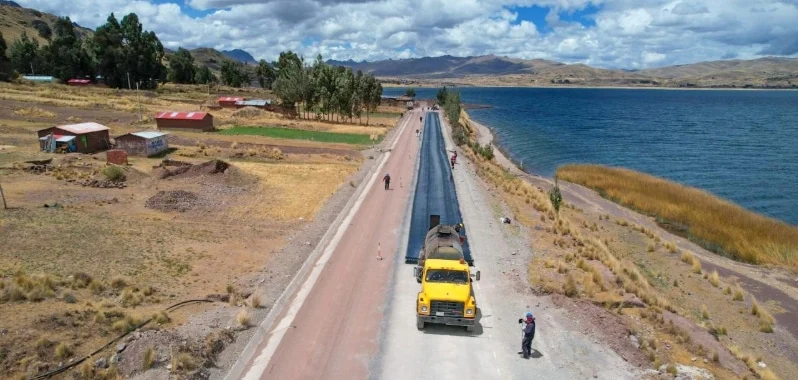
As of the latest reporting period, teams have successfully completed 9 kilometers of intensive periodic maintenance along the PE-3S route. Periodic maintenance involves more invasive work, such as surface reinforcement and structural repairs to the road base. Simultaneously, routine maintenance—which includes clearing side ditches, cleaning culverts, patching small fissures, and managing vegetation—is occurring continuously along the entire 327-kilometer stretch.
Supporting Data: The Technical Rationale
The "service level" approach adopted by the MTC is a modern infrastructure management tool. Unlike traditional road maintenance, where contractors are paid for specific tasks, this model pays contractors based on their ability to maintain the road at a pre-defined quality standard.
Infrastructure Health Metrics
- Surface Condition: Regular monitoring of the International Roughness Index (IRI) to ensure smooth travel.
- Safety Features: Ongoing restoration of guardrails, road markings, and reflective signage to minimize accident risks, especially during night driving or in foggy conditions common in the Andean highlands.
- Drainage Efficiency: Clearing of culverts is critical in this region to prevent the "washing away" of road edges during the intense summer rainy season.
Official Perspective: The MTC’s Strategy
The Ministry of Transport and Communications has emphasized that these interventions are part of a broader national strategy to decentralize economic growth. By maintaining the southern corridor, the MTC is not just fixing asphalt; it is enabling the efficient flow of goods between Cusco, Puno, and the international border with Bolivia.

According to ministry officials, the objective is to eliminate "bottlenecks" that hinder the transport of agricultural products and minerals. Furthermore, by ensuring the structural integrity of the roads, the MTC is protecting the public investment in these highways, preventing the need for costly total reconstruction in the future.
Implications for the Region
The ripple effects of this maintenance program are profound, touching various sectors of the southern Peruvian economy.
Economic Impact
For local producers in the Cusco and Puno regions, reliable roads are synonymous with market access. Dairy products, potatoes, and quinoa from the rural heartlands rely on these routes to reach major urban centers and export hubs. Improved road conditions mean reduced freight costs, which in turn can lower the price of consumer goods and increase the profitability of local agricultural enterprises.
Tourism and Connectivity
The route serves as a significant transit corridor for tourists moving between the historic sites of Cusco and the cultural landscapes of Lake Titicaca in Puno. A well-maintained road enhances the visitor experience, promotes tourism-related services along the route, and increases the overall safety of international and domestic travelers.
Social and Safety Considerations
Perhaps most importantly, the project addresses a critical safety concern. Many of these routes cross challenging mountain passes (such as the La Raya pass) where hazardous conditions are common. By providing consistent monitoring and rapid response to weather-related damage, the MTC is significantly reducing the likelihood of traffic accidents.

Challenges and Future Outlook
Despite the progress, the project faces ongoing challenges. High-altitude construction is inherently difficult, with labor productivity affected by the thin atmosphere and weather patterns that can halt work at a moment’s notice.
Looking forward, the MTC intends to continue the "service level" management for the duration of the current contract, ensuring that the progress made is not lost to natural erosion or lack of oversight. The Ministry is also exploring the integration of IoT (Internet of Things) technology to monitor road conditions in real-time, which could revolutionize how maintenance teams are dispatched to emergency areas.
Conclusion
The ongoing work by the MTC in the Sicuani-Puno corridor is a testament to the importance of proactive infrastructure management. By blending routine maintenance with periodic structural upgrades, the government is securing the connectivity of southern Peru. As the project advances, the focus will remain on delivering a high-quality road network that serves as a catalyst for economic development, social integration, and improved quality of life for the residents of the Cusco and Puno regions.
The success of this 327-kilometer effort will serve as a benchmark for future regional road management programs, proving that consistent, data-driven oversight is the most effective path toward sustainable development in Peru’s complex Andean geography.