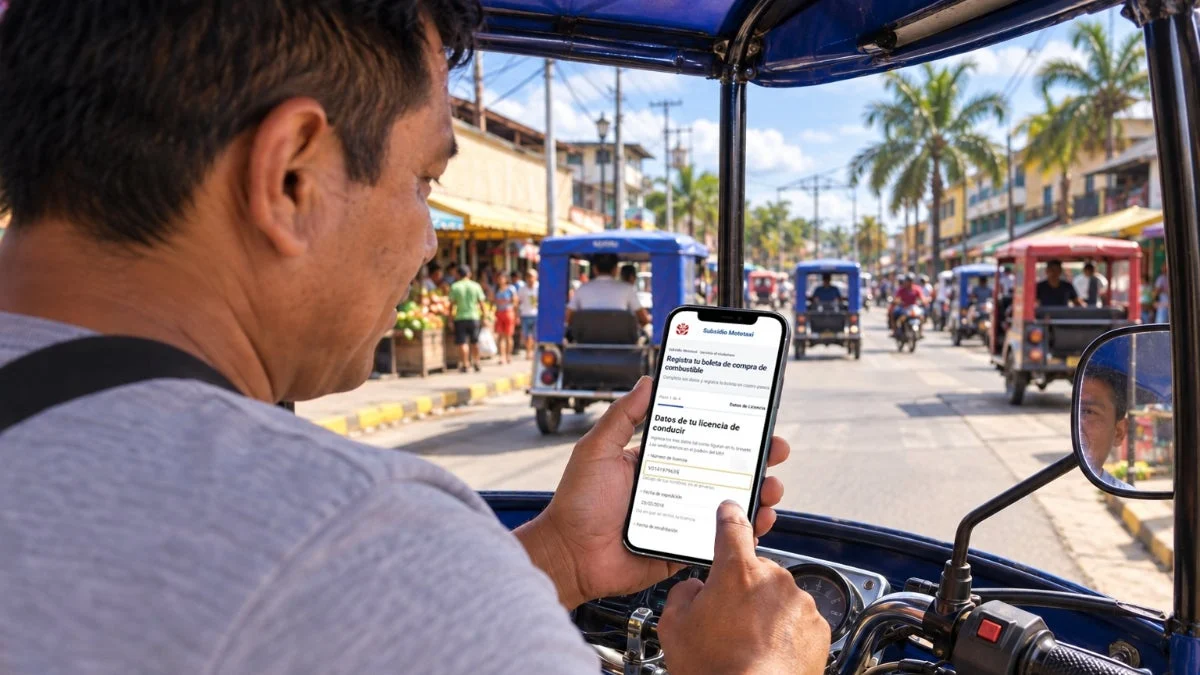
In a decisive move to mitigate the economic strain caused by volatile fuel prices, the Peruvian government has officially launched a specialized digital platform to support mototaxi operators in the Amazon region. Starting Saturday, September 19, thousands of drivers in Loreto, Ucayali, and Madre de Dios can begin registering their fuel purchases to access a monthly subsidy of up to S/100, totaling S/300 over the three-month lifespan of the initiative.
This economic relief measure is designed to alleviate the daily financial burden on one of the most vital segments of the Amazonian transport sector. By providing a rebate of S/4 per gallon of gasoline or gasohol, the government aims to stabilize the income of drivers who have been disproportionately affected by the global and local fluctuations in energy costs.
The Core Mechanics of the Subsidy Program
The initiative, managed by the Ministry of Economy and Finance (MEF), represents a streamlined effort to inject capital directly into the hands of those who keep the Amazon’s urban centers moving. The program’s accessibility is a key feature; the government has removed bureaucratic barriers by ensuring that the digital portal—found at https://mototaxi.mef.gob.pe/—does not require the creation of complex usernames or passwords.
Eligibility and Scope
The subsidy is exclusively targeted at drivers of Category L5 vehicles, the common three-wheeled mototaxi, which serves as the primary mode of public transportation in many Amazonian cities. To ensure the funds reach legitimate, registered operators, the government has established a strict set of requirements:
- Identification: A valid National Identity Document (DNI).
- Licensing: A current Class B, Category II-C driver’s license.
- Vehicle Documentation: The mototaxi must be identified with its official National License Plate of Circulation.
- Safety Compliance: A valid Mandatory Accident Insurance (SOAT) or, where applicable, a current Certificate against Traffic Accidents (CAT) issued by an authorized AFOCAT.
Arturo Ruiz, Director of Road Transport Policies and Standards at the Ministry of Transport and Communications (MTC), noted in a recent interview that the program is expected to reach approximately 53,300 drivers, provided they meet these specific regulatory criteria. Notably, the program allows for up to two drivers to be registered per individual vehicle, acknowledging that many mototaxis are operated in shifts.
Chronology of the Implementation
The road to this subsidy began with the government’s acknowledgment of the unique logistical challenges faced by the Amazonian regions, where transport costs are significantly higher due to geographic isolation.
- Initial Authorization: The government formally approved the subsidy framework earlier this year, recognizing that fuel prices were threatening the viability of the mototaxi industry.
- System Development: Throughout the late summer, the MEF and the MTC collaborated to develop a digital ecosystem capable of cross-referencing tax data from SUNAT (the national tax authority) with transport registry data.
- The Launch Phase: September 19 marks the official "Go Live" date, allowing drivers to begin the formal registration of their fuel receipts.
- The Three-Month Window: The program is scheduled to run for 90 days. During this period, the government will continuously process registrations, validate receipts, and authorize payments through the Banco de la Nación.
Data-Driven Transparency and Validation
A critical component of this program is its reliance on verifiable digital data. The government is not simply handing out cash; it is incentivizing formal, documented commerce.
The Role of Digital Receipts
For a fuel purchase to qualify for the S/4 per gallon rebate, it must be made at an establishment officially registered with the Osinergmin Hydrocarbons Registry. Crucially, drivers must obtain and retain an electronic payment receipt. This document is the cornerstone of the subsidy claim.
The process for the driver is as follows:
- Purchase: The driver fuels up at an authorized station within Loreto, Ucayali, or Madre de Dios.
- Registration: The driver logs into the MEF portal, entering their DNI, license information, vehicle details, and the specific electronic receipt code.
- Verification: The MEF cross-references the data with SUNAT to ensure the transaction actually occurred and that the station is compliant.
- Accumulation: Drivers can accumulate the benefit throughout the month. For instance, a driver who purchases 25 gallons of gasohol will hit the monthly cap of S/100.
Administrative Safeguards
The Ministry of Economy and Finance has integrated several "smart" filters into the platform. These checks ensure that the same receipt cannot be used twice and that only vehicles registered in the specific Amazonian regions are eligible. By centralizing the data, the government aims to prevent fraud while maintaining a transparent trail of where the public funds are being distributed.
Official Responses and Ministerial Perspectives
The measure has been met with cautious optimism from local transport unions, though government officials emphasize the necessity of strict compliance to ensure the program’s success.
"This is not a blanket handout," explained a representative from the MEF. "It is a targeted, performance-based intervention designed to reward drivers who are formalizing their businesses and complying with traffic and safety regulations."
The MTC has been particularly vocal about the importance of the SOAT/CAT requirements. By making the subsidy conditional on holding valid insurance, the government is subtly pressuring informal operators to enter the formal system, thereby increasing the overall safety of passengers and pedestrians in the Amazonian regions.
Broader Economic Implications
The introduction of this subsidy has several far-reaching implications for the Amazonian economy:
1. Combating Informal Economy
By requiring valid licenses and documentation to access the S/4-per-gallon rebate, the government is providing a tangible incentive for "informal" drivers to register their vehicles and obtain their permits. This "carrot-and-stick" approach is a significant step toward bringing thousands of mototaxistas into the formal economy.
2. Stabilizing Transport Costs
In cities like Iquitos or Pucallpa, where the mototaxi is the primary transit tool, any increase in fuel prices is immediately passed on to the consumer. By subsidizing the fuel, the government effectively caps the upward pressure on public transport fares, providing a secondary benefit to the low-income commuters who rely on these vehicles daily.
3. Strengthening Regional Supply Chains
The program also benefits the formal fuel stations in these regions. By requiring that fuel be purchased at Osinergmin-registered sites, the government is incentivizing drivers to avoid the black market or substandard fuel, which in turn supports legal businesses and ensures higher quality fuel is used in vehicles, potentially reducing mechanical breakdowns and environmental impact.
4. A Blueprint for Future Interventions
The digital nature of this subsidy—the use of a web portal, the integration with SUNAT, and the automated validation process—serves as a pilot program for future government aid. If successful, this model of "digital-first" distribution could be applied to other sectors, such as small-scale agriculture or regional fishing, where reaching beneficiaries in remote areas has historically been logistically challenging.
Conclusion: A Step Toward Digital Governance
The launch of the mototaxi.mef.gob.pe portal marks a shift in how the Peruvian government interacts with its most vulnerable economic sectors. By leveraging digital tools, the government has bypassed the need for physical paperwork and long queues, creating a more efficient and responsive mechanism for social support.
While the program is temporary, its impact on the daily lives of over 50,000 drivers is immediate. As the first cycle of registrations concludes, the success of this initiative will be measured not just in the S/300 provided to each driver, but in the number of operators who successfully transition into the formal transport system. For the Amazonian driver, this subsidy is more than just a reduction in fuel costs—it is a recognition of their essential role in the connectivity and economic health of the region.