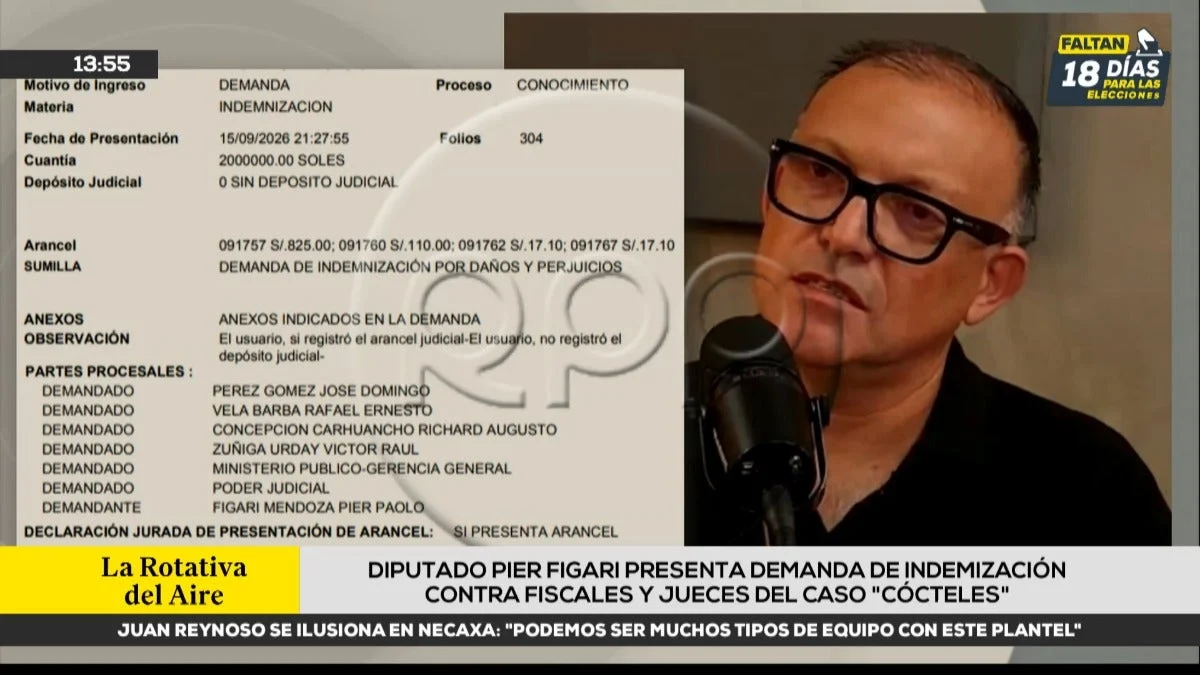
In a significant escalation of the legal fallout following the collapse of the "Caso Cócteles" investigation, Pier Figari, a prominent figure within the Fuerza Popular party, has formally filed a lawsuit seeking S/ 2 million (approximately $530,000 USD) in damages. The legal action targets the prosecutors and judges who spearheaded the long-running probe into alleged illicit campaign financing for the political movement led by Keiko Fujimori.
This development marks a pivotal moment in the Peruvian judicial landscape, where the line between prosecutorial discretion and judicial overreach has become a focal point of intense national debate. Figari, who spent 19 months in pretrial detention during the investigation, is now seeking accountability for what his legal team describes as a "malicious and antijuridical" process that irreparably damaged his reputation, career, and personal life.
The Targets of the Litigation: A Direct Challenge to the Judiciary
The lawsuit, filed by Figari’s defense team, names four high-profile judicial and prosecutorial figures:
- Rafael Vela Barba: The lead superior prosecutor who oversaw the case’s strategy at the appellate level.
- José Domingo Pérez: The former lead investigator who became the face of the "Caso Cócteles" probe.
- Richard Concepción Carhuancho: The judge who, in 2018, ordered the controversial pretrial detention of Figari.
- Víctor Raúl Zúñiga: The judge who, in 2023, mandated that the case proceed to oral trial.
Marco Montenegro, representing Figari, confirmed that the lawsuit encompasses both the Ministry of Public Prosecution and the Judiciary, arguing that the conduct of these specific individuals went beyond the scope of their official duties, resulting in clear "tortious acts."
Chronology: From Pretrial Detention to Ultimate Dismissal
To understand the weight of Figari’s claim, one must look at the timeline of the "Caso Cócteles," a case that gripped Peruvian politics for nearly a decade.
2017–2018: The Initiation of the Probe
The investigation, centered on the alleged money laundering of campaign funds during the 2011 and 2016 Fuerza Popular presidential bids, began under the tenure of José Domingo Pérez. In late 2018, the atmosphere reached a boiling point when Judge Richard Concepción Carhuancho issued a mandate for pretrial detention against Pier Figari and other key members of the party’s inner circle.
2019–2022: The Struggle for Liberty
Figari spent 19 months behind bars. During this period, his defense consistently argued that the detention was a political maneuver designed to dismantle Fuerza Popular rather than a pursuit of justice. The legal battle moved through various appellate courts, with Figari eventually being released, though the case against him continued to loom over his professional and political activities.
2023: The Push to Trial
Despite mounting criticism regarding the lack of concrete evidence, Judge Víctor Raúl Zúñiga ordered the case to proceed to an oral trial, keeping the legal pressure on Figari and the leadership of Fuerza Popular.
2024–2026: The Collapse of the Case
The trajectory of the investigation shifted dramatically when the Constitutional Tribunal (TC) intervened, issuing a ruling that effectively nullified major components of the investigation. Following the TC’s intervention, the Judiciary officially archived the "Caso Cócteles," confirming that there were insufficient grounds for a conviction. This exoneration served as the catalyst for Figari’s current lawsuit.
Supporting Data: Calculating the "Cost of Justice"
The S/ 2 million figure requested by Figari is not an arbitrary sum, according to his legal counsel. Marco Montenegro explained that the damages are categorized into three distinct pillars:
- Patrimonial Damages: This covers the direct financial losses incurred by Figari during his 19 months of incarceration, including loss of income, legal fees, and the inability to engage in professional activity.
- Extrapatrimonial Damages (Moral and Reputational): This addresses the "social stigma" and the deep psychological distress suffered by Figari and his family. The defense argues that the constant media exposure and the label of "criminal investigation" effectively destroyed his standing in public life.
- The "Project of Life": A complex legal concept in Peruvian civil law, this refers to the interruption of a person’s career trajectory and personal goals. The argument posits that the investigation robbed Figari of nearly a decade of professional growth and political influence that cannot be recovered.
In the formal filing, the defense team provides a granular breakdown of the "antijuridical conduct" attributed to each defendant. They argue that the prosecutors and judges ignored procedural safeguards and violated the principle of "presumption of innocence" by using pretrial detention as a punitive measure rather than a precautionary one.
Official Responses and Procedural Hurdles
The filing of the lawsuit has triggered a firestorm of commentary within the Peruvian legal community. While the defendants—Vela, Pérez, Carhuancho, and Zúñiga—have not issued immediate individual responses to the lawsuit, their supporters and various judicial watchdogs have raised concerns about the implications of such litigation.
Some legal analysts argue that if civil servants (judges and prosecutors) are held personally liable for their decisions in high-stakes cases, it could lead to a "chilling effect" on the judiciary. They fear that magistrates might become overly cautious or fearful of presiding over complex corruption cases if they risk personal bankruptcy or civil liability for every judicial decision they make.
Conversely, Figari’s supporters argue that the lawsuit is a necessary check on power. They maintain that the "Caso Cócteles" was a "judicial circus" characterized by media leaks and political bias, and that those who wielded the power of the state must be held accountable when their actions are proven to be unfounded or procedurally flawed.
Broader Implications for the Peruvian Political System
The lawsuit is more than a dispute over money; it is a battle for the narrative of Peruvian politics over the last decade. By seeking compensation, Figari is attempting to formally validate the claim that the investigation into Fuerza Popular was a campaign of judicial harassment.
1. The Erosion of Public Trust
The spectacle of a politician suing the very prosecutors and judges who investigated him further erodes public confidence in the judicial system. It reinforces the perception that the courts are being used as a weapon in the ongoing "war of attrition" between opposing political factions in Peru.
2. The Future of Judicial Independence
If the court rules in favor of Figari, it could set a dangerous precedent for the judiciary. It may embolden other politicians—across the entire political spectrum—to file similar lawsuits whenever a criminal investigation against them is dismissed. This could lead to a cycle of litigation that keeps the judicial system paralyzed by its own past decisions.
3. The Shift in Power Dynamics
With the "Caso Cócteles" archived and the key figures of the investigation now being targeted for damages, the political balance in Peru appears to be shifting. Fuerza Popular, once under the heavy shadow of the investigation, is now aggressively moving to reclaim its reputation and turn the tables on its accusers.
Conclusion: A Precedent-Setting Battle
As the legal proceedings move forward, the Peruvian public will be watching closely. The case of Pier Figari v. The Judiciary and Public Prosecution is set to test the limits of legal immunity and the accountability of those who hold the scales of justice.
Whether the lawsuit succeeds or fails, it serves as a stark reminder of the long-term consequences of the "Caso Cócteles." The investigation, which began as a promise to cleanse the political system of illicit funds, has ended in a bitter legal stalemate that suggests the battle for justice in Peru is far from over—it has simply moved from the criminal courts to the civil arena. For Figari, the S/ 2 million is more than a settlement; it is a claim for the restoration of a life that was profoundly altered by the machinery of the state.