Lima, Peru – In a significant move signaling a shift in the strategic leadership of Peru’s security forces, the President of the Council of Ministers, Luis Galarreta, announced this Sunday that Lieutenant General Fredy López Mendoza has been designated as the new Commander General of the Peruvian National Police (PNP). This institutional transition follows the formal request for retirement submitted by the outgoing commander, General Óscar Arriola, a figure who has remained at the center of the national security debate for months.
The announcement, delivered from the Government Palace, marks a pivotal moment for the administration of President Keiko Fujimori. As the country grapples with persistent challenges in public safety and the fight against organized crime, the change at the top of the police hierarchy is being framed by the executive branch as an orderly, institutional succession.
Main Facts: A Controlled Succession
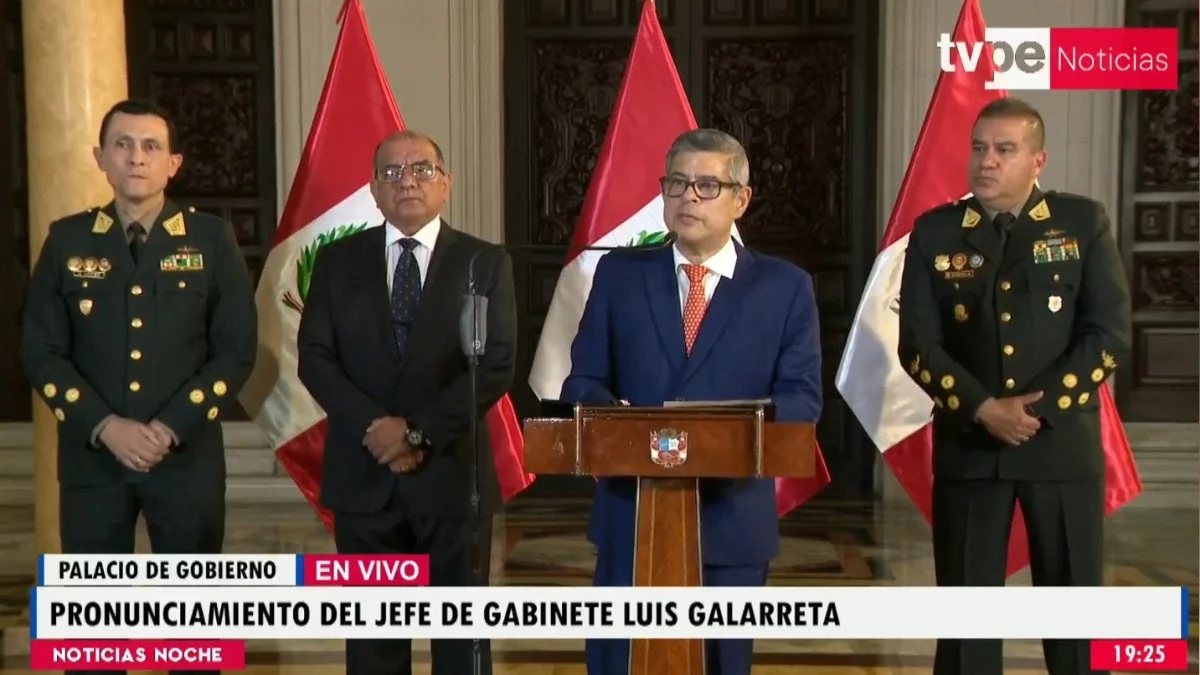
The transition was made official during a brief but solemn press conference at the Palace of Government. Prime Minister Luis Galarreta, flanked by the Minister of the Interior, César Astudillo, and the two high-ranking police officers, confirmed that the government has accepted the request for retirement presented by General Arriola.
"We want to inform that the National Police General, Fredy López Mendoza, will be designated to replace General Arriola in the corresponding position. This designation responds to an institutional transfer, keeping in line with the established hierarchy and the internal regulations of the police force," Galarreta stated.
General Fredy López Mendoza, who currently serves as the Chief of the General Staff of the Police, is widely seen as a career officer capable of maintaining stability within the institution. While the specific date for the formal inauguration of his command has not yet been disclosed, the administration emphasized that the handover will be seamless.
Chronology of a High-Stakes Tenure
To understand the weight of this transition, one must look back at the trajectory of General Óscar Arriola. His tenure has been characterized by both high-profile operations and intense political scrutiny.
- September 2025: General Óscar Arriola assumes the position of Commander General of the PNP, appointed by the administration of then-President Dina Boluarte. He took over the command from Lieutenant General Víctor Zanabria, inheriting a force facing mounting pressure from decentralized criminal networks.
- Late 2025 – Early 2026: Arriola’s command begins to face criticism from various political sectors. Despite his long-standing reputation as an expert in counter-terrorism, concerns are raised regarding the perceived lack of tangible results in the broader fight against urban criminality and extortion.
- Mid-2026: With the change in the national executive branch and the transition to the administration of President Keiko Fujimori, pressure on the police high command intensifies. The media and opposition lawmakers demand a change in strategy, often targeting the leadership for its inability to curb rising crime rates.
- August 2026 (The Present): Following weeks of rumors and mounting political pressure, General Arriola announces that he will step down. He characterizes his decision as a personal gesture of commitment to the nation, aimed at allowing new leadership to address the current security crisis.
The Resignation: An Act of Institutional Loyalty
In his final address as the head of the PNP, General Arriola sought to project a sense of serenity and duty fulfilled. Speaking before the media, he emphasized that he was leaving the post with his "conscience absolutely clean."
"In the coming days, I will be relieved of my duties as Commander General of the National Police by Lieutenant General Fredy López Mendoza. This decision obeys the motivation previously stated, and I only have words of gratitude," Arriola declared.
He took the opportunity to acknowledge the various political administrations he served under, a testament to the turbulent political landscape of Peru in recent years. "I leave with my conscience clean and my head held high, just as I did when I left my beloved Chiclayo. I am grateful for the opportunity to have served under President Keiko Fujimori, President Dina Boluarte, President José Jerí, and President José María Balcázar."
Prime Minister Galarreta, in his defense of the outgoing commander, noted that the public and political spheres often prioritize the critique of errors over the recognition of structural successes. "There are professions that are inherently ungrateful, and the police is one of them. We hear much about when a mistake is made, but rarely do we see the recognition for the successes achieved. I take this moment to congratulate the police for their recent operations," Galarreta added.
Implications for Public Security
The appointment of Fredy López Mendoza comes at a time when public perception of the National Police is at a critical juncture. The transition is not merely a change of faces; it represents a test for the current government to prove that it can manage the institution effectively without succumbing to the constant volatility of Peruvian politics.
1. Rebuilding Public Trust
The primary challenge for the incoming Commander General will be to regain the confidence of the citizenry. The recent wave of public discourse—centered on the alleged "lack of results" against criminal organizations—has left a vacuum of authority that the new administration must fill with concrete, measurable actions.
2. Internal Cohesion
By choosing an officer currently serving as the Chief of the General Staff, the government has opted for continuity. This is a strategic move designed to avoid the internal friction that often accompanies a total overhaul of the high command. Maintaining the morale of the rank-and-file officers will be paramount as they transition to a new operational style under López Mendoza.
3. Addressing the Criminal Landscape
The incoming command must contend with a more sophisticated criminal environment than in previous years. Extortion, human trafficking, and illicit mining have expanded their reach, requiring the PNP to modernize its intelligence-gathering capabilities. The government has signaled that this change is part of a broader, more aggressive, or perhaps more focused, strategy to address these threats.
Supporting Data and Political Context
The context of this change is intrinsically linked to the broader political climate in Peru. The resignation of Arriola is perceived by political analysts as a "pressure-release valve." By allowing the high commander to step down voluntarily, the government avoids a forced dismissal, which could have been perceived as a sign of weakness or an admission of failure.
However, the political opposition remains vigilant. Members of Congress have already signaled that they will hold the incoming Commander General to a higher standard of accountability. The discourse from the Prime Minister’s office suggests that the government is attempting to balance the need for political optics with the necessity of maintaining the integrity of the institution.
Conclusion
The transition from Óscar Arriola to Fredy López Mendoza is a defining moment for the Peruvian National Police. As the institution prepares to turn the page, the focus remains firmly on the effectiveness of the new leadership in tackling the deep-seated security issues that affect every level of Peruvian society.
The government’s message is clear: while individuals may change, the institution remains the bedrock of state authority. Whether the appointment of General López Mendoza will result in a more efficient, transparent, and successful police force remains a question that only time and future statistics will answer. For now, the administration has secured a moment of calm, but the pressure to deliver results in the streets of Lima and beyond remains higher than ever.