Executive Summary: A Stagnating Growth Trajectory
The Peruvian economy is currently navigating a period of significant volatility as climate-related disruptions begin to dismantle the growth momentum built during the early months of 2026. According to the latest technical report on National Production released by the National Institute of Statistics and Informatics (INEI), the country’s Gross Domestic Product (GDP) grew by a mere 1.75% in June. This figure represents the slowest pace of expansion observed in the year to date, signaling an urgent need for structural resilience in the face of environmental challenges.
The deceleration is not merely a statistical anomaly; it is a direct consequence of the "El Niño Costero" phenomenon, which has severely battered the primary sectors—specifically agriculture and fisheries—that serve as the bedrock of the Peruvian economy. As these sectors stumble, the ripple effects are being felt across the manufacturing industry and the wider national supply chain.
Chronology of the 2026 Growth Slide
To understand the gravity of the June figures, one must look at the trajectory of the first half of 2026. The year began with optimistic growth, which has since been steadily eroded by external and environmental factors.
- January: The year opened with a robust expansion of 3.76%, reflecting strong post-holiday demand and stable industrial output.
- February: Growth remained resilient at 3.68%, despite early murmurs of shifting oceanic temperatures.
- March: A slight cooling occurred, with growth slipping to 3.27% as supply chain constraints began to surface.
- April: A surprising rebound to 3.81% suggested potential for a strong second quarter.
- May: The first clear sign of trouble emerged, with growth dropping to 2.18% as the impact of climate volatility became undeniable.
- June: The current low of 1.75%, confirming a clear downward trend that has left economists and policymakers questioning the outlook for the remainder of the year.
Cumulatively, the Peruvian economy achieved a 3.05% expansion during the first half of 2026. However, the month-on-month data, which indicates a 0.22% contraction in the seasonally adjusted production index compared to May, paints a more sobering picture of current economic health.
The Climate Crisis: A Double-Edged Sword for Agriculture and Fishing
The Agricultural Collapse
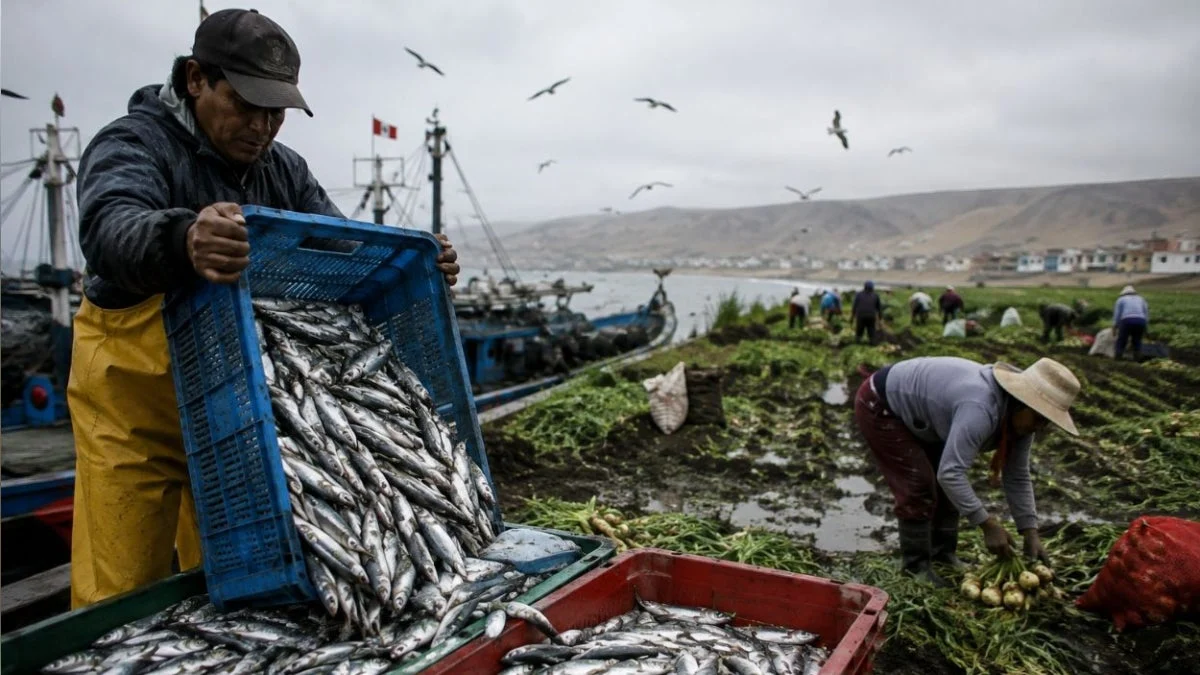
The agricultural sector suffered a staggering 8.12% decline in June, primarily driven by an 11.96% plummet in agricultural production. The INEI report highlights a perfect storm of unfavorable conditions: excessive rainfall in the coastal and highland regions contrasted sharply with a severe drought in the Amazonian jungle.
Key commodities—including rice, olives, coffee, avocados, onions, wheat, barley, and corn—experienced significant drops in output. This is attributed not only to the immediate weather patterns but also to a reduction in total planted surface areas, as farmers struggle to predict planting cycles amidst chaotic weather forecasts.
The Fishing Sector: A Near-Total Wipeout
Perhaps the most dramatic indicator of the El Niño impact is the fishing industry, which contracted by a catastrophic 51.94% in June. The industrial fishing segment was the hardest hit, with the capture of anchoveta—a pillar of Peru’s export economy—collapsing from 462,000 tons in June 2025 to a negligible 629 tons in June 2026. This represents a 99.86% decline.
According to the Multisectoral Commission for the Study of the El Niño Phenomenon (ENFEN), the warming of coastal waters has caused the anchoveta to migrate into deeper, colder waters, far beyond the reach of industrial fleets. Furthermore, the change in temperature has introduced non-native species into the region, disrupting the traditional ecological balance of the Humboldt Current.
Industrial and Mineral Stagnation
The malaise has extended beyond the primary sector into the manufacturing and mining industries, further hampering national output.
Manufacturing: The Secondary Victim
The manufacturing sector fell by 6.19% in June, with both primary and non-primary manufacturing contributing to the decline. The primary manufacturing sector, which is inextricably linked to the processing of raw materials from the sea and the soil, saw a sharp reduction in fishmeal production, oil refining, and sugar processing. The non-primary manufacturing sector, meanwhile, declined by 1.65%, reflecting a softening in domestic demand and higher input costs.
Mining: A Structural Slowdown
Mining and hydrocarbons, typically the engine of Peru’s export growth, recorded a 2.18% contraction. Metallic mining fell by 2.52% as production of zinc, copper, silver, lead, and gold all retreated. INEI analysts point to a dual issue: a reduction in total tonnage extracted and a decrease in the quality of mineral grades processed in concentrator plants. This suggests that the mining sector is not just facing market hurdles but is also dealing with technical challenges at the source of extraction.
Resilience Amidst the Storm: Construction and Commerce
While the primary and secondary sectors faltered, the economy found vital support in the construction and commerce industries, preventing an even more severe contraction.
- Construction: This sector proved to be a surprising bright spot, growing by 9.04%. This was fueled by a 12.54% increase in the internal consumption of cement and a 1.18% uptick in the physical execution of public works. This indicates that government infrastructure spending and private residential development are currently acting as a buffer against broader economic instability.
- Commerce: The trade sector grew by 7.81%, supported by strong wholesale and retail activity, as well as robust performance in the automotive market.
- Services: The services sector also provided a necessary lift, with accommodation and restaurants growing by 5.04% and business services expanding by 3.65%.
In the year-to-date analysis, commerce contributed 0.69 percentage points to the 3.05% growth, followed by other services and construction. These figures suggest that while the "real" economy of extraction and production is hurting, the service and consumption-based economy remains surprisingly buoyant for the time being.
Official Outlook and Long-Term Implications
The current data from the INEI provides a stark warning: Peru is entering a high-risk phase of its economic cycle. The persistence of the "El Niño Costero" alert is not just a temporary weather forecast; it is a macroeconomic risk factor that threatens to derail the recovery efforts for the remainder of 2026 and well into 2027.
The Threat of a Stronger El Niño
ENFEN has maintained a state of high alert, noting a significant probability that the El Niño phenomenon will reach its peak intensity between October 2026 and January 2027. If these predictions materialize, the impact on agriculture—particularly for crops that depend on specific harvest windows—could be devastating.
Policy Considerations
For the Peruvian government, the path forward requires a delicate balancing act. There is a clear need to:
- Enhance Agricultural Infrastructure: Investing in irrigation systems and climate-resistant crops to mitigate the impact of irregular rainfall.
- Support for Fishing Communities: Developing programs to assist those affected by the migration of maritime species.
- Fiscal Prudence: Given that manufacturing and mining, the sources of tax revenue, are underperforming, the government must manage public expenditure to maintain the growth seen in construction while preparing for potential revenue shortfalls.
In conclusion, while the Peruvian economy has avoided a recessionary contraction, the loss of momentum is palpable. The transition from a 3.8% growth environment in April to a 1.75% environment in June illustrates that the economy is highly vulnerable to the whims of the climate. The success of the second half of 2026 will depend heavily on the ability of the state and the private sector to adapt to these new environmental realities, ensuring that the structural pillars of the economy do not crumble under the pressure of an intensifying El Niño. The resilience of the construction and commerce sectors offers a glimmer of hope, but it may not be enough if the primary sectors remain in a state of deep, climate-induced decline.