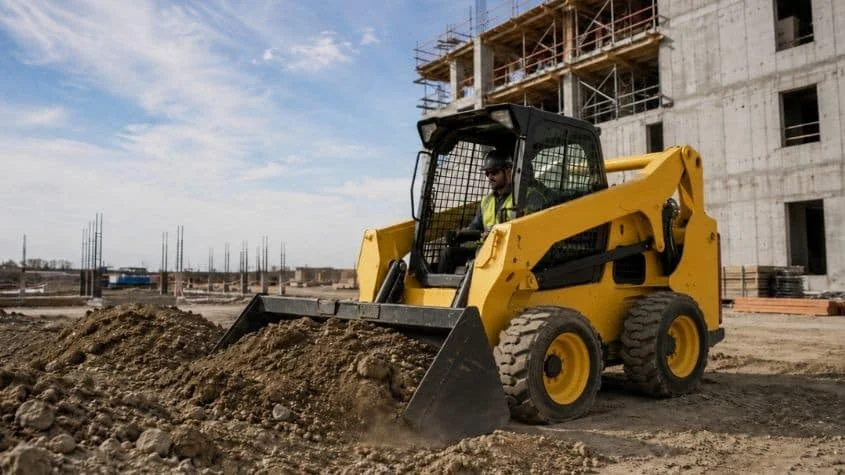
In the fast-paced world of contemporary construction, efficiency is no longer just an objective—it is the baseline requirement for project success. Among the diverse array of heavy machinery populating job sites today, the skid steer loader has emerged as a cornerstone of productivity. Often referred to as the "Swiss Army Knife" of the construction industry, these compact, agile machines have redefined how contractors approach tasks ranging from initial site preparation to final landscaping.
By blending raw power with a remarkably small footprint, skid steer loaders have secured their status as indispensable strategic assets. This article explores the technical evolution, operational versatility, and critical selection criteria of these machines, which continue to set the standard for performance in constrained environments.
The Anatomy and Core Functions of the Skid Steer Loader
At its most fundamental level, a skid steer loader is a compact, engine-powered machine with lift arms that can attach to a wide variety of labor-saving tools. Its unique design—characterized by a rigid frame, independent wheel or track drive systems, and a zero-turn radius—allows it to rotate within its own length.
Essential Components
A modern skid steer comprises several integrated systems that must function in perfect harmony:
- The Powerplant: High-torque engines provide the muscle required for heavy lifting and hydraulic operation.
- The Hydraulic System: The "heart" of the machine, delivering the pressure necessary to power attachments.
- Lift Arms & Coupling: The mechanical interface that allows for the quick attachment of specialized tools.
- The Undercarriage: Available in both wheeled and tracked configurations, providing the necessary traction for varied terrain.
These machines are not merely for transport; they are precision instruments used for excavating, grading, backfilling, and material handling. Whether moving bulk earth, transporting aggregate, or clearing debris from tight urban quarters, the skid steer provides a level of control that larger machinery, such as backhoes or full-sized wheel loaders, simply cannot match in cramped conditions.
Chronology: From Farm Utility to Construction Powerhouse
The history of the skid steer is a testament to industrial innovation aimed at solving specific human challenges.

- 1957 (The Genesis): The concept was born in a turkey barn in Minnesota, USA. Two brothers, Cyril and Louis Keller, were approached by a farmer who needed a machine capable of cleaning out second-story poultry barns. They developed a three-wheeled loader that could turn 360 degrees within its own footprint.
- 1960s (The Standardization): The Melroe Manufacturing Company (which later became Bobcat) acquired the rights to the Kellers’ design. They transitioned the machine from three wheels to four, creating the "Bobcat" identity that would become synonymous with the category.
- 1980s (The Technological Leap): The introduction of standardized "Quick-Attach" mounting plates revolutionized the industry. Suddenly, a single machine could switch from a bucket to a post-hole digger in minutes, massively increasing the ROI for contractors.
- 2000s–Present (The Digital Era): The modern era has seen the integration of telematics, electro-hydraulic controls, and GPS. These advancements have transformed the skid steer from a mechanical tool into a data-driven asset, allowing fleet managers to track performance metrics, fuel consumption, and maintenance schedules in real-time.
Supporting Data: Why Agility Wins on the Job Site
The dominance of the skid steer is supported by operational metrics that favor "compact efficiency." Studies in site logistics indicate that in urban infill projects—where space is at a premium—the use of a skid steer reduces material handling time by approximately 30% compared to traditional manual methods or the use of larger, less maneuverable equipment.
The Impact of Attachments
The true value of these machines lies in their versatility. By swapping a standard bucket for specialized attachments, a single machine can perform the work of five separate pieces of equipment:
- Hydraulic Hammers: For demolition of concrete and masonry.
- Pallet Forks: For efficient site logistics and material staging.
- Sweepers/Brooms: Essential for final site cleanup and street maintenance.
- Trenchers: For rapid utility installation.
- Forestry Mulchers: For land clearing and vegetation management.
This "multifunctional" capability significantly lowers capital expenditure for construction firms, as they need to transport fewer machines to a single job site.
Official Perspectives: The Industry Shift Toward Technology
Leading manufacturers and industry experts consistently highlight that the next frontier for skid steer loaders is not just raw power, but "smart" integration.
"The modern operator expects the same level of digital feedback in their cab as they do in their personal vehicle," notes one industry analyst. Modern units now feature high-definition displays, rear-view cameras, and advanced telematics that provide proactive maintenance alerts. These systems are designed to eliminate the most common cause of downtime: unexpected mechanical failure.
By monitoring hours of operation, idle time, and hydraulic fluid pressure, these systems allow fleet managers to practice predictive maintenance. Instead of waiting for a breakdown, service teams can perform preventative maintenance during non-operational hours, ensuring the machine is ready when the crew arrives on site.

Implications for Construction Management
The choice between a wheeled or tracked skid steer is the most critical decision a project manager will make regarding these machines.
Wheeled vs. Tracked: The Performance Divide
- Wheeled Skid Steers: Best suited for hard, stable surfaces like asphalt or concrete. They offer higher top speeds, lower initial purchase costs, and lower long-term maintenance costs regarding the undercarriage. They are the standard for road work and interior building site applications.
- Tracked Loaders (Compact Track Loaders): These are the gold standard for soft, wet, or muddy conditions. Their tracks distribute the weight of the machine over a larger surface area, providing lower ground pressure. This allows them to "float" over mud that would trap a wheeled machine, preventing costly delays in site preparation.
Strategic Selection Criteria
Selecting the right machine requires a rigorous analysis of the project’s specific needs:
- Operating Capacity: Ensuring the machine can handle the weight of the intended loads safely.
- Hydraulic Flow: High-flow hydraulics are necessary for demanding attachments like brush cutters or cold planers.
- Vertical vs. Radial Lift: Radial lift offers better digging performance and simplicity, while vertical lift provides greater reach and height, ideal for loading high-sided trucks.
- Support and Service: The availability of spare parts and technician support is paramount. A machine that is down for a week waiting for a part is a liability that negates its productivity gains.
Conclusion: The Future of Compact Construction
As construction sites become more complex and environmental regulations tighten, the skid steer loader will continue to evolve. We are already seeing the emergence of electric and hybrid models, aimed at reducing the carbon footprint and noise levels in urban environments.
The skid steer loader has moved beyond being just a piece of heavy equipment; it is now a digital, multifunctional platform that serves as the heartbeat of the modern job site. Whether it is a small-scale renovation or a massive infrastructure project, the efficiency provided by these machines is, and will remain, a defining characteristic of successful construction management. For contractors and developers, the key to maximizing profit lies in understanding these machines not as a commodity, but as a strategic advantage in a highly competitive market.