In an era defined by rapid technological advancement and a global emphasis on social entrepreneurship, the ability to innovate has become a critical barometer for a nation’s progress. However, a groundbreaking study from Peru suggests that while the desire to improve the status quo is alive and well among the youth, the path to collective impact is riddled with systemic obstacles.
The inaugural Citizen Innovation Index (IIC), a collaborative effort between the Peruvian University of Applied Sciences (UPC) and Ipsos Peru, has unveiled a stark reality: while young Peruvians between the ages of 18 and 45 are highly motivated to learn and initiate change, they face significant barriers when attempting to translate individual ingenuity into tangible, community-based solutions.
The State of Innovation: Main Findings
The IIC, which surveyed 1,000 individuals across the country’s connected urban population, established an overall Innovation Index score of 66.35 out of 100. At first glance, the metrics suggest a society that is intellectually curious and proactive. A staggering 88% of respondents view continuous learning as vital for personal development, and 80% reported acquiring a new skill or knowledge base through self-directed efforts within the past year.
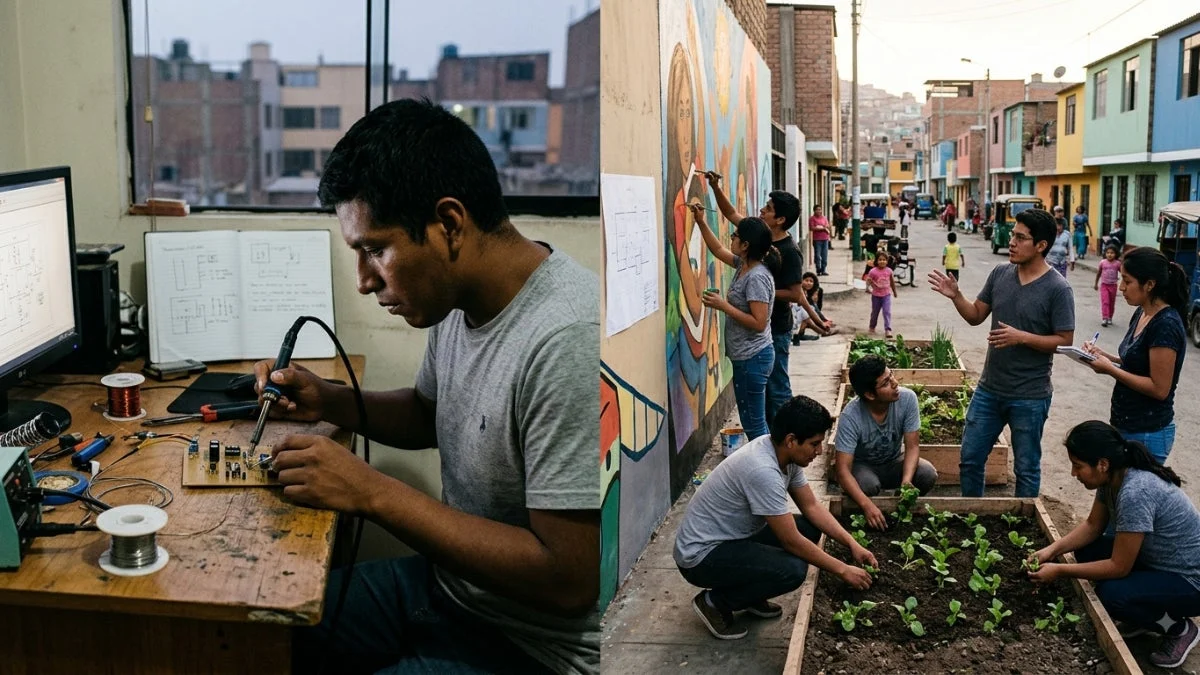
Despite this high degree of individual agency, the data reveals a "geography of innovation" where success is unevenly distributed. Peruvians are finding it significantly easier to implement improvements in private spheres—specifically the home and the workplace—than in the public square.
Over the past 12 months, 38% of respondents successfully modified or improved a physical space within their homes, while 32% implemented a new process or operational improvement at their place of work. In contrast, the community remains a difficult frontier. One out of every three young people (33%) reports having concrete, actionable ideas for community improvement that remain stalled, waiting for implementation. Furthermore, 24% of respondents admitted that they neither generated ideas nor initiated any changes within their local neighborhoods during the same period.
Chronology of a Bottleneck
To understand why this disconnect exists, one must look at the progression of an idea from conception to execution. The IIC data highlights a distinct drop-off point in this timeline:
- The Acquisition Phase (High): 88% of young adults demonstrate a strong appetite for learning. The drive to acquire knowledge is not the bottleneck.
- The Proposal Phase (Moderate): 70% of respondents report that they actively propose improvements in their work or community settings. The desire to voice solutions is prevalent.
- The Collaborative Phase (Low): Despite the high number of proposals, only 56% of respondents actually participate in collaborative projects.
- The Impact Phase (Fragmented): Only a small fraction of these ideas successfully navigate the transition from a "good idea" to a "community solution."
This chronology suggests that the primary failure is not a lack of vision or interest, but a lack of structural bridges to move from a solitary, intellectual exercise to a collaborative, social enterprise.
Supporting Data: The Disparity of Influence
The data from the IIC provides a clear look at the structural versus psychological barriers. The contrast between workplace innovation and community innovation is particularly telling. In the professional sphere, there are clear hierarchies, defined goals, and incentivized structures that allow for the implementation of ideas. If an employee identifies a more efficient way to manage a workflow, there is often a pathway to communicate that to management or colleagues.
In the community sphere, those pathways are largely absent. The 33% of youth who have "ideas on hold" for their communities are essentially being silenced by a lack of institutional support. They lack the platforms to pitch their ideas, the funding to pilot them, and the social infrastructure to organize volunteers.
Moreover, the survey indicates that while 76% of young Peruvians are comfortable sharing what they learn with others, this "information sharing" rarely matures into "co-creation." This suggests that current social networks, whether physical or digital, are acting as forums for information exchange rather than incubators for collective action.
Official Responses: Expert Analysis
The findings have sparked a conversation among leaders in education and public policy regarding the future of social capital in Peru.
Jorge Bossio, Director of Educational Innovation and Internationalization at UPC-Laureate Peru, emphasizes that the nation is at a crossroads. For Bossio, the data is a clear mandate for structural change. "The innovation index reveals that the country needs to strengthen collaboration networks," he stated. "Innovation cannot be understood as an individual act. It is strengthened when people collaborate, exchange knowledge, and find spaces to develop solutions together."
Bossio advocates for a shift in how universities operate. "Universities have a strategic role to play. We must move beyond the classroom to act as bridges, connecting students, companies, the State, and local communities. Our goal is to convert academic learning into projects that have a real, measurable impact on the country."
Patricia Rojas, Director of Public Affairs at Ipsos Peru, offers a more psychological perspective on the data. She argues that the issue is not just about a lack of infrastructure, but about a deficit in the "culture of creation."
"A large part of innovation is produced in community, and that is where young Peruvians do not feel they have a space, or do not have a positive emotional predisposition to create in a group," Rojas explained in an interview with RPP. She suggests that the fear of failure, the complexity of managing group dynamics, and a potential distrust in local institutional stability are preventing young people from taking the risk of collaborative innovation.
Implications: The Path Forward
The implications of the IIC findings are profound for the Peruvian economy and social fabric. If one-third of the nation’s youth has actionable ideas for their community that are not being realized, the country is suffering from a massive loss of human capital and potential social welfare.
Reimagining the Education-Community Link
To bridge the gap, the experts suggest several key shifts:
- Problem-Based Learning: Educational institutions must pivot toward curricula that are rooted in real-world problems. Instead of hypothetical scenarios, students should be tasked with solving local issues as part of their degree requirements.
- Creating "Third Spaces": There is a dire need for physical or virtual "innovation hubs" where the private sector and the public sector meet. These spaces would serve as neutral ground for youth to pitch community projects to local government or private sponsors.
- Articulating the Ecosystem: As Patricia Rojas noted, the challenge is the lack of articulation. Universities, the state, and private enterprises currently operate in silos. A successful innovation ecosystem requires these three sectors to align their resources to support grassroots initiatives.
- Emotional and Soft-Skill Training: If the barrier is partly emotional, then future educational initiatives must include training in conflict resolution, project management, and collaborative leadership. Innovation is as much about managing people as it is about developing technology.
Conclusion: Turning Potential into Progress
The first Citizen Innovation Index provides a vital diagnosis of the Peruvian spirit. It paints a picture of a generation that is eager, capable, and informed—a generation that has already mastered the art of improving its own private surroundings. However, the data also serves as a warning: personal progress is insufficient to drive national development if it remains isolated.
The task ahead for policy makers, educators, and the private sector is to move from a culture of individual initiative to one of collective responsibility. By creating the frameworks necessary for collaboration, Peru can unlock the massive, latent potential currently sitting in the minds of its youth. The ideas are there; the passion is there. The only thing remaining is to build the architecture of cooperation that will allow these ideas to transform the nation.