Nuuk, Greenland – A seemingly routine logistical operation by a Texas-based energy company has ignited a firestorm on Greenland’s remote east coast, blurring the lines between private enterprise and geopolitical ambition. Greenland Energy’s unannounced landing of exploration equipment in late July has not only drawn a stern rebuke from the Greenlandic government but has also amplified existing anxieties surrounding potential U.S. territorial interests in the strategically vital Arctic territory.
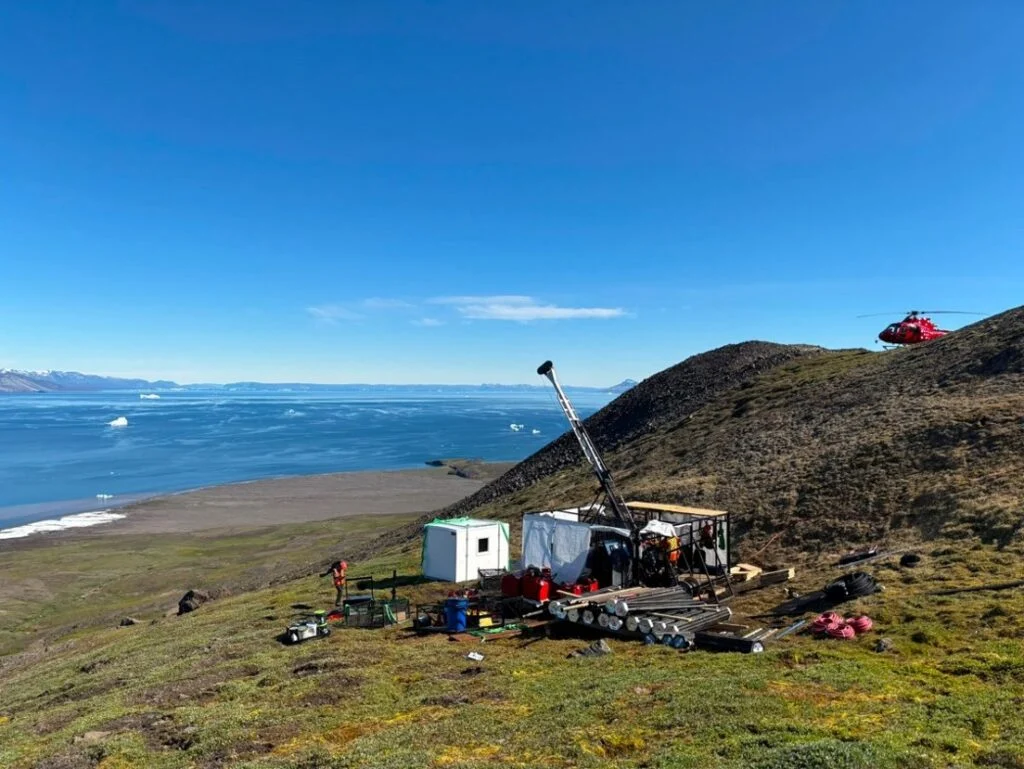
The incident, first brought to light by Danish investigative outlet Danwatch, involved a tugboat delivering a barge laden with approximately fifteen containers to the shores of Jameson Land, an area also known as Nunap Qeqqa. This unpermitted arrival has sent ripples through the delicate political landscape of Greenland, a self-governing territory within the Kingdom of Denmark. The company, while insisting on its independence from any alleged territorial designs by former U.S. President Donald Trump, finds itself embroiled in a controversy that touches upon resource extraction, environmental concerns, and the ever-present specter of Arctic geopolitics.
Unsanctioned Arrival and Swift Official Condemnation
The landing of equipment occurred in the sparsely populated eastern region of Greenland towards the end of July. Local residents, accustomed to the quiet rhythm of life dictated by nature, were surprised to witness the delivery of a substantial quantity of material. Danwatch’s subsequent investigation confirmed that the cargo belonged to Greenland Energy, a company engaged in oil and gas exploration activities.
The Greenlandic government reacted with immediate and decisive action. A "severe warning" was issued to Greenland Energy, unequivocally reminding the company that all future logistical operations require prior notification and explicit approval from the competent authorities. The message was further amplified by Múte B. Egede, Greenland’s Minister for Foreign Affairs and Natural Resources. Speaking to local television station KNR, Minister Egede expressed strong skepticism regarding the company’s ability to commence drilling operations this autumn. He underscored the potential consequences of further non-compliance, warning that more severe sanctions, including restrictions, hefty fines, and even the revocation of licenses, could be imposed.
This official stance highlights a growing assertiveness from the Greenlandic government in asserting its sovereignty and control over its natural resources, particularly in the face of external pressures and potential resource exploitation. The incident serves as a stark reminder that while exploration licenses may exist, the practical execution of such operations is subject to strict governmental oversight and regulatory frameworks.
The Shadow of Trump and Geopolitical Undercurrents
The context surrounding Greenland Energy’s operations is inextricably linked to the controversial pronouncements and alleged ambitions of former U.S. President Donald Trump. The company’s perceived proximity to Trump’s inner circle has raised significant alarm bells, adding a layer of geopolitical complexity to the unfolding situation.

Greenland Energy’s president, Larry Swets, has been described as being close to the former president. Furthermore, the company has strategically bolstered its advisory board by including Carol Craig, a veteran of the U.S. Navy who is reportedly involved with the "Golden Dome" project, a missile defense system for which Trump has openly expressed a vital interest in controlling Greenland. Adding to this intricate web, the company has enlisted the well-known television personality Phil McGraw, "Dr. Phil," to produce a documentary series focusing on Arctic exploration.
The political undercurrents were further amplified by Trump’s own social media activity. He posted an AI-generated image on Truth Social depicting himself as a formidable figure overlooking a Greenlandic village, accompanied by the caption "Hello, Greenland!" This imagery, whether intended as a playful jest or a subtle assertion of interest, has not been lost on observers, fueling speculation about broader U.S. strategic interests in the Arctic.
Ulrik Pram Gad, a researcher at the Danish Institute for International Studies, accurately encapsulated the prevailing sentiment, stating, "There is a diffuse sense that there is a connection to Trump." He elaborated, "This generates anxiety and tensions, especially because with Trump, you can expect anything." This sentiment underscores a pervasive feeling of unease and a degree of apprehension about unpredictable actions and potential overreach from the United States, particularly concerning Greenland’s future.
The Legal Framework and Existing Licenses
Greenland Energy has maintained that its exploration permits, granted in 2015 and 2018, remain valid. This assertion is factually correct. While Greenland did indeed impose a moratorium on hydrocarbon exploration in 2021, licenses granted prior to this decision were not retroactively revoked. The British company 80 Mile, which holds the exploration rights in Jameson Land, currently possesses three active licenses. Greenland Energy finances these operations in exchange for a majority stake in the project, highlighting a complex partnership structure.
However, the core of the current dispute lies not in the existence of the exploration permits themselves, but in the requirement for specific, phase-by-phase authorizations for operational activities. Despite Greenland Energy’s claims of "constructive" discussions with regulatory bodies, the company has yet to secure the necessary approvals for establishing a camp or commencing drilling operations. Their initial ambitious plan to drill two wells to a depth of 3,500 meters, with an estimated investment of $60 million, has been scaled back to a single well. Yet, even this reduced objective faces significant hurdles in obtaining regulatory clearance.
The stark contrast between the company’s optimism and the cautious stance of the Greenlandic authorities is palpable. In a letter to its shareholders, Greenland Energy expressed feeling "encouraged by the progress made" in securing the necessary authorizations. Conversely, the government in Nuuk, the capital of Greenland, maintains a far more guarded position. Minister Egede has been unequivocal, stating that the project is "far from receiving approval."

Local Opposition and Environmental Concerns
Beyond the governmental and geopolitical dimensions, significant local opposition to the project adds another critical layer to the controversy. In Ittoqqortoormiit, the closest settlement to the licensed exploration area, over a hundred residents—a substantial portion of the total population of 325—participated in a protest in mid-July against the proposed drilling.
Anne Merrild, a professor at Aalborg University specializing in Arctic affairs, highlights the profound dependence of the region’s inhabitants on their natural environment. As hunters and fishermen, their livelihoods are intrinsically linked to the health and stability of the local ecosystems. Merrild warns that extensive drilling operations would inevitably lead to numerous environmental disruptions. The anticipated increase in human activity, coupled with the potential for pollution and habitat alteration, poses a significant threat to the region’s delicate fauna.
The economic potential of the Jameson Land area is considerable, according to geological surveys. The Geological Survey of Denmark and Greenland estimates that the region could hold approximately 2.35 billion barrels of oil equivalent, with some studies projecting recoverable reserves as high as 13 billion barrels. Greenland Energy has even alluded to the possibility of extracting a trillion dollars worth of crude oil.
However, Merrild urges a broader perspective beyond pure economic gains. She posits, "From the company’s logic, considering the current geopolitical tensions, the project sends a signal: it is a way of saying, ‘we have access to resources elsewhere.’" This perspective suggests that the pursuit of these resources is not solely driven by profit but also by a strategic imperative to demonstrate and secure access to vital energy reserves in a world increasingly defined by geopolitical competition. The implications extend beyond oil and gas; they touch upon the assertion of presence, the projection of influence, and the symbolic act of "planting a flag" in a territory that has become a focal point of international interest.
A Recurring Theme of Tension and Distrust
The current friction between the United States and Greenland is not an isolated incident. Former President Trump previously generated significant controversy in January 2025 by refusing to rule out the use of military force to gain control of the island. Since then, both Denmark and Greenland have consistently rejected any annexation plans, and a high-level working group has been established to seek a negotiated resolution to these territorial discussions. However, incidents like the one involving Greenland Energy serve to erode trust and further fuel existing suspicions.
The Texan company has consistently denied any direct link between its exploration project and Trump’s alleged annexation ambitions. Roderick McIllree, Greenland Energy’s CEO, acknowledged the unannounced landing as "a mistake on our part, a mistake that will not be repeated." Nevertheless, the damage has been done. The operation has starkly illuminated the often-blurred boundaries between private commercial interests and the complex realm of Arctic geopolitics. It has once again placed Greenland at the epicenter of a storm it did not solicit, highlighting its vulnerability and the multifaceted challenges it faces in navigating its future amidst competing global interests. The incident underscores the critical need for transparency, adherence to regulations, and respect for the sovereign rights of Greenland as it seeks to chart its own course in a rapidly evolving geopolitical landscape.