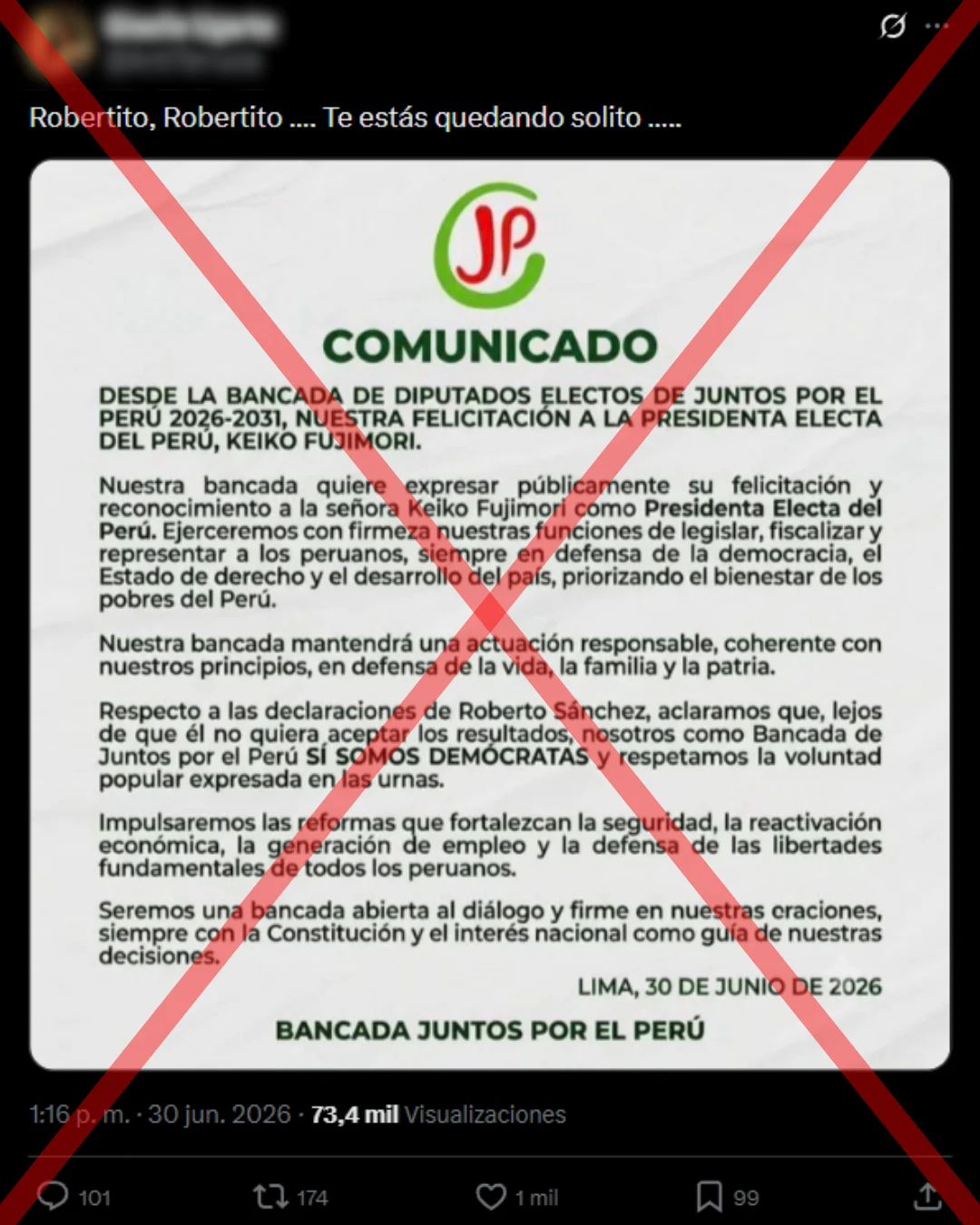
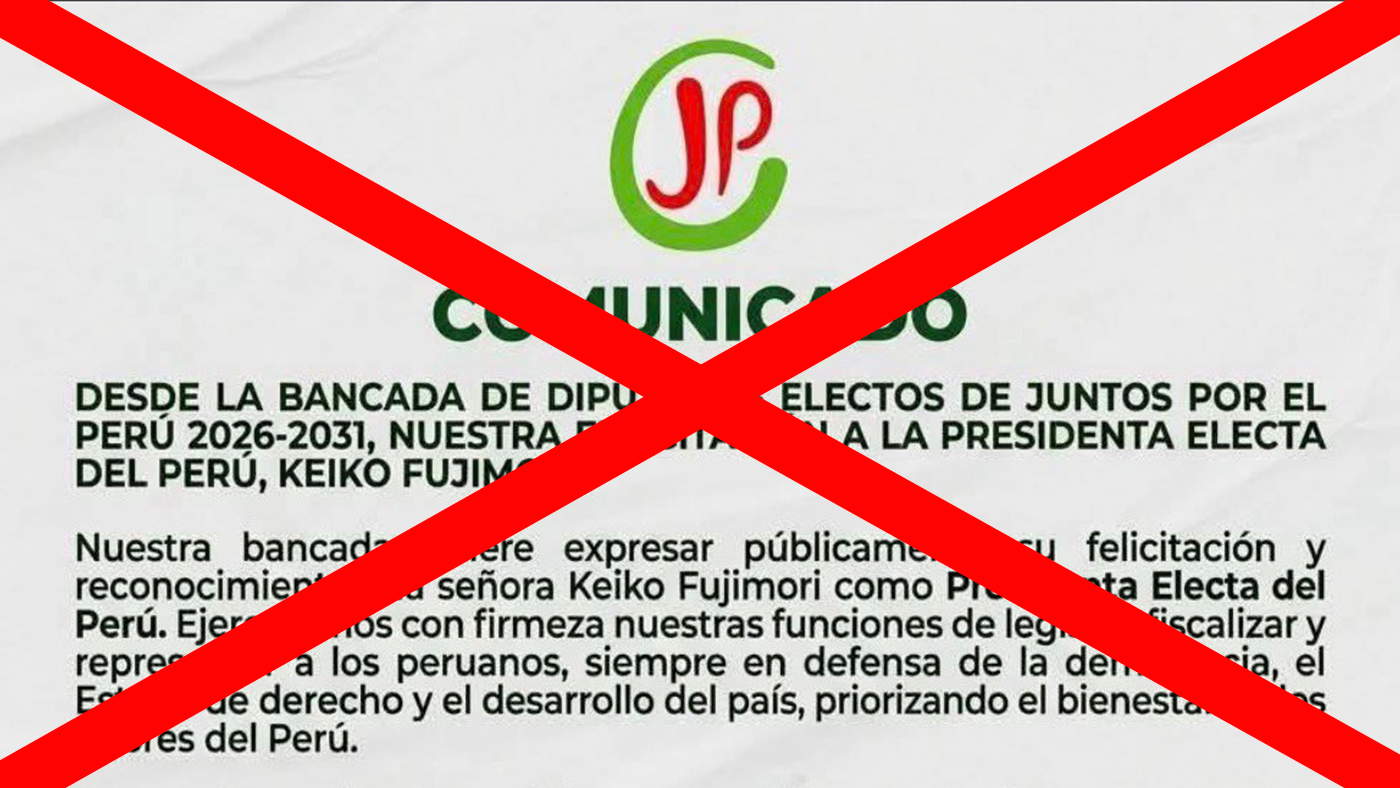
In the high-stakes aftermath of Peru’s recent presidential runoff, the digital landscape has become a volatile battleground for political narratives. As the nation awaited the final tallying of ballots, a sophisticated piece of disinformation emerged, threatening to distort public perception of the political climate. A doctored document, masquerading as an official communiqué from the incoming parliamentary caucus of Juntos por el Perú (JP), purported to offer a formal recognition and congratulation to Keiko Fujimori of Fuerza Popular (FP) as the country’s president-elect.
After a rigorous forensic analysis of official party communications and statements from key stakeholders, the fact-checking network AmaLlulla has officially debunked the document, categorizing it as a malicious fabrication. This report explores the mechanics of this disinformation campaign, the official responses from the affected political party, and the broader implications of such digital manipulation during sensitive electoral transitions.
The Anatomy of the Fraud
The fraudulent image surfaced on the platform X (formerly Twitter) on June 30, capturing immediate attention due to its visual fidelity. The creators of the hoax went to great lengths to mimic the institutional aesthetic of Juntos por el Perú, utilizing the party’s official logo, color palette, and standard formatting conventions. By co-opting these visual markers, the purveyors of the fake statement aimed to bypass the critical scrutiny of the average social media user, lending the document an air of legitimacy that it fundamentally lacked.
The post was disseminated with the provocative caption: "Robertito, Robertito. Te estás quedando solito" (Robertito, Robertito. You are being left all alone), a taunt clearly aimed at inflaming internal divisions within the left-wing coalition. By the time this investigation was finalized, the post had garnered over 76,100 views, signaling a high level of engagement and rapid viral spread across both X and Facebook.
Chronology of the Disinformation Campaign
To understand the impact of this incident, it is necessary to map the timeline of its emergence and the subsequent rebuttal:
- June 30, Morning: The fabricated document begins circulating on X and Facebook, coinciding with the heightened tensions following the conclusion of the ballot count.
- June 30, Midday: The post gains significant traction, reaching tens of thousands of users. The narrative attempts to frame the JP caucus as having broken ranks with its ideological base to appease the declared president-elect.
- June 30, Afternoon: Juntos por el Perú issues an official alert via its verified Facebook page, explicitly labeling the document as "apocryphal" and warning the public against falling for the deception.
- June 30, Evening: Ernesto Zunini, a newly elected deputy and Secretary General of JP, issues a personal clarification on X, categorically denying the existence of any such party-sanctioned communiqué.
- July 1 and beyond: Fact-checkers, led by AmaLlulla, begin the process of cross-referencing the document with official party registries and media archives, confirming the total absence of the statement from any legitimate party channel.
Official Responses and Denials
The speed with which the political actors involved acted to quash the rumor highlights the importance of institutional vigilance in the age of viral disinformation.
The Party’s Institutional Stance
On its official Facebook platform, Juntos por el Perú did not mince words. Their statement served as a definitive corrective, emphasizing that the party’s official communications are released through established channels and never via leaked, unverified images. The party underscored that the document was designed to generate confusion and potentially incite unrest among their supporters.
The Voice of Leadership: Ernesto Zunini
Ernesto Zunini’s intervention was particularly crucial. As a high-ranking official within the party’s parliamentary wing, his word carries the weight of authority. In his public statement, Zunini was unequivocal: "This document is false; there is no statement in the name of the Juntos por el Perú parliamentary caucus."
Furthermore, during a press conference held on the same day, Zunini clarified the party’s actual position. Rather than offering congratulations, the caucus was in the process of evaluating its legal and political options regarding the electoral results. By framing the party’s response as a strategic deliberation rather than an impulsive reaction, Zunini successfully steered the narrative away from the fabricated "congratulations" and toward the party’s genuine legislative agenda and ongoing internal review.
Supporting Data: Why the Document Was Clearly Fake
Beyond the official denials, several forensic inconsistencies point to the amateurish, albeit effective, nature of the hoax:
- Absence of Digital Footprint: An official communiqué of such national importance would necessarily be hosted on the party’s website, sent via press release to major media outlets, and shared across all official social media platforms. The total absence of this document in any primary source location was the first indicator of its falsity.
- Linguistic and Style Mismatches: Political communications from established parties typically follow rigid stylistic guidelines. The fake document, while visually competent, lacked the bureaucratic nuances and the specific vocabulary usually employed by the party’s communications office.
- The "Propaganda" Factor: The metadata and the surrounding social media engagement (such as the taunting caption) were characteristic of "troll farm" activity rather than institutional messaging. The goal was clearly to provoke a reaction from political opponents and supporters alike, rather than to inform.
The Broader Implications: Disinformation and Democracy
The incident surrounding the fake Juntos por el Perú statement is not an isolated event; it is emblematic of a global trend in which political actors use synthetic media to influence public discourse during sensitive democratic transitions.
Erosion of Public Trust
Every instance of disinformation—whether successful or quickly debunked—chipped away at the public’s ability to trust the information they consume on social media. When political factions are constantly bombarded with "fake news," the public may eventually disengage from the democratic process altogether, viewing all official communications with extreme, and sometimes unhealthy, cynicism.
The Responsibility of Social Media Platforms
While X and Facebook were the vehicles for this disinformation, the responsibility for curbing its impact remains complex. While the platforms have mechanisms for reporting misinformation, the speed at which a post can reach 76,000 views often outpaces the moderation and verification processes. This highlights the urgent need for a more robust integration between political entities and fact-checking organizations to ensure that debunked information is flagged or removed with greater efficiency.
The Role of Fact-Checking Networks
Networks like AmaLlulla have become the new "gatekeepers" of truth in the digital era. By providing transparent, evidence-based verification, they offer a necessary counterbalance to the rapid spread of falsehoods. The effectiveness of this debunking relied heavily on the swift cooperation of the party leadership, demonstrating that political transparency is the most effective weapon against disinformation.
Conclusion: Lessons Learned
The attempt to circulate a fake congratulatory statement from Juntos por el Perú serves as a stark reminder of the challenges facing Peru’s political stability. While the forgery was ultimately exposed as a failure, its reach—nearly 80,000 views in a matter of hours—demonstrates that the digital environment remains fertile ground for bad actors seeking to manipulate the electorate.
For citizens, the takeaway is clear: in an era of high-tech deception, skepticism is a civic duty. Official statements should only be trusted when they appear on verified institutional channels. For political parties, the incident underscores the need for proactive communication strategies and rapid-response teams capable of identifying and neutralizing disinformation before it gains a foothold in the public imagination.
Ultimately, the preservation of democratic integrity depends not only on the security of the ballot box but also on the security of the information landscape. As Peru moves forward into a new administration, the vigilance shown by groups like AmaLlulla and the clear communication from political leaders like Ernesto Zunini will be the pillars that support a more resilient and informed society. The truth, in this instance, prevailed—but the threat of future fabrications remains a constant, quiet challenge to the health of the republic.