In an era defined by the rapid dissemination of information, social media platforms have become battlegrounds for political narratives, often blurring the lines between reality and fabrication. Following the conclusion of the vote count for the country’s recent presidential runoff, a sophisticated disinformation campaign emerged, targeting the political stability of the nation.
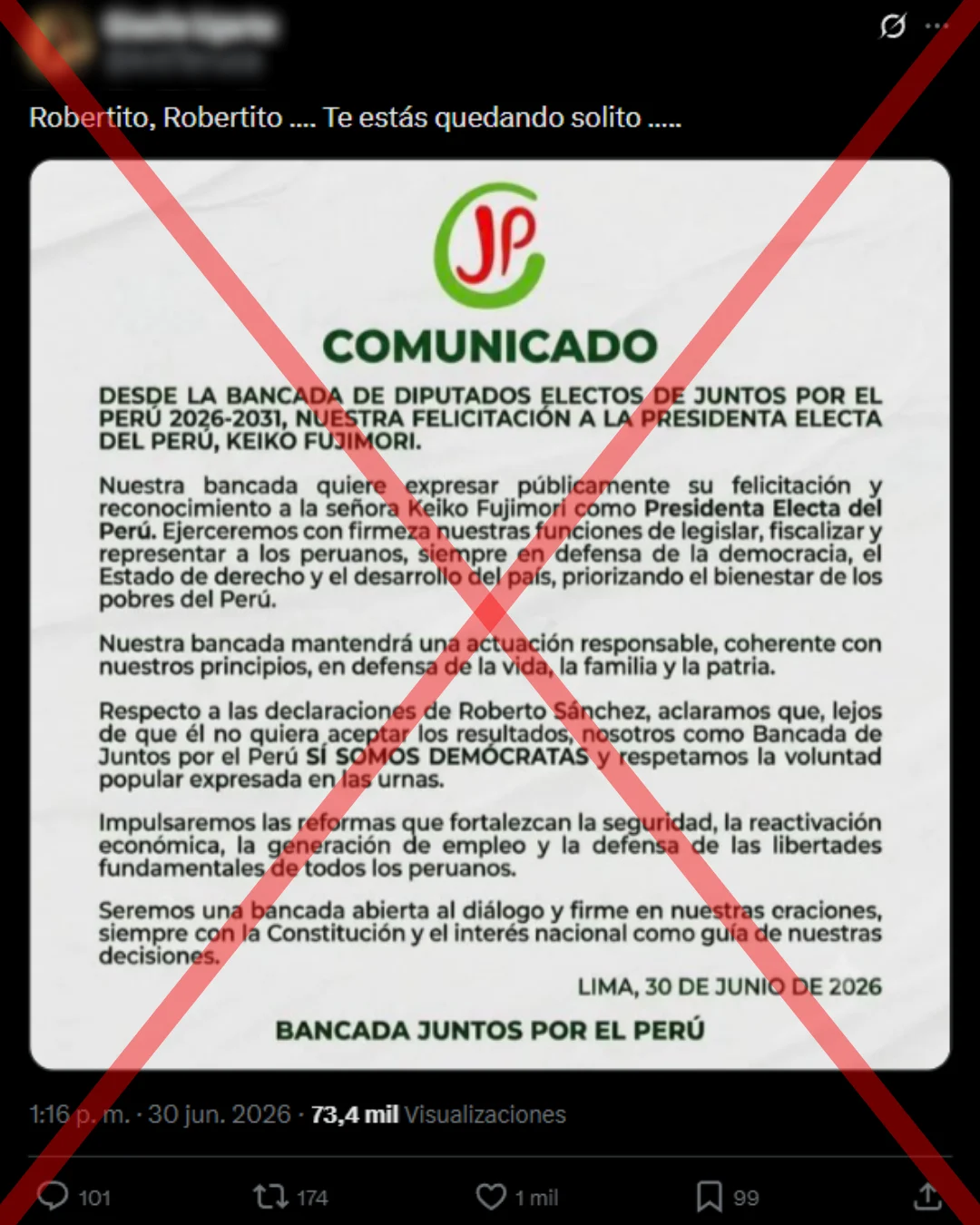
A purported official statement from the bench of newly elected deputies of the political party Juntos por el Perú (JP)—which allegedly congratulated and recognized Keiko Fujimori of Fuerza Popular (FP) as the president-elect—began circulating virally across X (formerly Twitter) and Facebook. However, after an exhaustive investigation and review of official party communications, the AmaLlulla fact-checking network has categorically concluded that the document is a fabrication.
The Anatomy of the False Narrative
The misinformation effort began in earnest on June 30. The doctored image, which mimicked the visual identity of Juntos por el Perú by utilizing its official logo, color palette, and institutional formatting, was shared with a provocative caption: "Robertito, Robertito. Te estás quedando solito" (Robertito, Robertito. You are being left all alone).
By the time the verification process was initiated, the post had garnered significant traction, reaching over 76,100 views on X. The reach was amplified by various accounts across social media, creating the illusion of a political shift within the JP ranks. By presenting a forged document that appeared to originate from a credible source, the architects of this misinformation sought to undermine the official stance of the party and generate confusion among the electorate regarding the legitimacy of the electoral results.
Chronology of the Disinformation Spread
The timeline of this incident highlights how quickly digital forgeries can spiral out of control if left unchecked.
- June 30, Morning: The forged image is uploaded to X. It gains immediate traction due to the inflammatory nature of the caption and the perceived credibility of the party’s branding.
- June 30, Midday: The image begins to migrate from X to Facebook, gaining momentum in political groups and private message threads.
- June 30, Afternoon: Juntos por el Perú officially notices the viral spread of the document and issues a corrective statement on their primary Facebook page.
- June 30, Evening: Ernesto Zunini, a newly elected deputy and Secretary General of Juntos por el Perú, intervenes personally on X to denounce the document.
- July 1: Fact-checking organizations, including the AmaLlulla network, finalize their investigative report, confirming the fraudulent nature of the document.
Official Responses and Verification
The speed with which the political party reacted was essential in curbing the impact of the disinformation. The official communication from Juntos por el Perú was unequivocal. In a statement posted to their verified social media channels, the party explicitly labeled the circulating communiqué as "apocryphal" and "false."
The party’s official stance was further bolstered by the public intervention of Ernesto Zunini. His message was direct and aimed at correcting the record for the thousands of users who had been exposed to the image: "This document is false; there is no statement in the name of the bench of deputies of Juntos por el Perú."
Zunini did not stop at simply debunking the image. During a press conference held on the same day, he addressed the broader political context, clarifying the party’s position regarding the election results. He emphasized that the party and its bench of deputies had not extended any congratulations to Keiko Fujimori. Instead, he underscored that the party was currently in the process of evaluating legal and political measures regarding the official proclamation of the president-elect. By clarifying that they had neither recognized nor congratulated the opposition candidate, Zunini effectively neutralized the narrative that JP had undergone an internal fracture or a change in ideological alignment.
Implications for Democratic Integrity
The attempt to pass off a forged document as an official party communication is not merely an isolated instance of "fake news"; it is a calculated effort to manipulate public perception during a period of high political sensitivity.
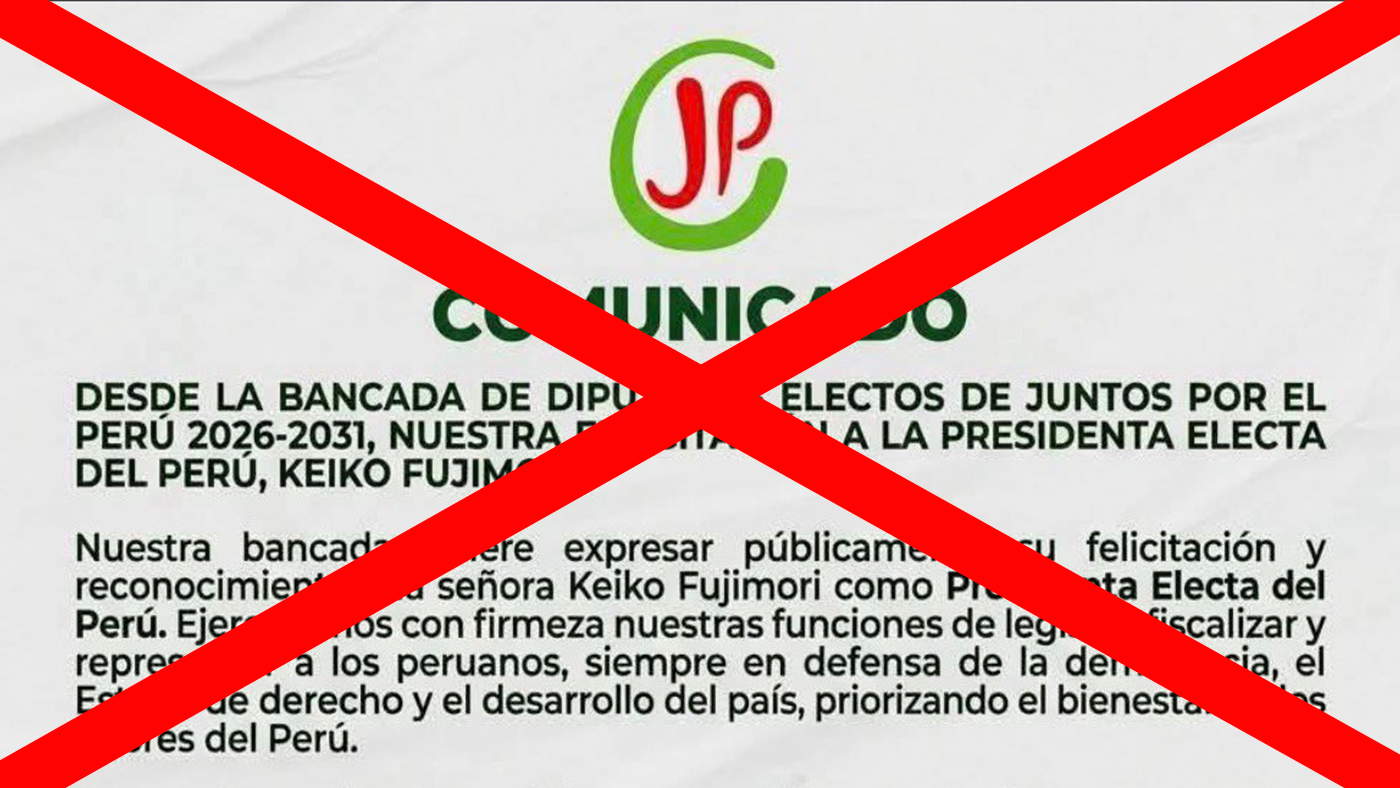
1. The Weaponization of Visual Credibility
By co-opting the visual language of a political entity—logos, specific typography, and institutional colors—the perpetrators of this hoax exploited the "trust-by-design" phenomenon. Voters often rely on the aesthetic markers of political parties to verify information; when those markers are successfully mimicked, the threshold for critical thinking is lowered.
2. Destabilizing Political Cohesion
The core objective of this particular fabrication was to create a perception of isolation for party leadership. By framing the "Robertito" (referring to leadership) as being "left all alone," the fake communiqué sought to demoralize the party’s base and create an atmosphere of defeatism, even while the party was officially maintaining a different strategic position.
3. The Challenge for Media Literacy
This incident serves as a stark reminder of the challenges posed by the modern information ecosystem. Even when a party issues a quick denial, the initial falsehood often leaves a "residual effect" in the minds of those who saw the image but missed the subsequent correction. The reach of 76,100 views demonstrates that the damage to the public discourse occurs in seconds, while the repair process takes hours or days of coordinated fact-checking.
Analyzing the Impact of Digital Forgery
The use of digital manipulation in elections is a growing threat to democratic processes worldwide. In the context of this incident, the perpetrators relied on the "post-truth" environment where supporters of a specific candidate may be more inclined to share information that confirms their existing biases.
The AmaLlulla network’s investigation highlights the importance of institutional vigilance. Had the party not been active on social media, the fake communiqué could have been cited by mainstream media outlets or political pundits as an "official shift," thereby changing the political narrative on a national scale. The fact that the party was forced to spend time and resources debunking a fabrication underscores the asymmetric nature of digital warfare: it takes one person minutes to create a lie, but it takes an entire organization hours to verify the truth.
Conclusion: The Verdict of AmaLlulla
Based on the evidence collected—including the direct testimony of party officials, the absence of any such document in the party’s official records, and the clear confirmation from the Secretary General—the AmaLlulla network confirms that the document is, in its entirety, a fabrication.
The "communique" was never drafted, signed, or released by the bench of deputies of Juntos por el Perú. It was a digital construct designed to mislead the public. As the nation moves forward from the election, this incident remains a poignant case study on the necessity of verifying all information before sharing, regardless of how official or authentic it may appear.
In a democracy, the right to information is fundamental, but so is the responsibility to ensure that the information circulating is accurate. The resilience of the political process depends not only on the integrity of the vote count but also on the collective ability of citizens to identify and reject the deceptive tools of those who seek to undermine it through disinformation. The case of the Juntos por el Perú fake statement is a victory for verification and a warning to those who attempt to weaponize falsehoods against the truth.