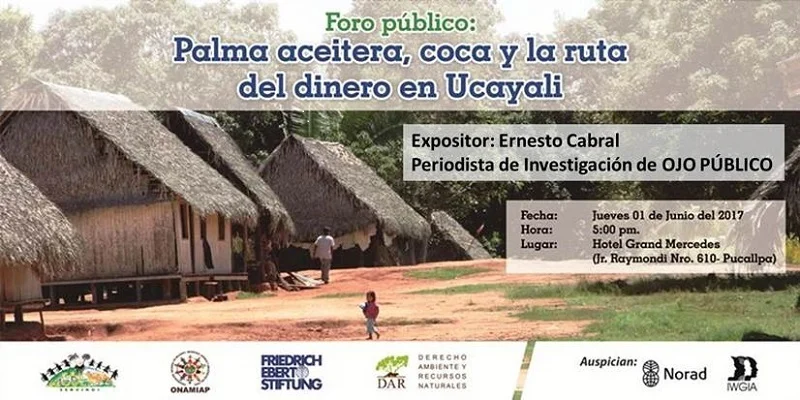
PUCALLPA, PERU – As the Amazon rainforest continues to face unprecedented pressure from industrial agriculture and illicit trade, the spotlight turns to the Peruvian region of Ucayali. On June 1, 2017, a pivotal public forum titled "Oil Palm, Coca, and the Route of Money in Ucayali" convened in Pucallpa, bringing together investigative journalists, environmental experts, and indigenous leaders to dissect the complex web of economic interests that threaten the region’s ecological integrity.
The event, held at the Hotel Grand Mercedes, sought to address a haunting question: What are the true costs of the industrial oil palm expansion and the clandestine coca trade, and who is truly profiting from the dismantling of the Amazonian landscape?
Main Facts: The Intersection of Industry and Illegality
The forum served as a critical platform to expose the dual threats facing Ucayali. On one side, the rapid, often controversial expansion of industrial oil palm plantations has been linked to large-scale deforestation and the displacement of indigenous territories. On the other, the persistent and evolving coca economy continues to fuel corruption and environmental degradation in the region’s remote corridors.
The event featured Ernesto Cabral of the investigative outlet OjoPúblico, whose rigorous work has tracked the financial flows—the "route of money"—that sustain these activities. Moderated by Ítalo García of the Network of Indigenous Communicators of Peru (REDCIP-Ucayali), the panel included prominent voices such as Claudia Zúñiga Carrillo (DAR), Raúl Vásquez Meza (ProPurús), and Lizardo Cauper (ORAU).
The primary objective was clear: to bridge the gap between financial transparency and environmental governance. By tracing how capital moves through the region, organizers aimed to hold stakeholders accountable and empower indigenous communities to act as the frontline guardians of their ancestral forests.
Chronology: A Week of Action for Forest Governance
The public forum was not an isolated event but rather the cornerstone of a broader, three-day strategic initiative held from June 1 to June 3, 2017.
- June 1, 2017: The public forum launched at the Hotel Grand Mercedes, setting the stage for a deeper exploration of illicit financial flows and their impacts on the Ucayali basin.
- June 1–3, 2017: This forum served as the inauguration for a specialized workshop titled "Forest Governance: Transparency and Forest Monitoring." This intensive training was designed specifically for indigenous communicators and spokespersons from across the Ucayali region.
- The Strategic Context: The workshop was supported by a coalition of international and national organizations, including the Norwegian Agency for Development Cooperation (NORAD), the International Work Group for Indigenous Affairs (IWGIA), and the German Agency for International Cooperation (GIZ) through their Pro-Land Program.
The synchronization of these events reflects a growing international recognition that local indigenous surveillance is the most effective tool against the encroachment of destructive industries.
Supporting Data: The Anatomy of a Crisis
To understand the urgency of this discourse, one must look at the data surrounding the Ucayali landscape. Ucayali has long been a focal point for land-use conflicts in Peru.
The Oil Palm Factor
Large-scale oil palm plantations have frequently been criticized for bypassing environmental impact assessments. According to data tracked by environmental monitoring groups, thousands of hectares of primary forest have been cleared under the guise of agricultural development, often without the consent of the indigenous communities whose land titles remain in legal limbo. The "route of money" mentioned by Cabral refers to the corporate structures that obscure ownership and liability, making it difficult for the state to regulate or penalize environmental crimes.
The Coca Economy
While oil palm represents a "legalized" form of deforestation, the coca trade represents the illicit shadow economy. In Ucayali, the coca trade often utilizes the same infrastructure—unauthorized roads carved into the forest—that are later used for timber extraction or plantation expansion. The illicit funds generated by this trade are frequently laundered through local businesses, creating a cycle of economic dependence that is difficult to break without robust institutional oversight.
Financial Transparency
The workshop’s focus on "transparency of climate funds" is particularly significant. As international bodies pour millions of dollars into Peru to support REDD+ projects and forest conservation, there is a persistent concern that these funds are not reaching the communities on the ground. The lack of transparency in how climate finance is managed creates a "grey market" where, ironically, the funds intended to save the forest may be managed by institutions that fail to account for the impact of their broader economic policies.
Official Responses and Stakeholder Perspectives
The panel of experts offered a multi-dimensional view of the crisis.
- Indigenous Leadership: Lizardo Cauper, representing ORAU, emphasized that for indigenous peoples, the forest is not a commodity but a life-support system. He argued that the "route of money" is often a "route of death" for indigenous culture and territory. His presence highlighted the necessity of FPIC (Free, Prior, and Informed Consent) in any development project.
- Legal and Environmental Advocacy: Claudia Zúñiga Carrillo of DAR underscored the need for a stronger legal framework to regulate land concessions. She noted that current regulations are frequently circumvented by companies that exploit loopholes in agricultural zoning laws.
- Conservation Perspectives: Raúl Vásquez Meza of ProPurús provided a technical outlook, explaining that the loss of biodiversity in Ucayali is not just an ecological tragedy but an economic one, as it destroys the ecosystem services—such as water regulation and carbon sequestration—that are vital for the region’s long-term viability.
The organizers—ONAMIAP, the Friedrich Ebert Foundation, DAR, and Servindi—reiterated that the goal of the workshops is to provide the "tools of the trade" for indigenous surveillance. This includes training in satellite mapping, legal documentation of land encroachments, and the use of digital media to broadcast violations to a national audience.
Implications: Building a Resilient Future
The implications of the discussions in Pucallpa are profound. If the "route of money" can be mapped and exposed, it creates a mechanism for international donors and national regulators to apply pressure.
Empowering the "Vigilantes of the Forest"
The primary outcome of the June 2017 events was the training of a new cohort of indigenous communicators. By equipping these individuals with the skills to investigate and report on environmental crimes, the project aims to create a permanent, decentralized monitoring network. This is a shift from reactive to proactive governance.
Strengthening Governance
The workshop’s focus on "transparency of climate funds" is a direct challenge to the status quo. If indigenous organizations can effectively monitor how funds are utilized, it forces government agencies to operate with greater accountability. The collaboration with GIZ, NORAD, and IWGIA suggests that international donors are moving toward a model where funding is contingent upon clear, transparent, and community-led governance.
The Path Forward
The events in Pucallpa serve as a microcosm of a larger struggle across the Amazon basin. As global demand for palm oil rises and the narcotics trade evolves, the pressures on the Amazon will only intensify. The efforts of organizations like Servindi and ONAMIAP represent a critical evolution in environmental activism: the realization that environmental protection is impossible without financial investigation.
In conclusion, the forum and subsequent workshops did more than just present data; they established a methodology for resistance. By tracking the money, the stakeholders in Ucayali are effectively pulling back the curtain on the forces that have long operated in the shadows of the canopy. The challenge remains for the state to act upon these revelations, ensuring that the rule of law prevails over the interests of those who seek to profit from the destruction of one of the world’s most vital ecosystems.
As the participants departed Pucallpa on June 3, the message was clear: the transparency of the forest begins with the transparency of the accounts that influence its fate. For the people of Ucayali, the struggle for their land is now a struggle for the truth.