Executive Summary
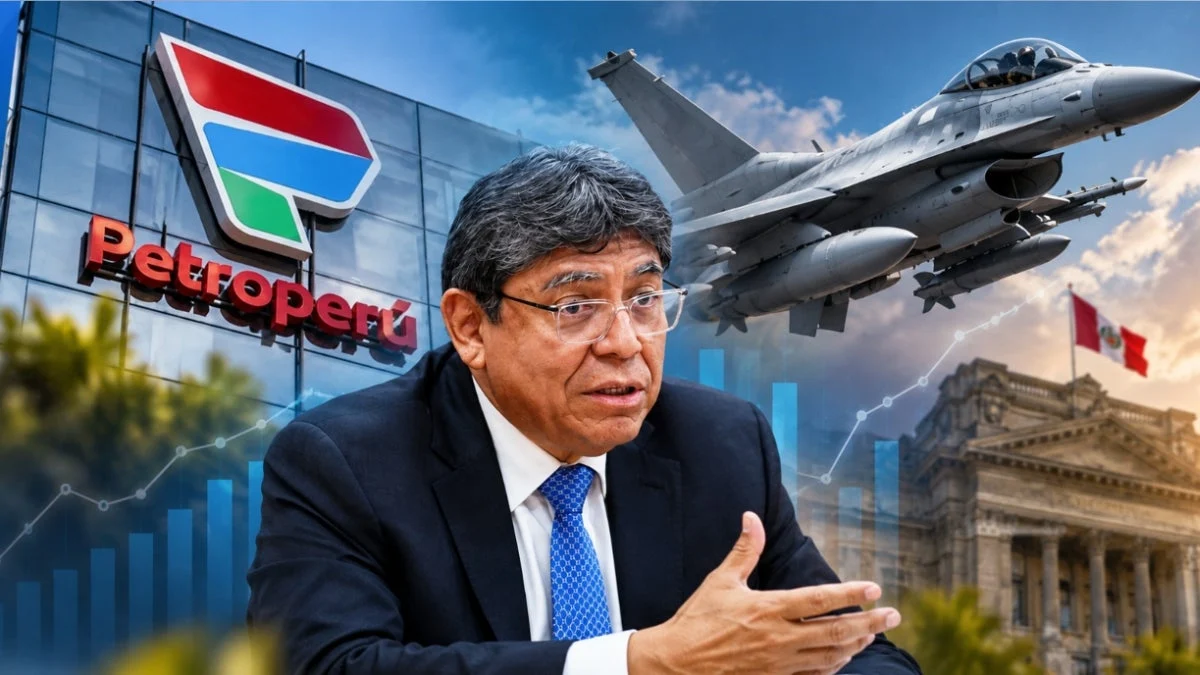
The Peruvian economic landscape is currently defined by a high-stakes debate between the Ministry of Economy and Finance (MEF) and independent analysts regarding the country’s fiscal trajectory. At the center of the controversy is a massive defense acquisition plan—the purchase of F-16 fighter jets from the United States—and the ongoing financial stabilization of the state-owned oil company, Petroperú. While the current Minister of Economy, Elmer Cuba, maintains that the government’s fiscal projections remain robust and manageable, former Minister Alfredo Thorne has raised significant alarms, suggesting that the deficit could balloon well beyond official estimates, potentially reaching 4.3% of the GDP by 2027.
The Core Conflict: Defense Spending vs. Fiscal Responsibility
The Peruvian government finds itself navigating a precarious balance between modernizing its military capabilities and maintaining fiscal discipline. The proposed acquisition of F-16 fighter jets, estimated at a cost of US$3.5 billion, has become a lightning rod for criticism.
Critics, led by former Finance Minister Alfredo Thorne, argue that the government’s fiscal roadmap is overly optimistic. The MEF has publicly targeted a deficit of 2.4% of the GDP by 2027, a goal that Thorne claims fails to account for a cumulative array of legislative spending measures and long-term infrastructure commitments. According to Thorne, the inclusion of previously uncalculated social and military spending, combined with the capital-intensive nature of the fighter jet purchase and continued state support for Petroperú, creates a "fiscal trap" that could see the deficit climb to 4.3%.
Minister Elmer Cuba has pushed back against these projections, arguing that the financial burden of the defense acquisition is being misunderstood. He maintains that the US$3.5 billion cost will not be a sudden shock to the national budget but rather a staggered expenditure distributed across a ten-year horizon. "The purchase of the planes is spread out over a decade," Cuba stated in a recent interview with RPP’s Ampliación de Noticias. "It is not a single-year expenditure; it is integrated into the public budget cycles for the next ten years."
Chronology of Economic Tensions
To understand the current impasse, one must look at the sequence of events that has led to the present fiscal friction:
- Mid-2023: Petroperú faces an unprecedented liquidity crisis, requiring emergency government intervention to prevent a total operational shutdown.
- Early 2024: The administration announces a shift in defense policy, citing the need for modernization of the Peruvian Air Force (FAP) after nearly four decades of stagnant hardware updates.
- Mid-2024: The MEF releases its medium-term fiscal framework, projecting a deficit of 2.4% of the GDP by 2027, predicated on optimistic growth scenarios.
- Late 2024: Independent economists, including Alfredo Thorne, begin publishing independent analyses warning that the government’s math fails to account for four specific, high-cost legislative acts passed by the previous administration, as well as the full scale of the planned F-16 procurement.
- Current Date: The Ministry of Economy and Finance remains firm on its projections, while the legislature continues to debate the efficacy of the government’s economic management, recently rejecting two-thirds of the legislative powers requested by the executive branch.
Data Analysis: The Deficit Calculation Dispute
The disagreement centers on the technical methodology used to forecast the country’s fiscal health. The MEF asserts that sustained economic growth—projected at 3% to 5% annually—will naturally broaden the tax base. Minister Cuba argues that this expansion will generate sufficient tax revenue (through income and IGV taxes) to absorb the costs of the F-16s without triggering a fiscal crisis.
However, the "Thorne Model" provides a more pessimistic, albeit detailed, breakdown. Thorne notes that:
- Legislative Drag: Four laws enacted by the previous government have added approximately 0.9 percentage points to the 2027 deficit projection.
- The "18 Billion" Injection: The government’s recent announcement to inject S/18,000 million (approx. US$4.8 billion) into the economy to stimulate growth adds a further 2 points to the deficit calculation.
- Hidden Liabilities: Thorne argues that the accounting for the F-16s, the construction of a new naval base, and ongoing financial subsidies for Petroperú remain opaque, lacking the transparency required to build market confidence.
If these figures are combined, the cumulative impact suggests a deficit figure nearly double the government’s stated target.
Official Response: The Defense of Petroperú
A critical pillar of Minister Cuba’s defense is the recent turnaround of Petroperú. The state oil company, often viewed by investors as a fiscal "black hole," is being presented as a success story of restructuring.
"A couple of years ago, Petroperú was reporting losses of US$1 billion," Cuba noted. "Last year, the result before taxes and depreciation reached a break-even point. This year, the trend has reversed entirely, showing US$600 million in positive results."
Cuba argues that the "hole" in the state’s budget created by the oil company has been effectively plugged. By citing these figures, the MEF is attempting to reassure international credit rating agencies that Petroperú is no longer a systemic risk to the national treasury. However, critics remain skeptical, pointing out that the positive figures may be the result of temporary capital injections rather than long-term operational efficiency.
Macroeconomic Implications
The ongoing discourse holds significant implications for Peru’s international standing and local economic stability.
1. Sovereign Credit Rating
Peru has long been regarded as a "fiscal anchor" in the Latin American region. Any deviation from the established fiscal rules could lead to a downgrade by major credit agencies. If the deficit truly climbs toward 4%, the cost of borrowing for the Peruvian state will inevitably rise, increasing the burden on the taxpayer.
2. Legislative Relations
The friction between the executive and the legislature has reached a boiling point. The recent rejection of two-thirds of the requested legislative powers by the Congress represents a "slap in the face" to the government’s economic agenda. This legislative paralysis hinders the government’s ability to implement structural reforms that could have potentially offset the costs of the defense modernization program.
3. Public Investment vs. Military Spending
There is a growing public perception that the government is prioritizing the F-16 purchase over social programs. While the MEF insists that the budget is large enough to cover both, the political optics of spending billions on military hardware during a period of economic recovery are challenging. The government must now decide if the strategic value of the F-16s outweighs the risk of social unrest driven by perceived neglect of public services.
Conclusion: A Need for Transparency
The dispute between Minister Elmer Cuba and former Minister Alfredo Thorne highlights a fundamental lack of consensus regarding the future of the Peruvian economy. Whether the government’s optimistic growth projections will materialize remains to be seen. However, the call for "greater transparency" issued by Thorne is one that resonates with many in the private sector.
For the Peruvian government to regain market confidence, it must move beyond verbal assurances. A detailed, public-facing breakdown of how the F-16 purchase, the naval base, and Petroperú’s ongoing financial requirements will be accounted for in the annual budget is essential. Without this clarity, the debate over the 4% deficit threshold will continue to cast a shadow over the government’s economic narrative, potentially undermining the very stability that the current administration is working so hard to protect.
The next few months, particularly during the upcoming budget hearings in Congress, will be critical. The administration will have to prove that its "growth-first" strategy is not just a theoretical model, but a reality that can sustain the significant fiscal obligations it has undertaken.