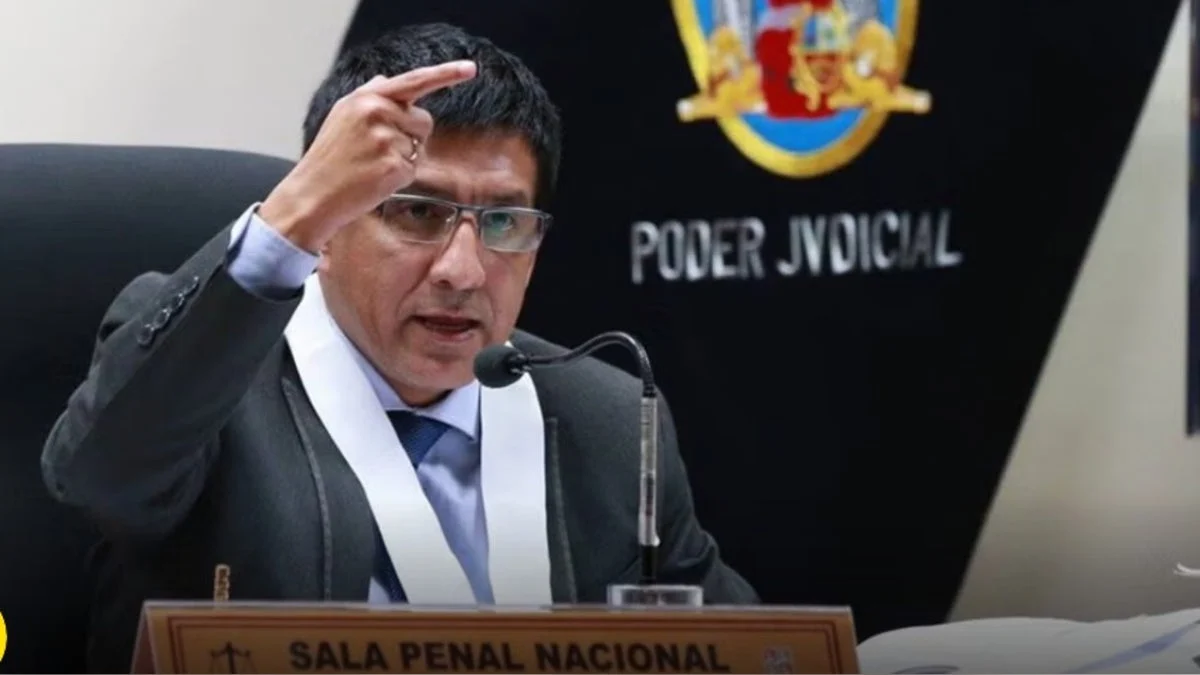
In a move that has sent shockwaves through the Peruvian legal establishment, the National Board of Justice (Junta Nacional de Justicia – JNJ) voted by majority this Friday to remove Richard Concepción Carhuancho from his post as Judge of the Preparatory Investigation of the National Superior Court of Specialized Criminal Justice. The decision, which marks the end of a high-profile judicial career characterized by its proximity to the most sensitive corruption cases in the country, centers on allegations of administrative negligence regarding the processing of legal appeals in the high-stakes “Los Waykis en la Sombra” (The Shadows’ Allies) case.
The Core Allegation: Procedural Delay as a Disciplinary Offense
The JNJ’s decision, spearheaded by the board’s president, María Teresa Cabrera Vega, hinges on the assertion that Judge Concepción Carhuancho failed in his functional duties by allegedly delaying the processing of an appeal filed by Mateo Castañeda, a key figure in the “Los Waykis en la Sombra” investigation.
The JNJ’s investigation concluded that the judge’s handling of the appeal violated procedural timelines, thereby infringing upon the due process rights of the parties involved. For the majority of the board—including members Cayo Galindo, Rafael Ruiz Hidalgo, and Germán Serkovic—the delay was not merely a clerical error but a significant omission that warranted the most severe disciplinary sanction: removal from the bench. Conversely, Jaime de la Puente Parodi stood as the lone dissenting voice, arguing that the sanction was disproportionate and lacked sufficient evidence of intent or systemic obstruction.
Chronology of the Conflict
To understand the magnitude of this decision, one must trace the timeline of the legal entanglement that led to the removal of one of Peru’s most recognized judges.
The Rise of the "Los Waykis en la Sombra" Case
The case emerged as a focal point of anti-corruption efforts in Peru, targeting individuals suspected of influence peddling and the formation of a criminal network within the inner circles of political power. Judge Concepción Carhuancho, known for his firm stance in previous landmark corruption cases, presided over the preliminary stages, including the imposition of preventive detention orders.
The Habeas Corpus Offensive
Mateo Castañeda, acting as both an attorney and a defendant within the broader legal matrix of the case, filed a constitutional habeas corpus challenge. Castañeda argued that his fundamental rights were being violated by the judiciary, specifically citing an inexcusable delay in the notification of his preventive detention order and a protracted wait time for his appeal to be elevated to the superior court.
The Tribunal Constitucional (TC) Intervention
The Peruvian Constitutional Tribunal (TC) reviewed Castañeda’s habeas corpus appeal and, in a landmark ruling, declared it well-founded. The TC did not merely stop at criticizing the procedural delays; it explicitly ordered that the findings be forwarded to the JNJ for disciplinary review. This ruling effectively opened the floodgates for the JNJ to initiate the proceedings that ultimately resulted in the judge’s removal this week.
Supporting Data and Procedural Context
The JNJ’s disciplinary process was based on the premise of "functional omission." Under Peruvian judicial law, a judge is responsible for the timely administration of justice. Critics of the JNJ’s decision argue that the administrative burden currently placed on the National Superior Court of Specialized Criminal Justice makes such delays almost inevitable.
Data from the court system suggests that judges handling high-complexity corruption cases are often overwhelmed by massive volumes of documentation and simultaneous appeals. Supporters of Concepción Carhuancho point out that his track record includes the management of thousands of pages of evidence in the Odebrecht and related systemic corruption cases. They argue that the JNJ has applied a "zero-tolerance" standard to a procedural delay that, in any other context, might have resulted in a warning or a minor fine rather than a career-ending destitution.
The case against the judge was not merely about the calendar; it was about the perception of impartiality. By failing to process the appeal of a defendant in a timely manner, the judge created a window for the defense to claim that the judiciary was actively preventing the defendant from seeking justice at a higher court, thereby undermining the perceived integrity of the court’s proceedings.
Official Responses and Public Reaction
The decision has polarized the legal community in Peru.
The JNJ’s Stance
For the National Board of Justice, the decision is a matter of maintaining the discipline and efficiency of the judiciary. President María Teresa Cabrera Vega has emphasized that the JNJ’s duty is to uphold the standard of conduct expected of all magistrates. "The law is blind to the profile of the judge," a source close to the board indicated. "If there is a procedural violation that harms the due process of the parties, the board must act, regardless of the judge’s previous reputation."
The Defense of Richard Concepción Carhuancho
Legal analysts and observers close to the judge have described the removal as "political interference disguised as administrative discipline." They argue that the TC’s ruling, which catalyzed this process, was influenced by legal maneuvers aimed at weakening the judiciary’s ability to combat organized crime. The removal is being interpreted by many as a tactical victory for those under investigation in the “Los Waykis en la Sombra” case, effectively neutralizing a judge who had shown no hesitation in ordering preventive detention for high-profile figures.
Civil Society and International Observers
International NGOs monitoring the rule of law in Latin America have expressed concern. The removal of a judge who has consistently sat in judgment of powerful figures often serves as a "chilling effect" on other judges. Many wonder if this will deter future magistrates from issuing strict rulings in high-level corruption cases for fear of facing similar disciplinary scrutiny.
Broader Implications for the Peruvian Judiciary
The removal of Richard Concepción Carhuancho is not an isolated event; it represents a deeper crisis of confidence within the Peruvian judicial system.
1. The Weaponization of Disciplinary Procedures
There is a growing concern that disciplinary bodies like the JNJ are being used to purge judges who are perceived as "inconvenient" to political or legal interests. By focusing on minor procedural lapses, opposing parties can effectively "judge the judge," turning a disciplinary hearing into a tool for legal warfare.
2. The Future of Specialized Courts
The National Superior Court of Specialized Criminal Justice was created to handle the most complex cases of organized crime and corruption. If the judges within this system are removed for procedural delays—even when those delays may be the result of a lack of resources or the sheer volume of work—the entire efficacy of the specialized court system is brought into question.
3. The Erosion of Judicial Independence
The most profound implication is the potential erosion of judicial independence. If judges feel that their tenure is contingent upon not making a single administrative error that could be challenged by a well-funded legal defense team, they may become overly cautious or, conversely, susceptible to external pressures. The removal of a high-profile judge for a technicality sends a signal to the entire judiciary that no one is immune to internal removal processes if they cross the wrong legal or political lines.
Conclusion: A Turning Point?
As the dust settles on the JNJ’s decision, the Peruvian legal landscape faces a period of intense reflection. Was this a necessary correction to ensure that the rights of defendants are protected, or was it a calculated strike against a magistrate who had become an obstacle to those under investigation?
The legacy of Richard Concepción Carhuancho remains complex. To some, he is a symbol of the fight against corruption, a man who brought the law to those who believed they were above it. To others, the administrative lapses in the “Los Waykis en la Sombra” case were proof that the judge allowed his pursuit of the case to overshadow the very rules of law he was meant to protect.
Regardless of one’s perspective, the decision by the JNJ will resonate for years to come. It serves as a stark reminder that in the arena of Peruvian justice, the line between procedural diligence and administrative disaster is razor-thin, and that the judges who hold the power to decide the fate of others are, ultimately, subject to the cold, often unforgiving mechanisms of the disciplinary systems that oversee them. The departure of Concepción Carhuancho will fundamentally alter the composition of the court and, potentially, the trajectory of the high-stakes cases he leaves behind.