The landscape of Peruvian politics is bracing for a seismic shift as the National Jury of Elections (JNE) has clarified the rigorous participation requirements for the 2026 Regional and Municipal Elections (ERM). In a move that transcends mere electoral participation, the decision serves as a survival test for the country’s political organizations. Failure to meet these thresholds will not only result in disqualification from the ballot but will trigger the cancellation of a party’s registration, effectively erasing them from the legal political map as of January 1, 2027.
The Core Mandate: Understanding the 50/20 Rule
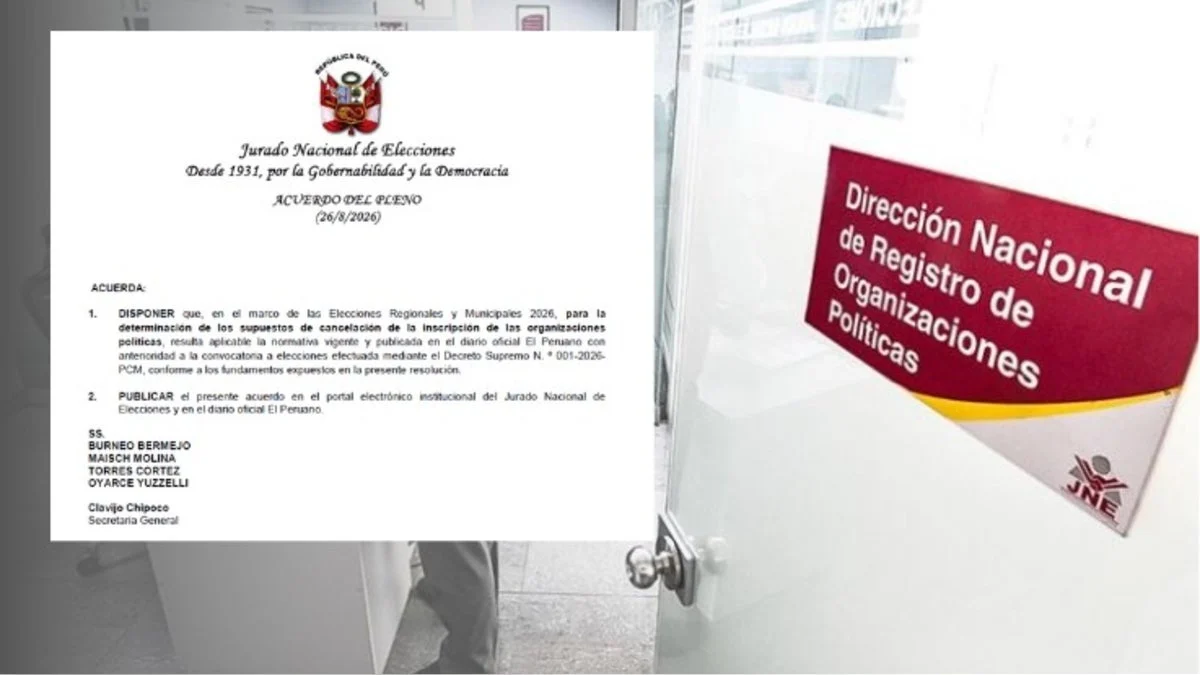
In a plenary agreement published in the official gazette El Peruano on September 5, the JNE set clear, non-negotiable quantitative benchmarks. To maintain their legal status, political parties must demonstrate national reach and structural robustness.
Specifically, the JNE requires:
- Regional Participation: Parties must field candidates in at least 50% of the country’s 25 regions. This translates to a minimum of 13 regional gubernatorial or council tickets.
- Municipal Participation: Parties must present candidates in at least 20% of the existing 196 provincial mayoralties. This equates to a minimum of 40 provincial lists.
The JNE emphasized that these are not cumulative requirements but dual mandates; failing to reach either of these thresholds puts a party’s registration in immediate jeopardy. By establishing these percentages, the electoral authority aims to prevent "electoral entrepreneurship"—the practice of creating parties with only localized or negligible influence—and instead incentivizes the growth of parties with genuine national capacity.
Chronology of a Regulatory Conflict
The path to this decision has been fraught with legislative friction between the electoral authorities and the Peruvian Congress.
- June 2024: The Congress of the Republic approved Law No. 32657, which sought to lower the bar for parties to maintain their registration. The law proposed a reduction from the historical 50% requirement down to just 30% for regional participation. Crucially, this law was passed after the subnational electoral process had already commenced, drawing immediate criticism from electoral experts and the JNE.
- September 5, 2024: The JNE Plenary issued its definitive ruling. By invoking the Law of Political Organizations, the JNE effectively rendered Law No. 32657 inapplicable for the 2026 ERM. The JNE argued that changing the rules of the game mid-process violates the principle of electoral stability and legal certainty.
- Post-2026 Outlook: The JNE has made it clear that the criteria are fixed. Any party failing to meet the 50% regional or 20% provincial threshold by the conclusion of the 2026 elections will be struck from the Registry of Political Organizations (ROP) on the first day of 2027.
Supporting Data and the Risk to Party Survival
The implications for parties that cannot meet these thresholds are catastrophic. Losing registration is not merely a bureaucratic inconvenience; it is a "death sentence" for a political organization. Once a party is de-registered, it loses its legal personality, its assets, and its ability to participate in future elections.
To return to the political arena, a de-registered party must restart the entire grueling process of legalization from scratch:
- Massive Signature Collection: Collecting hundreds of thousands of signatures from citizens to support a new registration.
- Affiliation Quotas: Accredit more than 25,000 active, verified members.
- National Infrastructure: Prove the legal constitution of party committees in every region of the country, ensuring the party is not just a Lima-centric entity.
José Tello, a prominent expert in electoral legislation, points out that the Partido Cívico Obras is currently the most vulnerable organization. According to Tello’s analysis, Obras is currently failing to meet both the 13-region requirement and the 40-province requirement. "If they do not reach the minimums in both scenarios, they lose their registration. This is a direct consequence of the results of the primary elections," Tello stated.
Official Responses and Internal Panic
The warning from the JNE has sent shockwaves through party headquarters. While some established parties have the machinery to meet these requirements, others are scrambling to form alliances or expand their reach in the final months before the filing deadlines.
In an interview with El Poder en tus Manos, the coverage platform of RPP, Susana Carazas, a representative (personera) for the Partido Obras, acknowledged that the party leadership is fully aware of the JNE’s mandate. However, she hinted at a broader crisis within the political system. "We are going to analyze the situation and evaluate what actions the executive committee and the political commission will take. We will assess the regulation carefully, because if we are in this position, we would certainly not be the only party at risk," Carazas noted.
This statement highlights the fragility of the current political system, where even parties that recently managed to secure seats in Congress are finding that their national organizational depth is insufficient to meet the JNE’s standards.
The Economic Impact: The Loss of Public Funding
Perhaps the most stinging consequence for parties like Obras—which managed to gain representation in the new dual-chamber Parliament (Deputies and Senators) during the 2026 General Elections—is the loss of Direct Public Financing.
José Manuel Villalobos, another expert in electoral law, clarifies that the cancellation of registration is terminal for financial health. "Because the cancellation of the registration means the party loses its legal representation and its legal personality ceases to exist, the ONPE (National Office of Electoral Processes) will no longer be able to disburse the money corresponding to public funding," Villalobos explained.
The financial stakes are staggering. Should Obras lose its registration, it stands to forfeit approximately S/ 32,457,266.94. These funds are earmarked for the five-year parliamentary period between July 27, 2026, and July 26, 2031. Losing this funding does not just impact the party’s day-to-day operations; it hampers the ability of the party’s elected representatives to conduct research, maintain offices, and engage in legislative activity, effectively neutralizing their presence in the halls of power.
Implications for the Future of Peruvian Democracy
The JNE’s decision is a clear attempt to force "institutionalization" upon a political system that has long been criticized for fragmentation and "rental" parties. By setting these bars, the JNE is effectively pruning the political forest, forcing smaller parties to merge, consolidate, or vanish.
However, critics argue that such high barriers may inadvertently limit political plurality. If only the largest, most well-funded parties can survive the 50/20 rule, there is a risk that the political system will become an oligopoly, where the same established powers remain in control, and new, reformist, or regional movements are systematically excluded from the national conversation.
As January 1, 2027, approaches, the eyes of the nation will remain fixed on the ROP. The political parties of Peru are currently in a high-stakes race against the clock, not just for votes, but for their very existence. The 2026 Regional and Municipal Elections will be remembered not just for who won or lost the regional governorships, but for which parties survived the audit of the National Jury of Elections.
The message from the electoral authority is clear: in the new Peruvian political order, a party must be a national institution or it will cease to be a party at all.