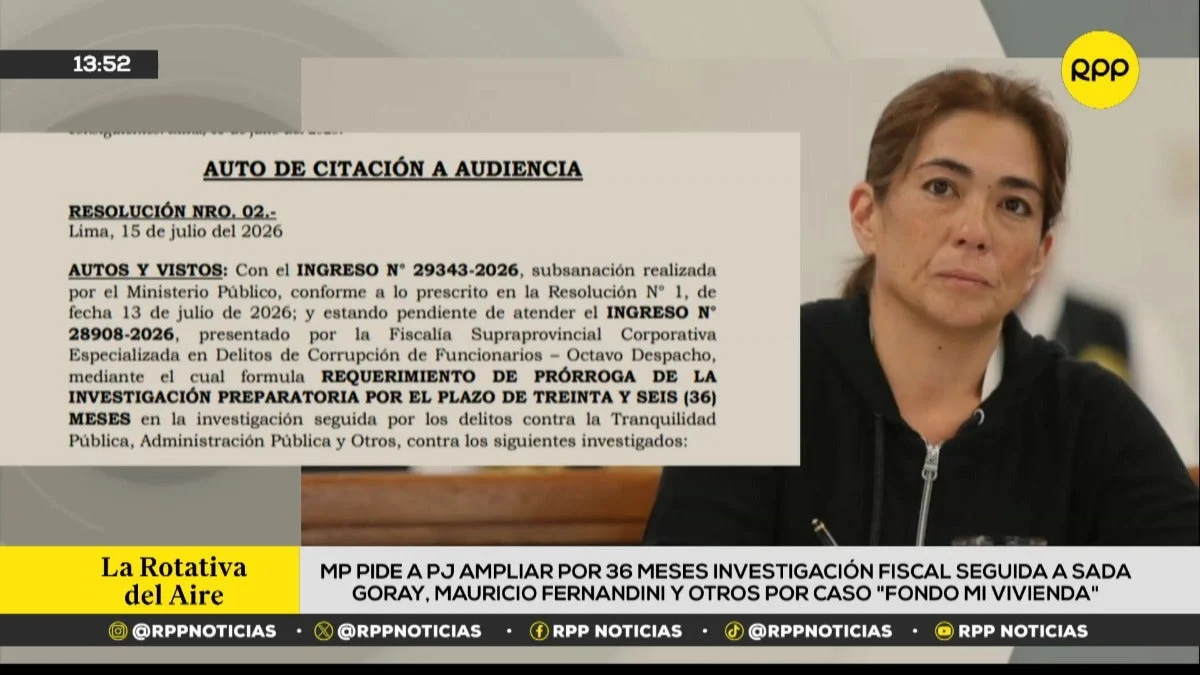
The request, filed by the Specialized Prosecution Office against Corruption of Officials, aims to ensure the completion of critical investigative procedures involving businesswoman Sada Goray and journalist Mauricio Fernandini.
The legal proceedings surrounding the sprawling corruption scandal known as the "Fondo Mi Vivienda" case have entered a new, critical phase. The Public Ministry of Peru has officially requested the Judiciary to grant a 36-month extension to the preparatory investigation currently targeting businesswoman Sada Goray, former journalist Mauricio Fernandini, and several other high-profile associates. This move signals that the prosecution requires significantly more time to untangle the complex web of bribery and influence-peddling that allegedly permeated the administration of former President Pedro Castillo.
The request was formally submitted by the Eighth Office of the Supraprovincial Corporate Prosecution Specialized in Corruption of Officials. The document argues that the extension is not merely a procedural formality but a necessity to carry out pending forensic and investigative diligences. The prosecution asserts that these steps are vital for the complete clarification of the facts and, crucially, to prevent the potential for impunity in one of the most significant corruption inquiries of the current decade.
The Court’s Response and Upcoming Schedule
The request is now in the hands of the Judiciary. Judge Lorena Sandoval, who oversees this stage of the process, has scheduled a virtual hearing for August 12 at 11:00 a.m. During this session, the judge will evaluate the prosecution’s petition. Legal representatives for all parties involved, including the defense teams for Goray and Fernandini, are expected to participate. A final ruling on the extension is anticipated to be delivered shortly after the hearing, potentially setting the timeline for the legal battle for the next three years.
Chronology of the Scandal
The "Fondo Mi Vivienda" case is not an isolated incident but rather the result of an intricate scheme that allegedly compromised the integrity of the Ministry of Housing, Construction, and Sanitation during the Castillo administration.
The Origins of the Scheme
The investigation gained traction following the revelations made by Sada Goray, who admitted to the Public Ministry that she had paid more than four million soles in cash to Salatiel Marrufo, the former Chief of the Cabinet of Advisors at the Ministry of Housing. The objective of these payments was clear: to ensure that her company, Markagroup SAC, would be awarded lucrative contracts and beneficial regulatory changes within the sector.
The Role of Mauricio Fernandini
The inclusion of journalist Mauricio Fernandini in the investigation brought the case to the forefront of national media attention. Fernandini is accused of acting as a facilitator, allegedly arranging meetings between Goray and government officials, including Marrufo, to grease the wheels of the influence-peddling scheme. His involvement transformed the narrative from a corporate corruption story into a wider scandal involving media and political power dynamics.
The Formation of the Special Team
Following the initial testimonies, the Special Team of Prosecutors against Corruption in Power (EFICCOP) was tasked with dismantling the structure. Throughout 2023 and 2024, the team executed a series of detention orders, asset seizures, and testimonial gathering, which slowly began to reveal the magnitude of the "Fondo Mi Vivienda" operation.
Supporting Data and Evidence of Corruption
The prosecution’s case rests on a mountain of evidence that points toward a systemic abuse of power. According to the fiscal theory of the case, the bribes paid by Goray were designed to manipulate the board of the Fondo Mi Vivienda—a state-run fund aimed at facilitating affordable housing. By placing allies in key decision-making positions, the group managed to direct state resources toward specific real estate projects linked to Markagroup.
Key elements of the evidence include:
- Financial Records: Detailed tracking of the cash transfers and electronic payments allegedly orchestrated by the defendants.
- Testimonial Evidence: The cooperation of key insiders, such as Salatiel Marrufo, whose plea deals have provided the prosecution with a roadmap of the corruption network.
- Regulatory Documentation: A timeline of policy changes within the Ministry of Housing that coincide with the meetings held between the private sector actors and government officials.
The prosecution contends that the 36-month extension is required because the investigation has grown significantly. As investigators follow the money trail, they have uncovered further connections that implicate more individuals and entities, necessitating a broader scope of inquiry than was originally anticipated.
Official Responses and Legal Perspectives
The defense teams for the accused have consistently maintained that the duration of the investigation is becoming excessive and infringes upon the constitutional rights of their clients. While the prosecution frames the extension as a battle against impunity, defense attorneys argue that the state is attempting to hold individuals under the "shadow of suspicion" without having finalized a formal indictment.
"The extension request is an admission that the Public Ministry does not yet have a solid case to take to trial," stated one legal analyst familiar with the proceedings. However, the prosecution remains steadfast, arguing that in complex white-collar crimes involving high-ranking public officials, the evidentiary hurdles are inherently higher and require the full extent of the law to properly document.
The Broader Implications for the Peruvian Judiciary
The request for a 36-month extension highlights several broader themes in the current Peruvian political and judicial landscape:
1. The Burden of High-Stakes Investigations
The sheer volume of corruption cases stemming from the Pedro Castillo administration has put immense pressure on the Peruvian judicial system. The "Fondo Mi Vivienda" case is just one of many, and the request for such a long extension indicates that the system is struggling to process these high-profile crimes with the speed the public expects.
2. The Fight Against Corruption
For the Public Ministry, the outcome of this case is a litmus test for the independence and effectiveness of the Special Team against Corruption in Power. If the judiciary denies the extension, it could effectively end the investigation prematurely. If it grants it, the prosecution will be under immense pressure to deliver a conviction at the end of that three-year period.
3. Public Perception and Accountability
The public discourse surrounding the case remains polarized. While some see the prosecution’s persistence as a necessary step toward holding the powerful accountable, others view the length of the proceedings as a symptom of a judicial system that is overly reliant on prolonged pre-trial investigations rather than timely trials.
Conclusion
As the date for the August 12 hearing approaches, all eyes will be on Judge Lorena Sandoval. The decision to grant or deny a 36-month extension will not only determine the future of Sada Goray and Mauricio Fernandini but will also serve as a defining moment for the integrity of the justice system in Peru. Whether the case will result in a landmark corruption conviction or whether it will continue to be mired in procedural delays remains to be seen. What is certain, however, is that the "Fondo Mi Vivienda" case will remain a focal point of the national agenda, symbolizing the deep-seated challenges the country faces in addressing systemic corruption within its executive branches.