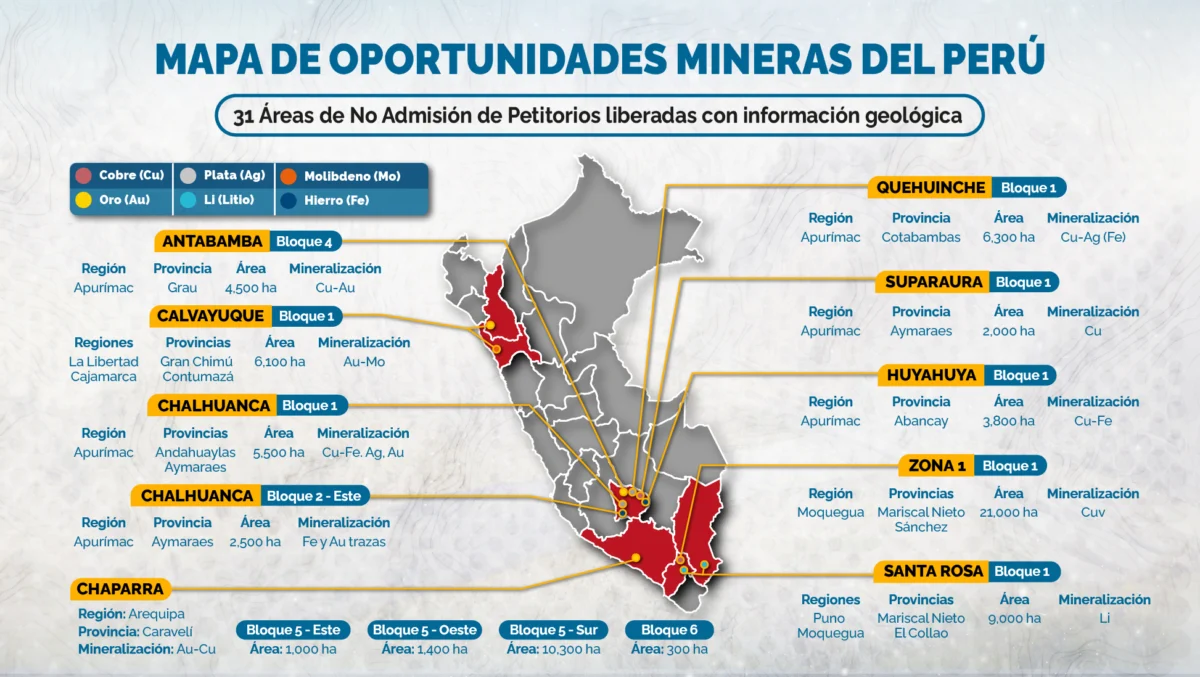
In a significant move to invigorate the national mining sector and stimulate geological investment, the Geological, Mining, and Metallurgical Institute (Ingemmet) has officially announced the release of 31 Areas of Non-Admission of Petitions (ANAP). Published in the official gazette El Peruano, this decision marks a pivotal moment for Peru’s extractive industry, aiming to reduce exploratory risk and provide high-quality geoscientific data to both domestic and international investors.
The initiative, governed by Supreme Decree No. 020-2020-EM and the Single Consolidated Text of the General Mining Law, underscores the Peruvian government’s commitment to transparency and technical rigor in the management of its vast mineral wealth. By transitioning these restricted zones into open, claimable areas, Ingemmet is effectively unlocking approximately 289,100 hectares of land that show strong promise for the extraction of gold, copper, iron, silver, and molybdenum.
The Strategic Framework: Understanding the ANAP Process
The Areas of Non-Admission of Petitions (ANAP) are regions where the state temporarily restricts the filing of new mining petitions to conduct exhaustive geological research. This process is not merely administrative; it is a scientific endeavor led by Ingemmet’s Directorate of Mineral and Energy Resources.
By conducting these evaluations, Ingemmet identifies areas with high mineral potential, thereby mitigating the "blind" exploration risk that often plagues mining projects. When these areas are deemed ready, they are "liberated," allowing the private sector—ranging from small-scale miners to larger exploration firms—to apply for mining concessions based on verified, reliable technical data.
This strategic release is scheduled to culminate in a "Free Denunciability" (Libre Denunciabilidad) event on August 3, 2026. This date represents a major window of opportunity for the mining industry to secure rights to lands that have been vetted by the country’s leading geological authority.
Chronology of the Initiative
The journey to the August 3, 2026, release has been a multi-year project involving rigorous field work and data synthesis:
- Preliminary Geological Mapping: Over several years, Ingemmet’s teams conducted regional surveys to identify anomalies and geological structures favorable for mineralization.
- Regulatory Compliance: Following the guidelines set by Supreme Decree No. 020-2020-EM, Ingemmet verified the status of existing mining rights to ensure no overlaps or legal disputes would hinder the release process.
- Data Compilation: The technical data gathered was integrated into the GEOCATMIN platform, the state’s digital repository of geoscientific information.
- Official Publication (July 2026): The formal announcement in El Peruano served as the final legal notification, officially clearing the path for the August auction/application process.
- The August 3, 2026, Deadline: This is the milestone date when these 31 areas will officially enter the public domain for new petition filings.
Regional Breakdown: Key Opportunities
The 31 areas released are not geographically uniform; they represent diverse geological environments, each with unique mineral signatures and economic potential.
The Apurímac Corridor
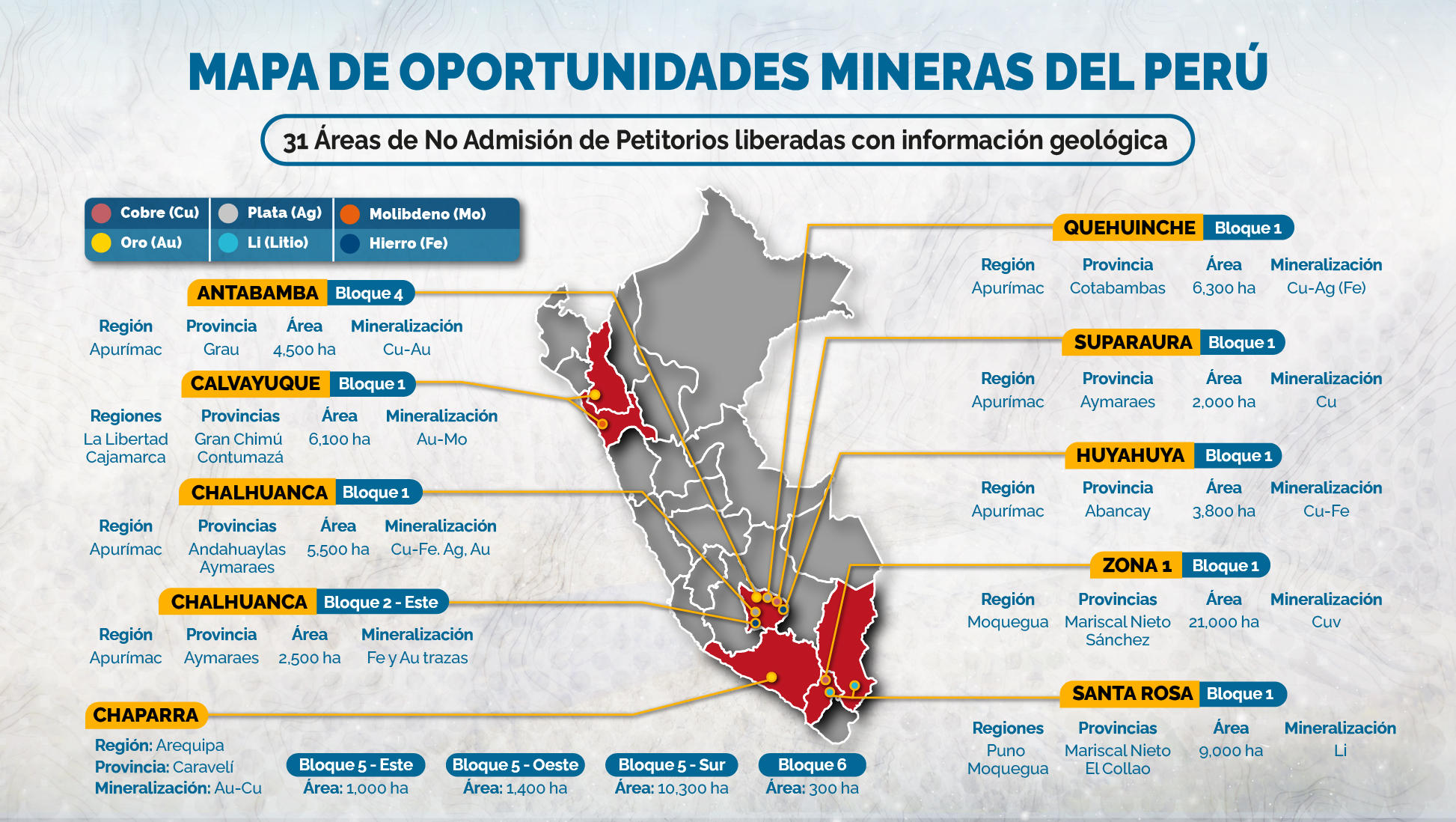
Apurímac remains one of the most promising regions for copper-related exploration. The areas designated as Suparaura, Chalhuanca, Huyahuya, and Quehuinche are particularly noteworthy. These zones exhibit clear indicators of porphyry-type deposits, which are often rich in copper and are frequently associated with secondary occurrences of iron, silver, and gold. For companies looking to expand their footprint in southern Peru, this region represents a high-priority exploration frontier.
The Auriferous Heart of Arequipa
In the province of Caravelí, the ANAP Chaparra area has been identified as a critical corridor for gold mineralization. Ingemmet has subdivided this region into distinct blocks, each offering different opportunities. The "5 Sur" and "6" blocks are specifically highlighted for their potential to host small-scale mining operations, where gold is concentrated in structures that are accessible and economically viable for smaller, more agile extraction teams. Meanwhile, the "5 Este" and "5 Oeste" blocks provide the geological foundation for more intensive, long-term exploration efforts.
Moquegua and the North
In the southern region of Moquegua, the ANAP Zone 1, Block 1, encompasses a massive 21,000-hectare tract. This area is characterized by significant copper anomalies, making it a target of interest for those seeking to capitalize on the global transition toward copper-dependent green technologies.
Further north, the ANAP Calvayuque—straddling the regions of La Libertad and Cajamarca—offers a different profile, focusing on gold and molybdenum. This area is particularly strategic given the existing mining infrastructure in the northern Andes, which could potentially lower the logistics costs for new exploration projects.
Official Perspectives: Ingemmet’s Vision
Ing. Paolo Andrés Alzamora, the Executive President of Ingemmet, emphasized that the primary goal of this initiative is to foster a more predictable mining landscape.
"The objective of liberating these areas is to provide greater predictability and transparency to the process of granting mining concessions," Alzamora stated. "The geological information generated by Ingemmet allows investment to be directed toward areas with the best prospects, reducing exploratory risk and optimizing decision-making from the initial stages of exploration."
Alzamora’s vision reflects a shift toward "data-driven mining." By providing investors with a "roadmap" of where the mineral potential is highest, the government is not only protecting the environment by preventing unnecessary exploration in unproductive areas but also ensuring that the capital that is invested is used efficiently.
Implications for the Mining Industry and the Peruvian Economy
1. Promoting Small-Scale Mining
One of the most notable aspects of the 31-area release is its specific focus on the small-scale mining sector. By selecting areas with proven gold and mineral potential, Ingemmet is providing a structured pathway for informal or small-scale miners to formalize their operations within the legal framework of the state. This is a vital component of Peru’s strategy to curb illegal mining, which often operates without oversight or environmental safety standards.
2. Reducing Financial Uncertainty
For exploration companies, the cost of "greenfield" exploration is exorbitant. By providing free access to the technical reports and geological surveys associated with these 31 ANAP areas, Ingemmet is essentially subsidizing the initial discovery phase for the private sector. This reduction in the "cost of entry" makes Peru a more competitive destination for global mining investment compared to other jurisdictions in Latin America.
3. Strengthening the GEOCATMIN Ecosystem
The release of these areas highlights the importance of the GEOCATMIN platform. This digital tool has evolved into an essential instrument for the mining sector. By centralizing geochemical, geophysical, and geological data, Ingemmet is setting a standard for digital governance in the mining sector. Investors can view the 31 areas on the platform, access drill-hole logs (where available), and download detailed maps that define the structural geology of the zones.
Future Outlook: A Sustained Commitment to Geoscience
The release of the 31 ANAP areas is not a one-time event, but rather a continuation of Ingemmet’s mandate to map the entirety of Peru’s subsurface. As global demand for critical minerals—such as copper for electrification and gold for economic stability—continues to rise, the importance of this geological inventory cannot be overstated.
Ingemmet has confirmed that it will continue to conduct complementary studies to refine the data on these areas. Furthermore, the agency is committed to expanding its research into other parts of the country, ensuring that as mining projects conclude or areas are abandoned, the land is assessed and, if appropriate, made available for new, more efficient exploration projects.
For stakeholders interested in these opportunities, the process is clear:
- Access: Review the technical data available via the Ingemmet website.
- Analyze: Utilize the GEOCATMIN platform to evaluate the mineral prospects of each block.
- Prepare: Ensure all legal and administrative requirements are met prior to the August 3, 2026, event.
The release of these 289,100 hectares is a clear signal that Peru remains open for business and is actively utilizing the power of geosciences to sustain its status as a global mining powerhouse. Whether for a multinational corporation looking to add to its portfolio or a local entrepreneur looking to develop a small-scale deposit, the opportunities presented by this initiative are as vast as the terrain itself.