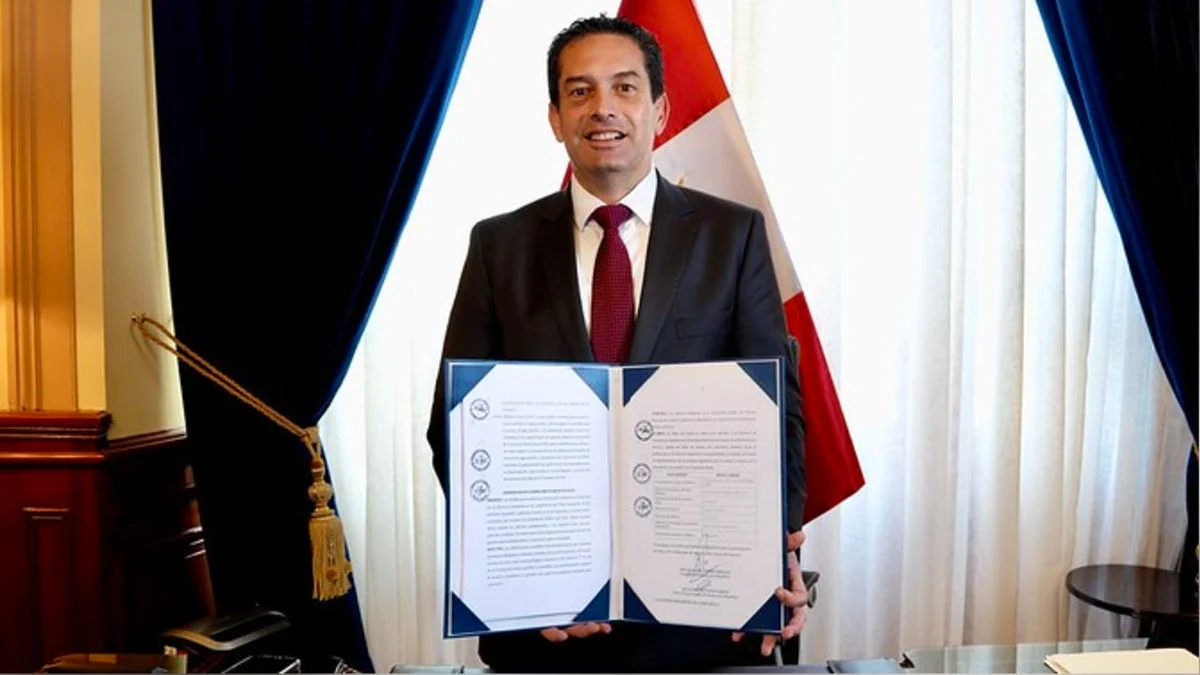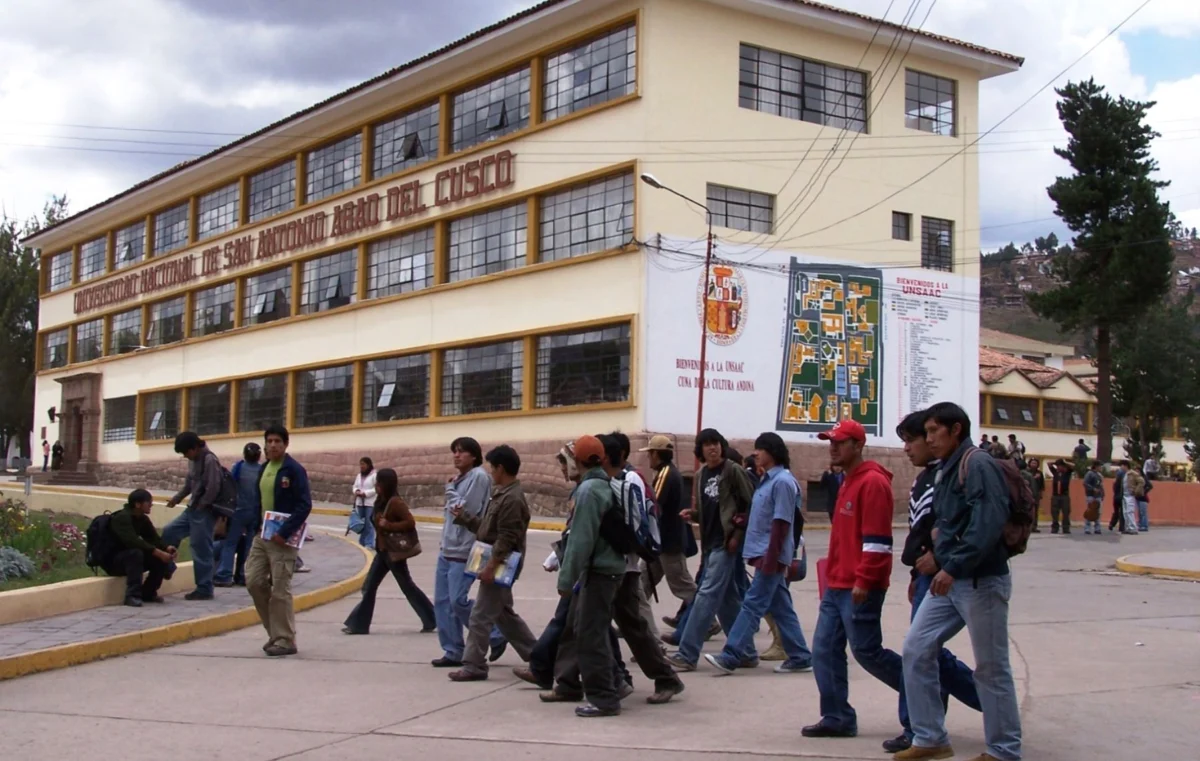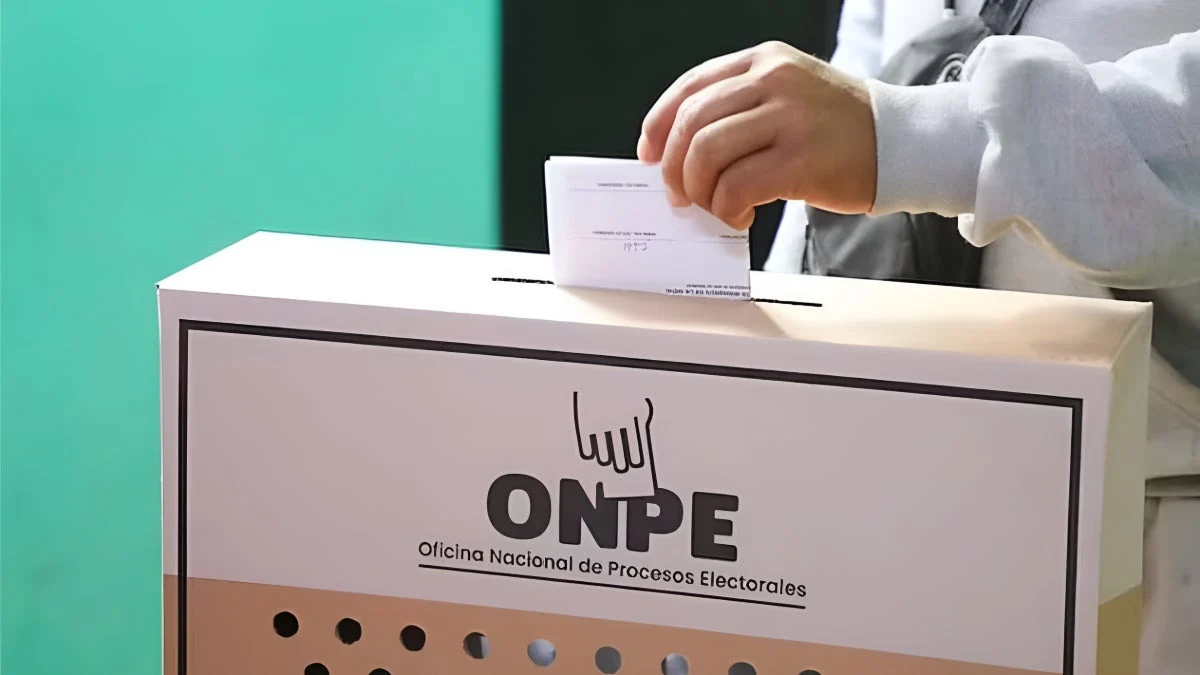
The electoral map of Peru has undergone a significant transformation following the conclusion of the vote count by the National Office of Electoral Processes (ONPE). As the nation transitions into a new political cycle, the results from the 2026 Regional and Municipal Elections offer a clear picture of shifting alliances, the rise of regional movements, and the necessity of runoff elections in key departments.
The dust has settled on the initial count. With 100% of the voting records processed, the electorate has signaled a diverse preference for governance, leading to a mix of decisive first-round victories and intense "balotaje" (runoff) scenarios.
1. The Main Facts: Defining the 2026 Electoral Map
The 2026 elections have served as a litmus test for the strength of both traditional political parties and emerging regional movements. While some regions have already confirmed their governors for the 2027–2030 term, others remain in a state of suspense as the top two candidates prepare for a decisive second round.
The critical threshold for victory in the first round is 30% of valid votes. Where no candidate surpassed this margin, the law mandates a runoff between the two highest-polling contenders. This mechanism ensures that the eventual winner holds a more robust mandate from the population.
Key highlights of the results:
- Decisive Wins: Regions like Apurímac, Callao, Cusco, Huancavelica, and San Martín have successfully elected their governors in the first round, avoiding the logistical and political burden of a second vote.
- The Runoff Trend: Major political hubs, including Arequipa, Junín, Lima, and Puno, are headed to a second round, underscoring a high degree of fragmentation in the vote.
- Administrative Next Steps: While the ONPE has finalized the counts, the formal proclamation of winners and the official scheduling of runoffs will be conducted by the National Jury of Elections (JNE) via official resolution.
2. Detailed Regional Breakdown: Victories and Runoffs
To understand the political pulse of the country, it is essential to analyze the specific outcomes in the regions where the ONPE has concluded its tallies.
Regions with Decisive First-Round Victories
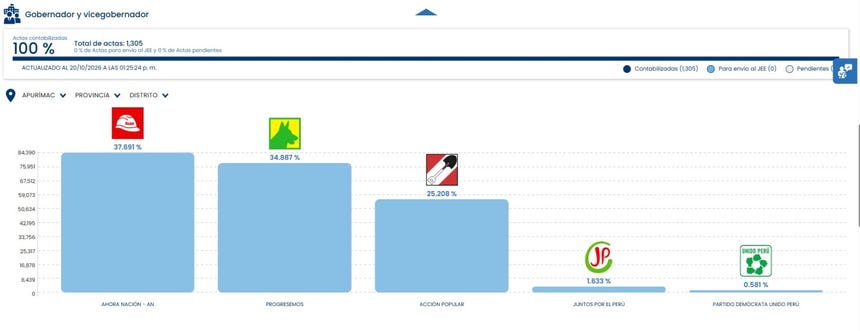
- Apurímac: Elvyn Samuel Diaz Tello (Ahora Nación) secured a solid victory with 37.6% of valid votes.
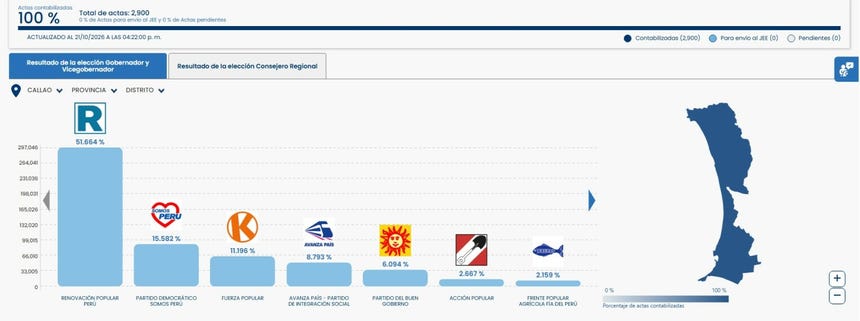
- Callao: Pedro Spadaro, representing Renovación Popular, dominated the race in the Constitutional Province with 51.6% of the votes, comfortably bypassing any requirement for a second round.
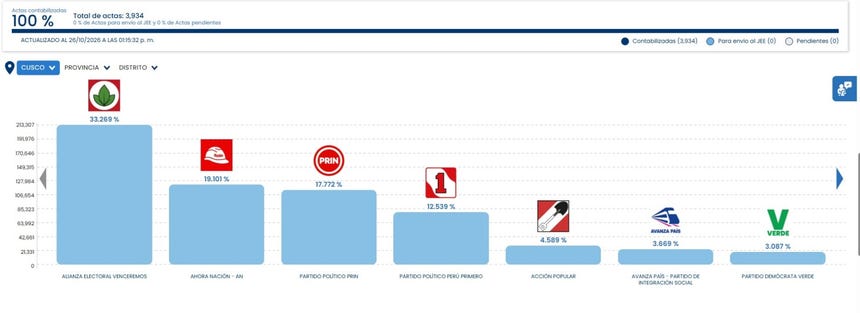
- Cusco: In a closely watched race, Verónika Mendoza, running under the Alianza Electoral Venceremos, claimed the governorship with 33.269% of the vote.
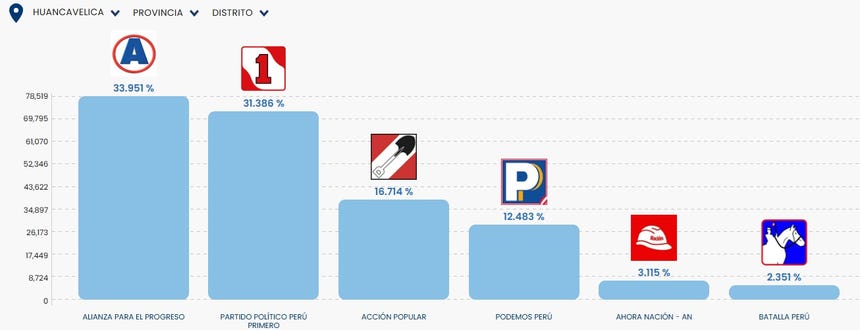
- Huancavelica: Juan Carlos Común (Alianza para el Progreso) emerged as the victor with 33.9% of valid votes.
- San Martín: Máximo Cabrera (Avanza País) secured the regional leadership with 31.2% of the vote, clearing the 30% hurdle.
Regions Headed to Second Round (Balotaje)
The second round is where the real political maneuvering will occur in the coming weeks. The following regions are currently in the midst of preparing for these runoffs:
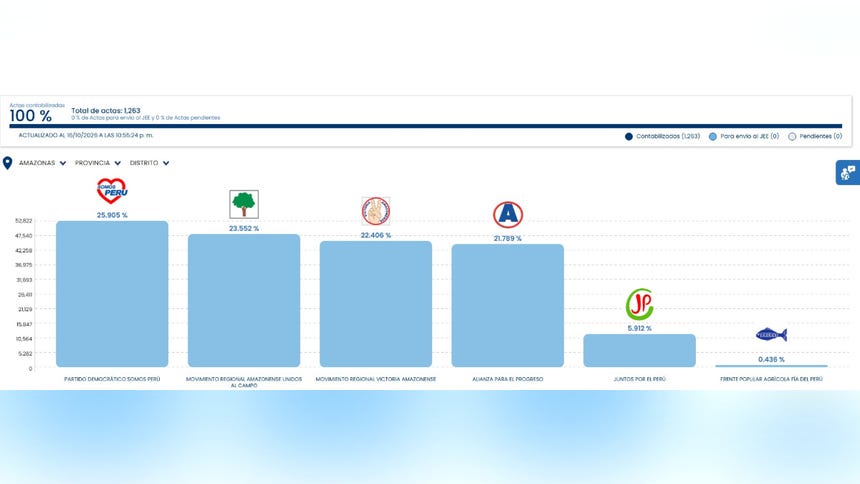
- Amazonas: Amílcar Díaz (Somos Perú, 25.9%) will face off against Segundo Hernández (Movimiento Regional Amazonense Unidos al Campo, 23.5%).
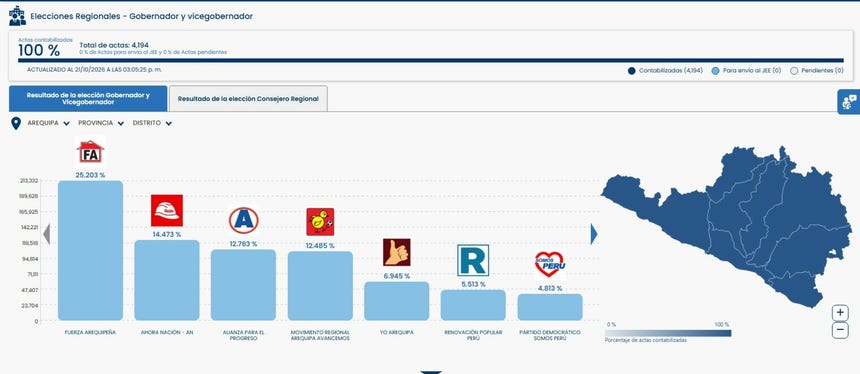
- Arequipa: A high-tension race between Florentino Zegarra (Fuerza Arequipeña, 25.2%) and Jenry Huisa (Ahora Nación, 14.4%).
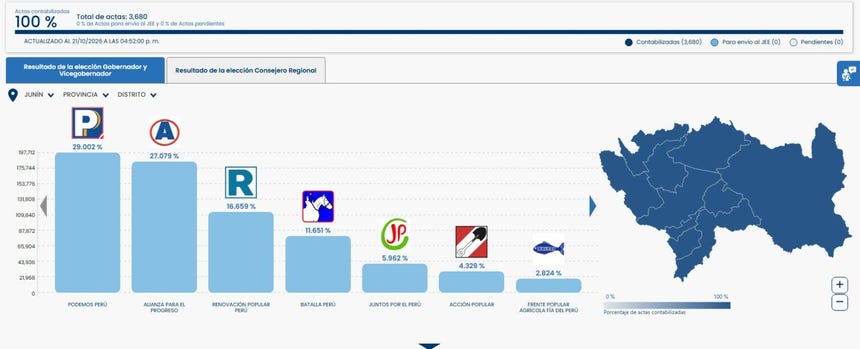
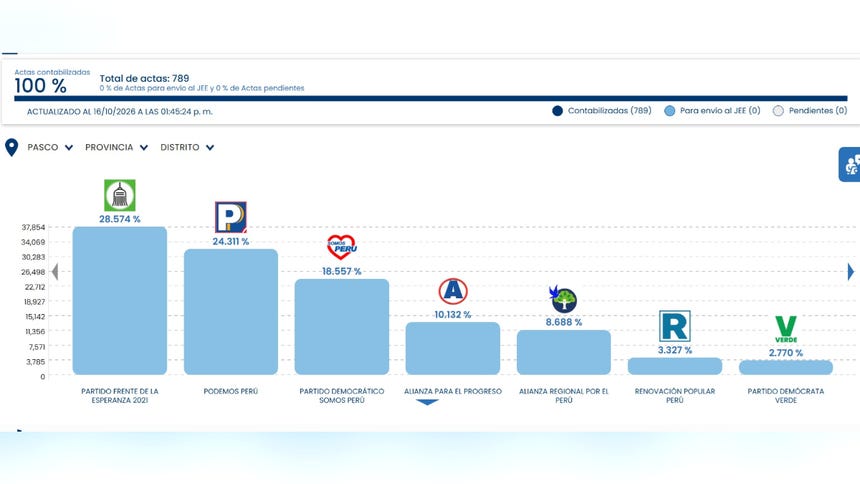
- Junín: Fernando Orihuela (Podemos Perú, 29.0%) and Arnoldo Mallma (Somos Perú, 27.0%) remain in a tight battle.
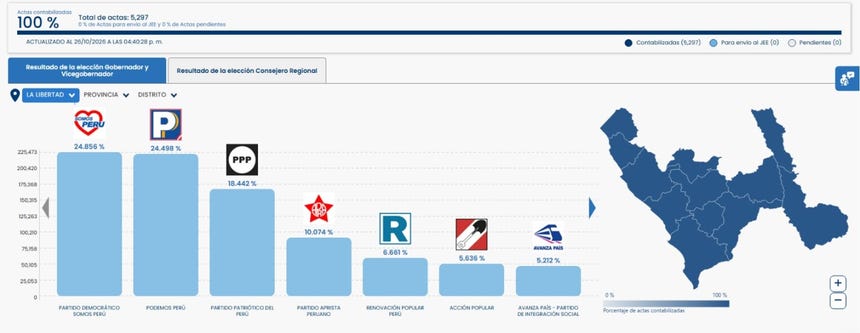
- La Libertad: Aldo Carlos Mariños (Somos Perú, 24.8%) and Elías Rodríguez (Podemos Perú, 24.4%) are separated by a razor-thin margin.
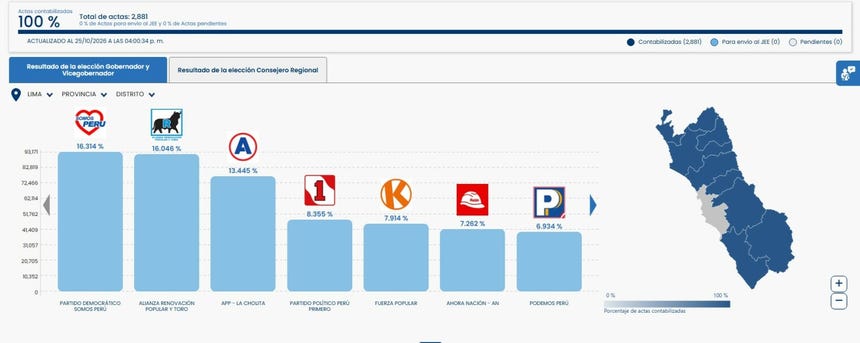
- Lima: A significant contest between Andrés Tello (Somos Perú, 16.3%) and Javier Alvarado (Renovación Popular, 16.0%).
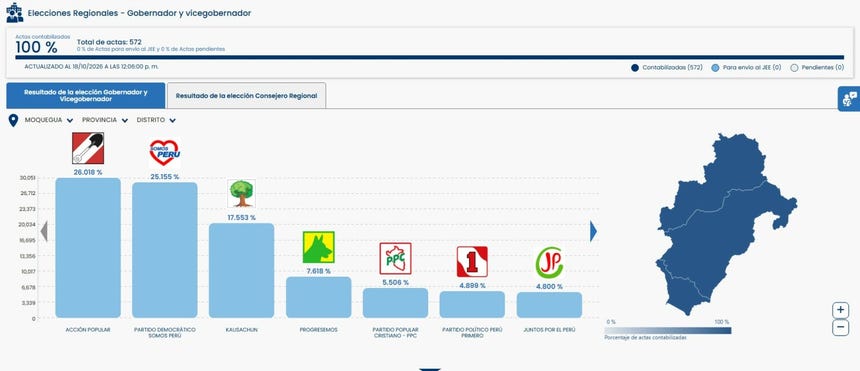
- Moquegua: Abraham Cárdenas (Acción Popular, 26.0%) and Juan Luis Herrera (Somos Perú, 25.1%) will define the regional future in the runoff.
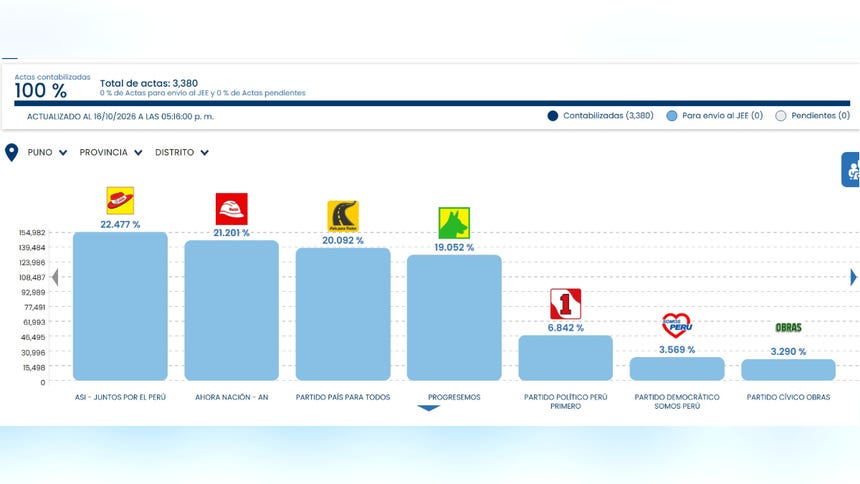
- Puno: Jhomar Tonconi (Así – Juntos por el Perú, 22.4%) and Eduardo Quispe (Ahora Nación, 21.2%) are preparing for a December 6th vote.
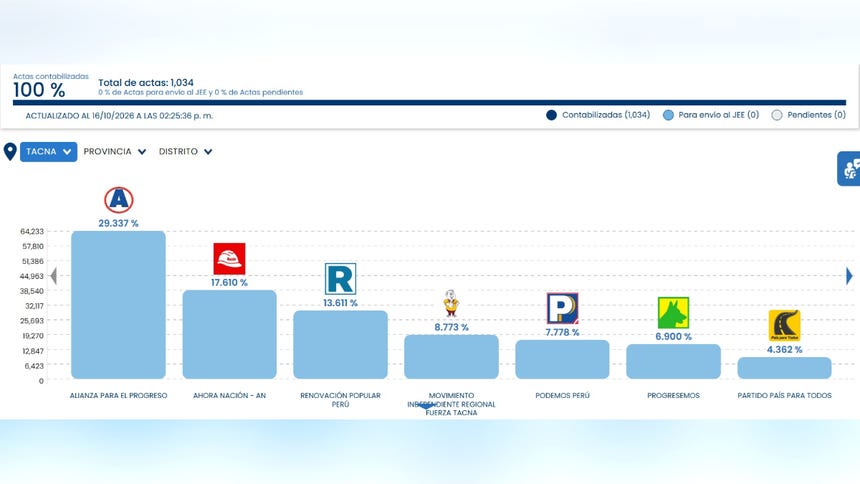
- Tacna: Segundo Ruiz Rubio (Alianza para el Progreso, 29.3%) leads, with Walter Anchapuri (Ahora Nación, 17.6%) trailing.
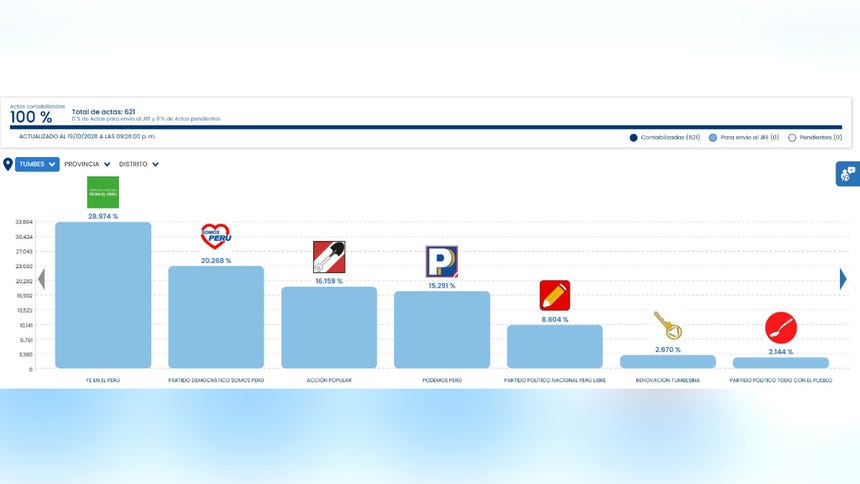
- Tumbes: Carlos Manuel Feijoo Ruiz (Fe en el Perú, 28.9%) and Luis Constantino Arévalo (Somos Perú, 20.2%) will vie for the governorship.
3. Supporting Data and Electoral Dynamics
The 2026 data reveals an interesting trend: the decline of monolithic party dominance in favor of regional platforms. In several departments, the difference between the first and second-place candidates is less than 2%, as seen in the cases of La Libertad and Lima. This indicates a deeply polarized electorate and a high degree of competition.
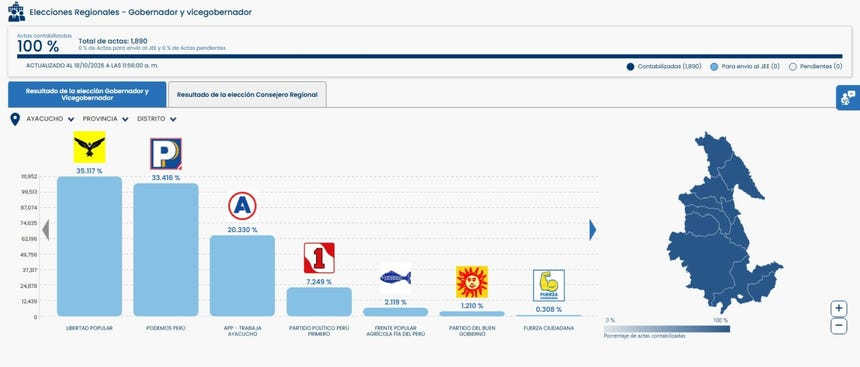
Furthermore, the "Ahora Nación" party has shown surprising resilience, appearing as a runner-up or winner in multiple disparate regions, such as Puno, Arequipa, and Apurímac. Conversely, "Somos Perú" has established itself as the most consistent political force nationwide, appearing in the runoff stages of nearly half of the regions mentioned.
4. The Legal and Institutional Framework
The entire process is governed by the Law of Regional Elections (Law No. 27683). Specifically, Article 5 serves as the anchor for the current electoral process. It dictates that if no candidate achieves the 30% threshold, the regional leadership cannot be declared, and a second round is mandatory.
The ONPE’s role has been purely administrative and technical—ensuring that every ballot is counted and verified. However, the final legal validity of these results rests with the JNE. The JNE is responsible for reviewing any potential challenges, overseeing the logistics of the upcoming runoffs, and eventually issuing the credentials to the winning candidates for the 2027–2030 term.
5. Implications for the Future of Peru
The results of the 2026 elections carry profound implications for the country’s political stability and development.
A Fragmented Governance
The necessity of a second round in over 60% of the country suggests that future regional governors will have to govern with a high degree of consensus-building. With no single party holding an absolute majority across the regions, the incoming governors will be forced to form coalitions within their regional councils to push through policy initiatives.
The Rise of Regionalism
The success of movements like "Movimiento Regional Amazonense" and others highlights a growing sentiment among the populace: a desire for local solutions to local problems. The traditional Lima-centric political parties have struggled to maintain their hegemony, leading to a decentralized political landscape where regional identity often trumps national party ideology.
Stability and Economic Growth
For investors and the public alike, the transition period between the current authorities and the new 2027 administration will be a period of observation. The economic performance of regions like Arequipa and Cusco—which are massive contributors to the national GDP through mining and tourism—will be heavily influenced by the platforms of the candidates currently preparing for the runoff.
Challenges for the JNE
The JNE faces the challenge of maintaining public trust during the upcoming runoff campaigns. With margins as tight as those seen in La Libertad and Lima, any perception of irregularity could trigger unrest. Transparent communication from the electoral authorities will be paramount to ensuring a peaceful transition of power.
Conclusion: The Road Ahead
As the nation looks toward the upcoming runoff dates, the message from the 2026 elections is clear: the Peruvian electorate is active, discerning, and demanding. The transition to the 2027–2030 term marks a turning point in regional governance.
While the "virtual" winners in regions like Callao and Cusco can begin their transition teams, the rest of the country remains in a period of intense campaigning. The citizens of regions currently headed to a second round will hold the power to decide the ultimate direction of their local governments.
The ONPE has fulfilled its mandate of providing the raw data, and now, the responsibility shifts to the candidates to present clear, actionable visions for their regions. Whether through consolidation or change, the results of the 2026 elections will shape the face of Peru for the next four years. All eyes remain on the National Jury of Elections as they finalize the proclamations that will close this chapter of the nation’s democratic history.