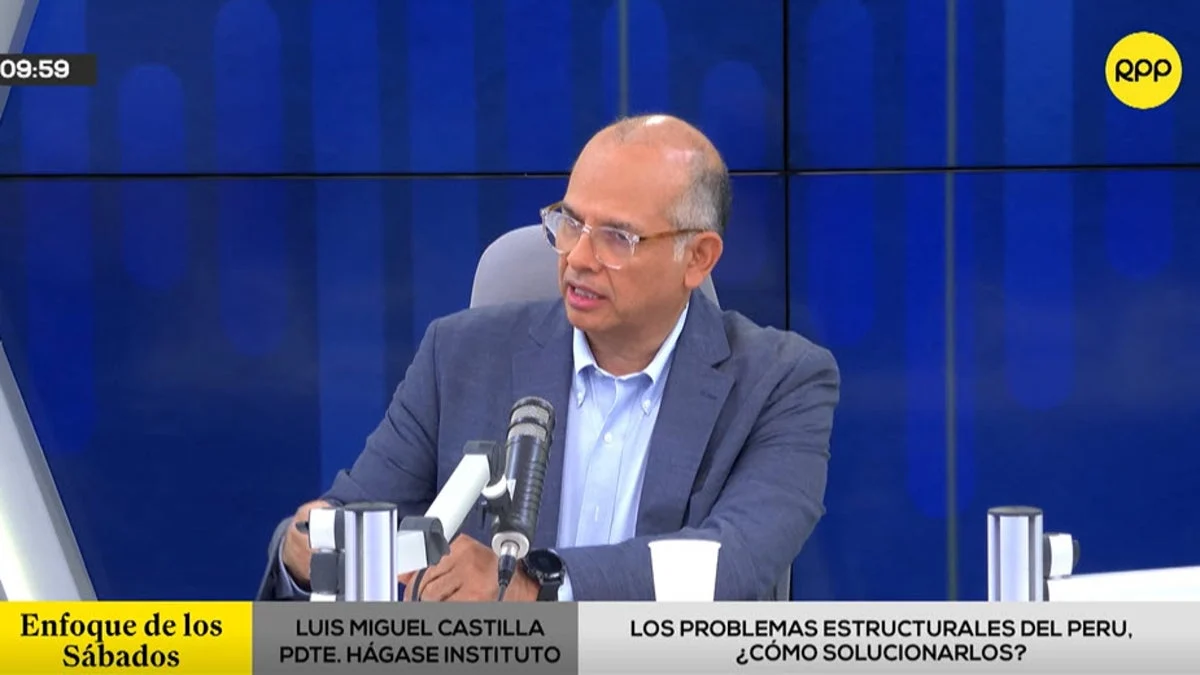
In a political landscape often characterized by endless diagnostic reports and a persistent disconnect between central authority and regional reality, a new initiative has emerged to shift the paradigm. Led by three former cabinet ministers from the Ollanta Humala administration—Luis Miguel Castilla, Milton von Hesse, and Paola Bustamante—Hágase Instituto has launched with a clear, ambitious mandate: to move beyond mere analysis and engage in the "doing" of public management.
As the country faces chronic instability, Hágase Instituto positions itself as a unique hybrid—a "think and do tank"—dedicated to transforming the mechanics of government at the regional and local levels.
Main Facts: A New Model for Public Intervention
The core philosophy behind Hágase Instituto is simple but radical for the Peruvian context: the country suffers not from a lack of plans, but from a fatal inability to execute them. By focusing on technical assistance, on-the-ground presence, and evidence-based monitoring, the institute seeks to reconcile the fractured relationship between the citizenry and their regional governments.
Luis Miguel Castilla, former Minister of Economy and current president of the institute, defines their mission as "having a vocation to build the country, not just think about it." The initiative arrives at a time when the "divorce" between the prosperous coast and the often-neglected Andean and Amazonian regions has never been more palpable.
Key operational pillars of the organization include:
- Customized Solutions: Rejecting "one-size-fits-all" recipes in favor of understanding specific regional pain points.
- On-Site Presence: A commitment to technical support provided in situ, rather than managing regional crises from desks in Lima.
- Institutional Empowerment: Focusing on the leadership capacity of regional governors and local mayors.
- Non-Compensatory Funding: Operating strictly on donations to ensure independence and avoid conflicts of interest or "quid pro quo" arrangements with public entities.
Chronology: From Cabinet Rooms to Fieldwork
The genesis of Hágase Instituto can be traced back over a decade to the professional and personal synergy developed by its founders while serving in the Peruvian cabinet.
- 2011–2016: Castilla, von Hesse, and Bustamante serve in various ministerial capacities under the Ollanta Humala administration, gaining firsthand experience in the limitations of central bureaucracy.
- Post-Government Years: The trio continues to collaborate on various public policy projects, identifying a recurring pattern: brilliant policy designs consistently failing at the implementation stage due to administrative volatility and lack of technical continuity.
- Late 2023/Early 2024: Formal conceptualization of Hágase Instituto as an entity that transcends traditional think-tank boundaries.
- Present Day: The organization moves into its operational phase, focusing on diagnosing administrative bottlenecks and providing direct technical assistance to subnational governments ahead of upcoming electoral and administrative transitions.
Supporting Data: The Cost of Administrative Volatility
The need for such an intervention is backed by grim statistics regarding the current state of public administration. Milton von Hesse, former Minister of Housing and director at the institute, highlights the devastating impact of high staff turnover.
"I was recently reviewing a national investment executive unit," von Hesse noted. "In just five years, it had cycled through 20 executive directors. This is not just a management issue; it is a catastrophe."
The Economic and Social Toll:
- Project Delays: The constant rotation of officials leads to a loss of institutional memory, resulting in projects that face delays exceeding 1,800 days.
- Cost Overruns: Due to the repetitive nature of restarting projects, overruns on public works now frequently exceed 35% of the original budget.
- Loss of Accountability: When a project changes hands four or five times a year, the "traceability of corruption" disappears. It becomes impossible to distinguish between genuine negligence and systemic corruption, effectively shielding those responsible for mismanagement.
Hágase Instituto argues that this "administrative amnesia" is the primary driver of the public’s distrust in the state. Without continuity, there is no performance; without performance, there is no public confidence.
Official Responses and Perspectives
The founders are clear that their goal is not to replace the state, but to act as a catalyst for better governance.
Luis Miguel Castilla on the "Implementation Gap"
Castilla emphasizes that the gap between passing a law and seeing its impact is where corruption and inefficiency thrive. "You can go to a municipality and find a ‘model’ manual of procedures that looks perfect on paper," he explained. "But if you dig deeper, you find immense discretion. That discretion is a form of corruption. Citizens are often extorted simply because the rule is applied selectively."
He noted that the institute plans to conduct independent field surveys to generate data that currently does not exist, creating a "public ledger" of progress that can be presented to the Comptroller General or the Congress to force accountability.
Paola Bustamante on Human Capital
Paola Bustamante, former head of the Ministry of Development and Social Inclusion (MIDIS), underscores the human element. "We are apostolizing for the strengthening of technical capacities. The human capital in the public sector is the foundation of everything," she said. She highlights that with new authorities taking office, there is a critical window of opportunity to implement "good practices" before the standard patterns of inertia set in.
Implications: A Shift Toward Accountability
The emergence of Hágase Instituto carries significant implications for Peruvian politics and the private sector alike.
1. Disrupting the Status Quo
By providing technical assistance to regional governments, the institute acts as a "watchdog" that also serves as a "mentor." This dual role forces local governments to improve, knowing that an external, highly qualified team is monitoring their output and reporting it publicly.
2. Combating Decentralized Inefficiency
The primary implication for the decentralization process is that regional autonomy is only as effective as the technical team behind it. By offering "extrapolable recipes"—solutions that have worked in one region and can be adapted to another—Hágase is attempting to create a network of best practices that bypasses the sluggishness of the central bureaucracy.
3. The Ethical Standard
Perhaps the most significant implication is the institute’s strict ethical framework. By explicitly rejecting resource exchange for services, they are setting a new standard for private-sector involvement in public management. In a country where "lobbying" and "consultancy" are often conflated with influence peddling, the transparency of Hágase’s funding model is a deliberate attempt to professionalize the relationship between civil society and the state.
4. Long-Term Political Stability
If successful, the model could serve as a template for future institutional stability. By emphasizing the preservation of "institutional memory," they are addressing the root cause of why many Peruvian infrastructure projects become "white elephants." If officials can be taught that their legacy is tied to the completion of projects rather than the mere proposal of new ones, the entire cycle of public investment could see a measurable improvement.
Conclusion: The Road Ahead
Hágase Instituto enters a crowded, often cynical political arena. However, the background of its founders—individuals who have navigated the highest levels of the Peruvian state—gives them a unique vantage point. They understand the traps, the bureaucratic hurdles, and the political pressures that paralyze progress.
Their success will not be measured by the number of white papers published or the media appearances they make. Instead, it will be measured by the reduction of overruns in regional projects, the stability of technical teams in municipal offices, and the narrowing of the "implementation gap" that has for too long separated the Peruvian citizen from the services they deserve.
As the country looks toward the future, the message from Castilla, von Hesse, and Bustamante is a call to action: in a country overflowing with talk, the most revolutionary act is to simply start doing.