The Contraloría General de la República (CGR) has issued a stern warning regarding the execution of an infrastructure protection project in Ollachea, citing poor material management, questionable reporting, and outdated technical specifications that threaten the integrity of the investment.
Executive Summary: A Flagged Investment
A critical infrastructure project, categorized as an "IOARR" (Investment in Optimization, Marginal Expansion, Replacement, and Rehabilitation), aimed at bolstering the security of the Ollachea Power Generation Plant, has come under the scrutiny of Peru’s Comptroller General. The project, managed by the state-owned Empresa de Generación Eléctrica San Gabán S.A., involves a total approved investment of S/ 882,585.30.
According to the Informe de Control Concurrente n.º 013-2026-OCI/0785-SCC, the execution phase is marred by technical oversights that range from improper storage of critical construction materials to significant discrepancies in progress reporting. These findings raise serious concerns regarding the long-term durability of the protection structures and the fiscal responsibility of the project management team.
Chronology of the Project
The project’s timeline has been marked by delays and administrative hurdles, leading to its current state of uncertainty.
- June 2024: The technical dossier, which currently serves as the baseline for the project, was approved. Critics note that this document has not been updated in over a year, despite changing conditions at the site.
- Contract Award: The construction contract was officially awarded to a consortium for a total of S/ 732,528.43, with a stipulated execution period of 100 days. A separate contract for supervision was valued at S/ 42,700.
- Stagnation and Restart: The project suffered two separate work suspensions. Work officially resumed on July 4, 2026, under a tight deadline to reach completion by October 11, 2026.
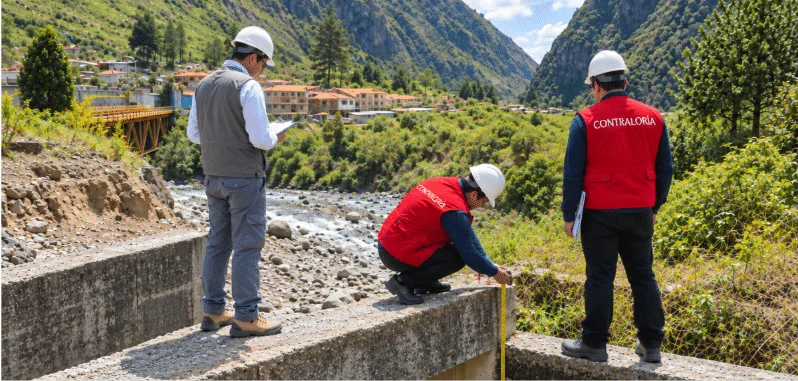
- August 19, 2026: A pivotal site inspection by the Contraloría revealed the extent of the mismanagement, leading to the issuance of the damning concurrent control report.
Technical Deficiencies and Material Integrity
The CGR’s report provides a detailed account of how poor site management is directly impacting the quality of the materials intended for the project.

Material Exposure
During the inspection conducted on August 19, auditors discovered that approximately 2,300 kg of corrugated steel and multiple rolls of wire were being stored improperly. These critical structural elements were found to be heavily oxidized due to direct exposure to the elements. Corrosion at this early stage compromises the structural integrity of the steel, potentially leading to future structural failures.
Furthermore, premium construction inputs—specifically tornillo wood and phenolic materials—were found left in the open. Exposed to intense solar radiation, high humidity, and rainfall, these materials are susceptible to warping, rot, and structural degradation. The CGR warned that if these materials are incorporated into the project, the entire life cycle of the protection works will be severely curtailed.
Discrepancies in Physical Progress
Perhaps the most alarming finding involves the reporting of physical progress. There is a wide, unexplained gap between the contractor’s claims and the findings of the supervisory team.
In July 2026, the contractor submitted a progress report indicating 7.48% completion. However, the external supervisor, tasked with verifying these figures, acknowledged only 1.02% of the work as completed. This 6.46-percentage-point discrepancy suggests a lack of rigorous oversight or an attempt to inflate the project’s reported performance. To make matters worse, the photographic evidence provided by the contractor was found to be unreliable; six key photographs lacked time and date stamps, rendering them useless as verifiable proof of progress for the billed period.
Structural and Planning Incompatibilities
Beyond the physical site issues, the project is suffering from a fundamental disconnect between the approved technical dossier and the reality on the ground.

The Outdated Dossier Problem
The reliance on a technical dossier approved in June 2024 without any subsequent updates is a primary source of the project’s friction. In engineering and construction, site conditions often evolve. By failing to update the dossier, the project is attempting to follow specifications that no longer align with current field conditions.
Incompatibility in Demolition and Metrados
The audit identified specific mismatches in the demolition of the purge canal and the pedestrian bridge. Discrepancies in dimensions and "metrados" (measurement units of work) mean that the project is essentially being built on a blueprint that does not match the terrain. These inconsistencies create significant legal and financial risks, as the work performed cannot be properly valued, and the structural designs may prove inadequate for the actual physical environment.
Implications for San Gabán and Public Investment
The situation at the Ollachea site represents a broader challenge in public works management. When state-owned enterprises fail to enforce strict oversight, it results in the "death by a thousand cuts" for public funds—small inefficiencies that eventually snowball into large-scale fiscal waste.
Financial Risk
With over S/ 880,000 at stake, the lack of coordination between the contractor and the supervisor puts the entire budget at risk. If the project continues under these conditions, the government may be forced to pay for "re-work" or repairs to structures that were compromised before they were even fully installed.
Operational Risk
The purpose of this IOARR is to protect the power generation infrastructure at Ollachea. If the protection works themselves are built with degraded materials or on faulty calculations, they will fail to fulfill their purpose during a natural disaster or peak operational stress. This could lead to unplanned outages, costly equipment damage, and long-term loss of power generation capacity.

Official Responses and Next Steps
The Contraloría General has formally communicated its findings to the leadership of the Empresa de Generación Eléctrica San Gabán S.A. The message from the oversight body is clear: immediate corrective and preventive actions are required to rectify the storage of materials, align the physical progress reporting with reality, and update the technical dossier to reflect actual site conditions.
While the project remains in progress, the spotlight is now on the San Gabán management team to demonstrate accountability. They must explain why the supervision team allowed such large gaps in reporting to persist and why the contractor was permitted to store materials in a manner that clearly violates standard construction safety protocols.
Moving Forward
As the October 11, 2026, deadline approaches, the pressure is mounting. The CGR’s intervention serves as a necessary "reset" button. However, the path to project completion will now require increased transparency, a rigorous audit of past payments, and a commitment to quality over speed.
The public, the energy sector, and regulatory bodies will be watching closely to see if the corrective measures are implemented or if this project becomes another example of public infrastructure failing before it is even commissioned. The case of San Gabán underscores the vital role of concurrent control in preventing the misuse of public funds and ensuring that infrastructure serves its intended purpose for the benefit of the region.