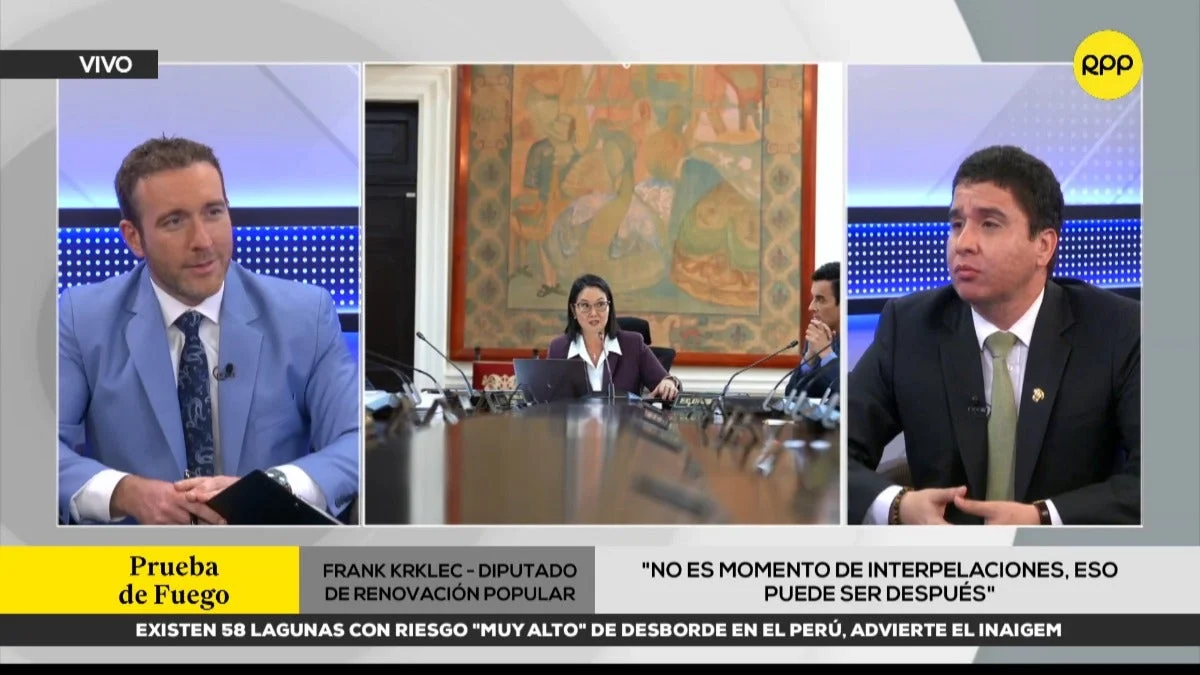
In a high-stakes political landscape, the relationship between the ruling administration and the legislature has reached a critical juncture. Frank Krklec, a prominent lawmaker representing the conservative Renovación Popular party, has publicly clarified the nature of his party’s involvement with the government of President Keiko Fujimori. During a recent interview on the RPP TV program Prueba de fuego, Krklec sought to dispel rumors of a formal coalition, while simultaneously launching a scathing critique against the Ombudsman’s office regarding potential constitutional crises.
The Nature of the "Collaboration": Clarifying the Alliance
For months, political analysts have speculated on the existence of a formal pact between Renovación Popular and the Fujimori administration. Addressing these claims directly, Krklec emphasized that his party maintains an autonomous stance.
"It is not an alliance; it is a collaboration of good faith on issues that are common and beneficial for the country, nothing more," Krklec stated. To bolster his argument, the congressman pointed to the conspicuous absence of Renovación Popular members within the cabinet led by Prime Minister Luis Galarreta. He further highlighted the appointment of figures known for their critical stance toward the management of former Lima Mayor Rafael López Aliaga—such as Rafael Rey, the current Minister of Transport and Communications (MTC)—as proof that the administration does not operate under the thumb of his party.
This strategic distancing is seen by observers as a move to preserve Renovación Popular’s political capital. By framing their legislative support as a conditional, issue-based cooperation rather than a structural alliance, the party positions itself to avoid the fallout of potential administration failures while remaining influential in the policy-making process.
Chronology of Legislative Friction
The tension between the executive and legislative branches has been exacerbated by the delayed submission of a request for delegated legislative powers. The executive branch had signaled its intent to seek these powers to expedite reforms; however, a one-month delay in the formal delivery of the request has raised eyebrows within the halls of Congress.
- Initial Expectations: The government signaled in early weeks that a broad package of reforms would be presented to Congress to tackle urgent national crises.
- The Waiting Game: As weeks turned into a month, frustration mounted among opposition and centrist benches.
- The Confrontation: During his interview, Krklec openly criticized the executive’s "delay," signaling that the honeymoon period for the administration’s legislative agenda might be ending.
Krklec made it clear that the legislature would not be reduced to a mere "rubber stamp" for the executive. "I have been elected as a representative of the population, and it would be irresponsible to be a mere administrative post office," he remarked, emphasizing that the role of a deputy is to debate, review, and refine, not simply authorize.
Supporting Data: Priority Areas for Consensus
Despite his firm rhetoric against serving as a legislative extension of the government, Krklec acknowledged that Renovación Popular remains committed to supporting the administration on specific, high-priority national issues. The party’s legislative agenda is currently focused on three pillars:
- Citizen Security: With crime rates remaining a top concern for the electorate, the party has expressed a willingness to back executive measures that bolster the capacity of law enforcement and the judiciary.
- Economic Reactivation: In a post-pandemic economic climate, the need for legislative frameworks that encourage investment and market stability is viewed as a prerequisite for national recovery.
- Mitigation of El Niño: The impending climate threats posed by the El Niño phenomenon remain a point of consensus, with Krklec noting that the party is predisposed to approve emergency infrastructure funding and disaster risk management strategies.
These areas of cooperation illustrate the delicate balance Renovación Popular is attempting to strike: being an effective partner in governance while maintaining a rigorous oversight role.
The Ombudsman Controversy: Constitutional Integrity at Stake
The most volatile segment of Krklec’s recent statements concerned the comments made by Ombudsman Josué Gutiérrez. In a series of remarks that have sent shockwaves through the political establishment, Gutiérrez suggested that if President Keiko Fujimori were to dissolve the Congress, her public approval rating would see a surge of 20 to 30 percentage points.
For Krklec, this statement was not only "inconceivable" but dangerous. He argued that for a high-ranking state official tasked with defending the constitutional order to suggest that a violation of that very order (the dissolution of Congress) could be a path to popularity is a dereliction of duty.
Implications of the Ombudsman’s Remarks
The implication of the Ombudsman’s words is profound. Critics, including Krklec, suggest that by framing the potential dissolution of the legislature as a popular, albeit potentially unconstitutional, move, Gutiérrez is effectively encouraging the executive branch to bypass democratic checks and balances.
"Promoting these types of statements, promoting constitutional breaks, represents a serious offense," Krklec warned. He went further, asserting that such behavior could provide sufficient grounds for the Senate to initiate proceedings for the removal of the Ombudsman. This threat of impeachment underscores the gravity with which the legislative branch views the preservation of its own institutional existence.
Analysis: The Fragility of the Fujimori Administration
The political climate in the country is currently defined by a high degree of volatility. The combination of a fragile legislative majority and the constant threat of a constitutional showdown creates an environment where every administrative delay and every public statement is scrutinized for its potential to destabilize the government.
The Role of the Senate
Should the conflict between the Congress and the Ombudsman escalate, the role of the Senate will become paramount. The legal framework governing the removal of high officials requires a rigorous, evidence-based process. Any move by the Congress to impeach the Ombudsman would likely be framed by the government’s supporters as a political vendetta, further deepening the divide.
Public Perception vs. Institutional Stability
The Ombudsman’s controversial assertion touches on a deeper, uncomfortable truth for many political analysts: the low levels of trust in the legislative branch. If the public indeed views the closure of Congress as a positive development, it suggests a profound failure of the representative system. However, as Krklec’s reaction demonstrates, the political class is increasingly sensitive to the idea that democratic institutions are being undermined from within.
Future Outlook: A Winter of Discontent?
As the Fujimori administration approaches the next phase of its legislative term, it faces a dual challenge: managing the economic and social pressures facing the nation while navigating a Congress that is becoming increasingly assertive.
The "collaboration of good faith" described by Krklec will likely be tested in the coming weeks. If the executive continues to delay its requests for delegated powers, or if the rhetoric regarding constitutional maneuvers continues, the relationship between Renovación Popular and the government could shift from "good faith" to open confrontation.
In conclusion, the statements from Frank Krklec serve as a warning shot. By distancing his party from a formal alliance, holding the government accountable for legislative delays, and threatening to impeach the Ombudsman for inflammatory remarks, Krklec has signaled that the period of political maneuvering is entering a phase of increased institutional tension. The stability of the Fujimori government will depend on its ability to reconcile its own political ambitions with the institutional realities of a Congress that is no longer willing to operate in the shadows of the executive branch.