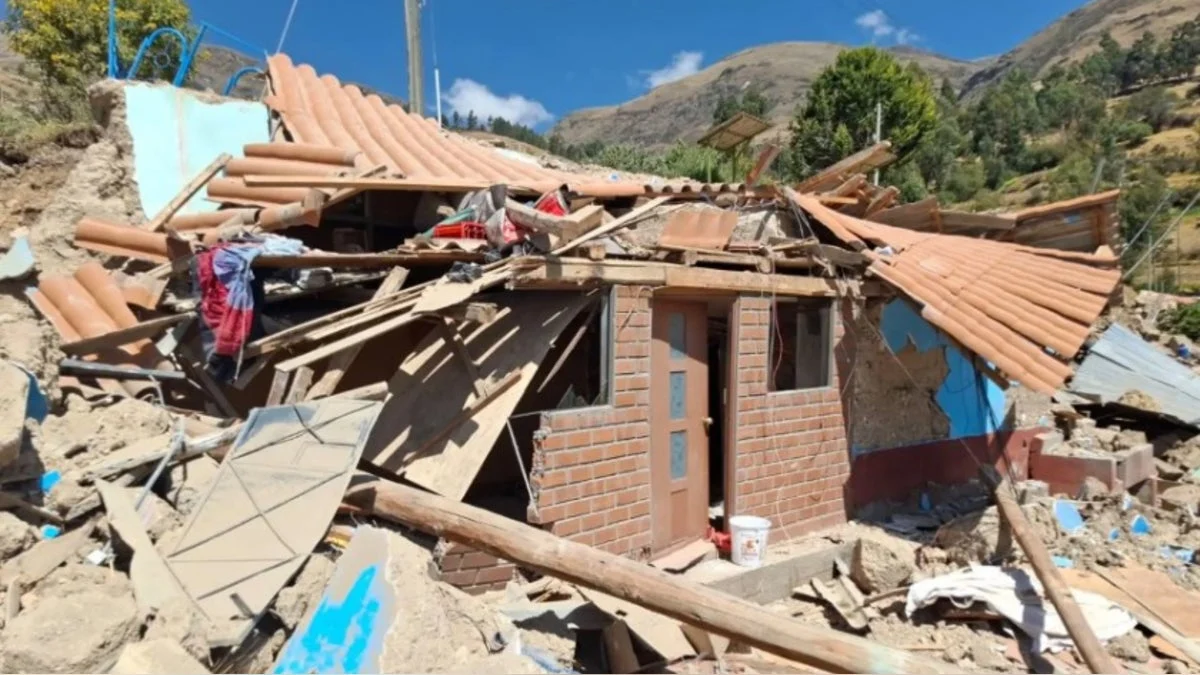
In a significant legislative move to address the aftermath of the 5.1 magnitude earthquake that struck the provinces of Chupaca and Huancayo, the Peruvian government has authorized an emergency fund totaling S/88.7 million. The allocation, formalized through Emergency Decree 009-2026, aims to provide immediate and long-term housing solutions for families whose homes were leveled or rendered uninhabitable by the seismic event.
This decisive action comes after mounting pressure from local authorities and affected populations, who had previously criticized the central government for delays in resource mobilization.
I. Main Facts: A Dual-Track Recovery Strategy
The government’s response is structured around two primary pillars: the rehabilitation of rural housing and the deployment of temporary shelters. The funding is sourced from the Contingency Reserve of the Ministry of Economy and Finance (MEF) and is designed to bypass bureaucratic bottlenecks by utilizing established community-led execution models.
The Breakdown of Funding
The total package of S/88.7 million is divided as follows:
- S/63.25 million for Rural Housing Improvement: This fund is earmarked for the Ministry of Housing, Construction, and Sanitation (MVCS). Within this figure, approximately S/62.4 million is dedicated to direct construction and improvement expenses, while S/415,960 is allocated for the crucial identification and selection of beneficiaries, ensuring that aid reaches the most vulnerable. An additional S/432,440 is designated specifically for technical improvements to rural dwellings.
- S/25.5 million for Temporary Modular Housing: This portion of the budget is reserved for the procurement, transportation, and installation of modular housing units intended to serve as immediate relief for those currently without shelter.
II. Chronology of the Crisis and Response
The road to this decree has been marked by a series of escalating demands and political friction.
The Seismic Event:
The earthquake, registering a magnitude of 5.1, struck the Junín region with intensity, causing widespread structural failure in older adobe and brick housing in the Chupaca and Huancayo provinces. The rural nature of the affected areas exacerbated the damage, leaving hundreds of families exposed to the elements.
Initial Stagnation:
In the immediate aftermath, regional authorities, including the Governor of Junín, publicly denounced the lack of state intervention. Criticism peaked when the Governor noted that a previous request for S/140 million in reconstruction funds had gone unheeded by the outgoing administration at the MEF, leading to significant public unrest.
Legislative Mobilization:
Following the inauguration of the new cabinet—including the appointment of Mauricio Arnillas as the Minister of Housing—the administration prioritized the emergency decree. The publication of Decree 009-2026 in the official gazette, El Peruano, serves as the formal end to the period of inactivity that had frustrated the local population.
III. Supporting Data: The Logistics of Recovery
The recovery effort is not merely a financial transfer; it is a complex logistical operation involving multiple government agencies and private sector collaboration.
The Role of "Núcleos Ejecutores"
The S/63.2 million assigned for rural housing will be managed via núcleos ejecutores (executive nuclei). This model empowers the affected communities to manage their own construction processes with technical oversight from the MVCS. This approach has been favored in recent Peruvian public policy as a means to reduce corruption and ensure that funds are used precisely where they are needed most.
The Innovation of Obras por Impuestos (OxI)
Perhaps the most notable aspect of the government’s response is the authorization to use the Obras por Impuestos (Works for Taxes) mechanism for temporary housing. Previously, the legal framework for OxI was interpreted as applying only to permanent infrastructure. Under the new decree, this is treated as an exception, allowing private companies to fund the installation of modular units in exchange for tax credits.
This change is designed to bypass the traditional public bidding process, which can take months, allowing for the rapid deployment of shelters in as little as a few weeks. The MVCS has been given a 10-day window to establish the specific conditions for these contracts, followed by a 5-day deadline to submit a prioritized list of interventions to ProInversión.
IV. Official Responses and Institutional Coordination
The appointment of Minister Mauricio Arnillas to the Ministry of Housing has been widely viewed as an attempt by the Galarreta cabinet to signal a more proactive approach to infrastructure and emergency management.
Minister’s Mandate
Minister Arnillas has been tasked with ensuring that the transition from temporary housing to permanent reconstruction occurs without the typical administrative gaps that have plagued past recovery efforts. Official statements from the Ministry emphasize that the identification process will be strictly monitored to prevent duplication of benefits, a common issue in disaster relief.
The MEF’s Stance
The Ministry of Economy and Finance, under the guidance of its current leadership, has highlighted that the use of the Contingency Reserve is a "calculated necessity." By allocating these funds, the MEF expects to stabilize the socio-economic conditions of the Junín region, preventing a potential migration crisis from rural areas into urban centers, which would place further strain on public services.
V. Implications: A Blueprint for Future Disasters?
The authorization of S/88.7 million carries broader implications for how Peru handles seismic risks and disaster relief.
1. Modernizing Disaster Response
By incorporating Obras por Impuestos into emergency housing, the government is essentially creating a "fast-track" legal precedent. If successful, this model could be applied to future natural disasters in other regions, significantly reducing the "waiting time" for displaced families.
2. The Challenge of Quality and Sustainability
While the rapid deployment of modular units is a priority, experts warn that the government must ensure these structures meet seismic safety standards. There is a risk that temporary solutions become permanent ones if the "reconstruction" phase of the rural housing plan faces future delays.
3. Economic Impact on Junín
The infusion of S/88.7 million into the local economy is expected to provide a temporary stimulus, as the funds will likely be used to hire local labor and purchase construction materials from regional suppliers. However, the true success of this initiative will be measured by the speed at which families move from temporary modules back into safe, permanent, and earthquake-resistant homes.
4. Political Accountability
For the current administration, the effective implementation of this decree is a litmus test. With regional tensions already high following the initial neglect of the request for funds, any further administrative delays or corruption in the allocation of these resources could lead to significant political repercussions for the Galarreta cabinet.
Conclusion
The situation in Junín remains fluid, but the issuance of Decree 009-2026 marks a turning point for the victims of the 5.1 magnitude earthquake. As the MVCS moves to meet its 10-day and 5-day deadlines for operationalizing the funding, the eyes of the nation will be on the provinces of Chupaca and Huancayo. The dual-track approach—combining community-led rural reconstruction with private-sector-funded temporary modular housing—represents a bold, if experimental, shift in Peruvian disaster management.
Whether this S/88.7 million serves as the catalyst for a successful recovery or merely the beginning of a prolonged administrative struggle will depend on the transparency and efficiency of the coming months. For the families currently living in the shadow of their destroyed homes, the delivery of these resources cannot come soon enough.