Executive Summary
The recent decision by the Peruvian government to grant a safe-conduct (salvoconducto) to former Prime Minister Betssy Chávez, facilitating her departure to Mexico, has ignited a fierce debate within the halls of power in Lima. While critics view the move as an affront to domestic judicial processes, former Foreign Minister Óscar Maúrtua has stepped forward to defend the administration’s actions. Maúrtua argues that the decision serves as a critical signal to the international community that Peru remains a nation committed to upholding its treaty obligations, regardless of the political unpopularity of the individuals involved.
The Core Conflict: International Law vs. National Justice
The central friction point in this diplomatic maneuver is the tension between the sanctity of international asylum and the pursuit of national justice. Betssy Chávez, a key political ally of former President Pedro Castillo, has been embroiled in legal turmoil following the failed constitutional rupture of December 2022.
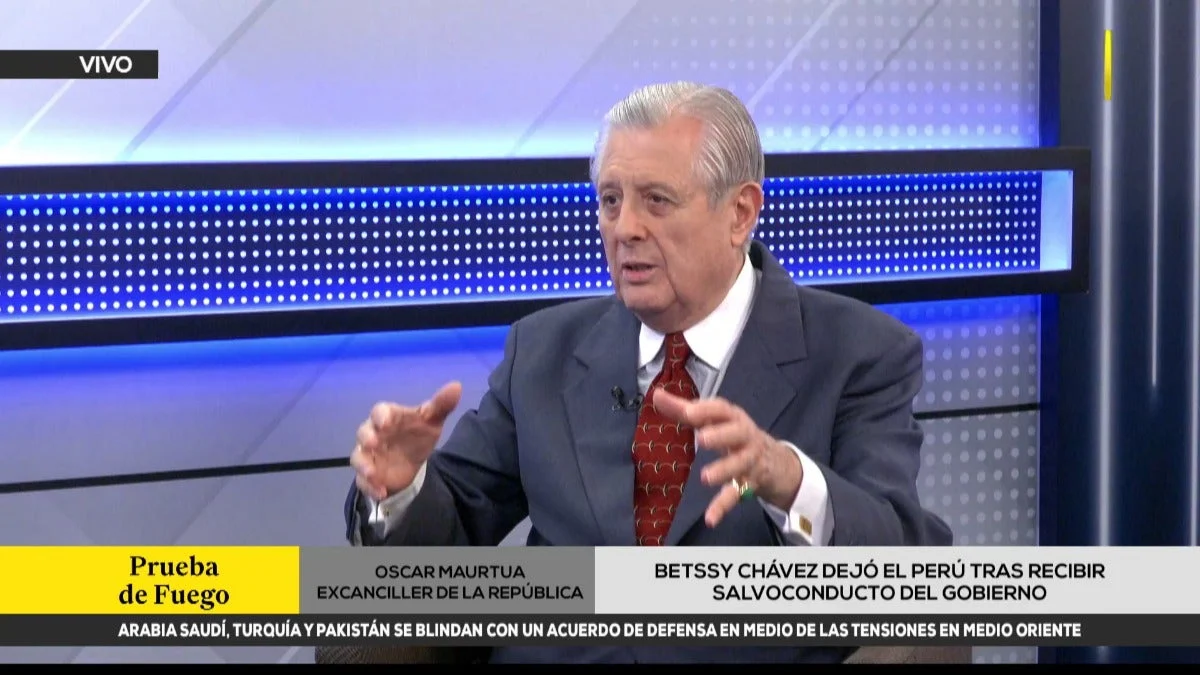
Óscar Maúrtua, speaking on the RPP TV program Prueba de Fuego, emphasized that the government’s decision was not a validation of Chávez’s actions, but rather a necessary exercise in diplomatic maturity. "The treaty grants the receiving state the right to qualify and grant asylum," Maúrtua explained. "What is asylum? It is a sacred institution, a concept that has existed since antiquity. It is a ‘sacred space.’"
Maúrtua argued that for Peru to unilaterally refuse a safe-conduct—a document required for an asylee to exit the country safely—would be to abandon the rule of international law. Such a move, he warned, would carry significant long-term consequences for Peru’s standing in global diplomatic forums, potentially framing the country as one that treats international agreements as optional based on domestic political convenience.
Chronology of a Political Crisis
To understand the gravity of the current situation, one must examine the timeline of events that led to the present impasse:
- December 7, 2022: Then-President Pedro Castillo announces the dissolution of Congress and the establishment of an "emergency government." Betssy Chávez, serving as Prime Minister, is physically present during the televised announcement, leading to accusations of complicity in a coup d’état.
- December 2022 – 2023: A series of legal proceedings are initiated against Chávez for the crimes of rebellion and conspiracy. As the judiciary tightens its grip, the debate over her potential flight risk intensifies.
- The Asylum Request: Seeking refuge from what she characterizes as political persecution, Chávez initiates the process for diplomatic asylum with the Mexican government—a nation that has historically maintained an "open door" policy for Latin American political figures.
- The Granting of the Safe-Conduct: The Peruvian executive branch, following diplomatic protocols, agrees to issue the required documents for her departure, sparking immediate public outcry and intense media scrutiny.
The Anatomy of the Diplomatic Protocol
The legal framework governing this situation is rooted in the 1954 Caracas Convention on Diplomatic Asylum. Under these rules, once a host country (Mexico) determines that an individual qualifies for asylum, the country of origin is generally obligated to provide the necessary transit documents to ensure the safety of the individual in question.
Maúrtua, who brings decades of experience to the discourse, highlighted the binary nature of the decision. "The State could have refused, but that would mean pursuing a policy of ignoring treaties," he stated. He maintained that while the actions of Chávez and Castillo during the 2022 attempt to break the constitutional order were "deplorable," the state must act with a sense of "statecraft" that transcends the emotions of the day.
The Path to Extradition: A Judicial Transition
While the diplomatic path has been cleared for Chávez’s exit, the legal battle is far from over. A critical question remains: Can Peru demand her return?
Maúrtua noted that the responsibility for bringing Chávez to justice now shifts from the Ministry of Foreign Affairs to the Judiciary. The process of extradition is a rigorous, technical, and often lengthy procedure that relies on evidence-based legal arguments rather than political rhetoric.
"This is no longer a matter for the diplomatic realm," Maúrtua clarified. "It is now entirely in the hands of the Judiciary." He noted that for an extradition request to succeed, Peruvian authorities must present a bulletproof case that meets the evidentiary standards of the Mexican courts, proving that the charges are strictly criminal and not merely political.
Furthermore, Maúrtua suggested that the political landscape in Mexico could eventually shift. He posited that once the administration of President Claudia Sheinbaum concludes, the protection afforded to Chávez could be subject to reassessment. International political dynamics change, and a future Mexican government may not feel the same ideological obligation to maintain the asylum status, potentially reopening the door for extradition efforts.
Implications for Peru’s International Standing
The decision to grant the safe-conduct, while politically divisive, serves as a test of Peru’s adherence to the Vienna Convention and regional asylum agreements.
Institutional Credibility
By granting the permit, the current government is signaling that it operates within a framework of institutional continuity. Even when dealing with individuals who sought to dismantle the very institutions of the state, the government is showing that it will not resort to "rogue state" tactics by blocking diplomatic movement.
The Regional Context
Mexico’s role in this saga is consistent with its long-standing foreign policy of non-intervention and asylum. However, this has often put Mexico at odds with other Latin American governments, leading to strained bilateral relations. Peru’s compliance with the request effectively "de-escalates" a potential diplomatic rupture between Lima and Mexico City, allowing both nations to move past this specific point of friction.
Domestic Reaction
Internally, the optics remain difficult for the government. Many citizens view the departure of Chávez as a "get out of jail free" card, feeling that the justice system is being circumvented. The government’s challenge now is to communicate effectively that diplomacy and criminal justice are separate tracks. The failure to secure a conviction domestically has fueled the perception of impunity, a challenge that the Attorney General’s office must address with urgency if they are to maintain public trust.
Expert Perspectives and Future Outlook
The discourse provided by former Minister Maúrtua highlights a profound truth about modern statecraft: the hardest decisions are often those that require adhering to rules that feel unjust in the moment. By upholding the treaty, Peru avoids a precedent where it might, in the future, find itself in a position where it needs the protection of international law for its own citizens abroad.
As the situation evolves, the focus will undoubtedly return to the judicial proceedings. If the Peruvian judiciary can build a compelling case that surpasses the threshold of political persecution, the international community will be watching to see how Mexico handles a formal extradition request.
Ultimately, the case of Betssy Chávez serves as a cautionary tale of the fragility of democratic institutions. While she may have escaped the immediate jurisdiction of the Peruvian courts, the shadow of the 2022 coup attempt continues to define the political and diplomatic landscape of the nation. The government’s commitment to international law has bought it a temporary peace on the diplomatic front, but the quest for domestic justice remains a long and arduous road ahead.
The stability of Peru’s future will depend not just on its ability to respect treaties, but on its capacity to strengthen its judicial institutions to a point where political actors—no matter their status—cannot escape the reach of the law, whether they are in Lima or halfway across the world.