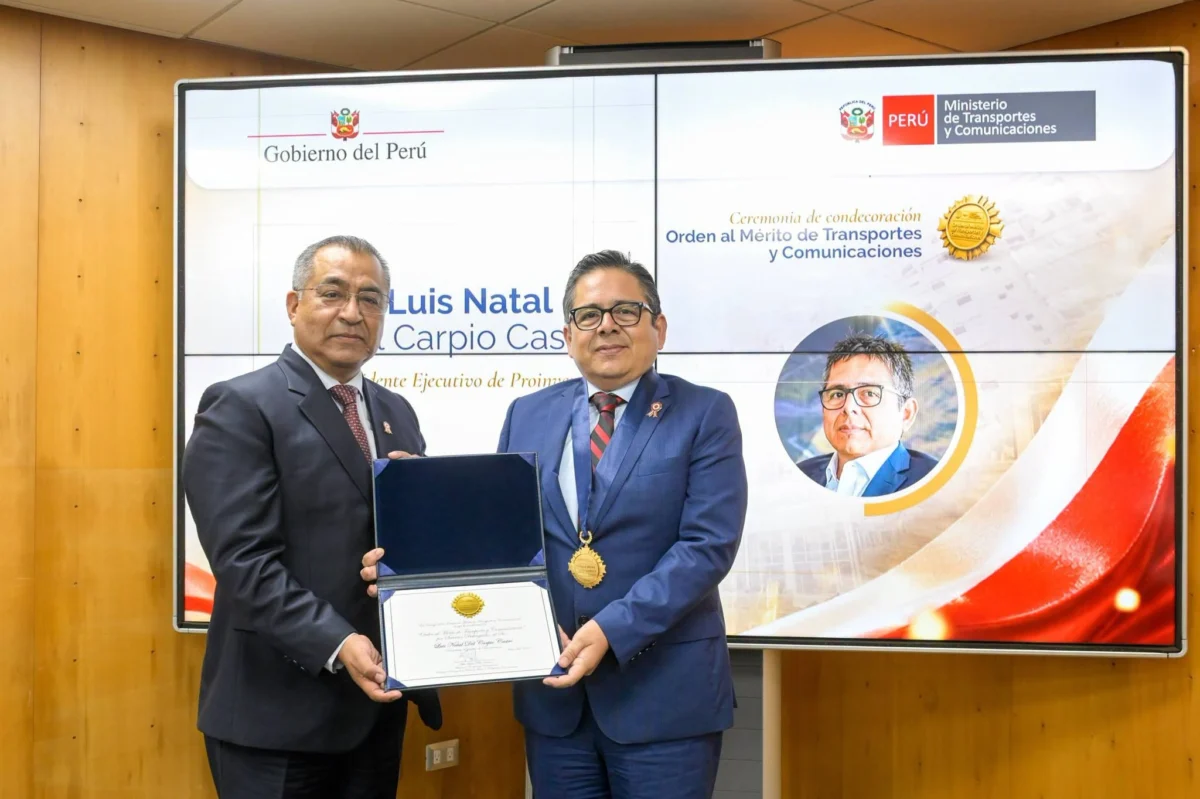
In a significant ceremony that underscored the critical synergy between public policy and private investment, the Peruvian Agency for Private Investment Promotion (PROINVERSIÓN) was formally bestowed with the prestigious "Order of Merit for Transport and Communications." The award, presented by the Ministry of Transport and Communications (MTC), serves as a testament to over three decades of tireless efforts in bridging the nation’s infrastructure gap and fostering a robust landscape for connectivity across Peru’s diverse geography.
The distinction was received by Luis Del Carpio, Executive Director of PROINVERSIÓN, during an official event that brought together key stakeholders, international development partners, and government officials dedicated to the modernization of the country’s logistical and digital backbone.
A Legacy of Three Decades: The Architecture of Progress
Since its inception, PROINVERSIÓN has evolved from a nascent initiative into a sophisticated engine of development. For more than 30 years, the agency has functioned as the primary architect of public-private partnerships (PPPs) in Peru. Its mandate has consistently been to identify, structure, and promote projects that the state could not deliver alone, thereby mobilizing the capital, technology, and operational expertise of the private sector.
The agency’s track record is marked by monumental achievements that have physically reshaped the map of Peru. Among its most notable milestones is the facilitation of over 7,000 kilometers of modern highway networks. These roads are not merely asphalt and stone; they are lifelines that connect remote Andean communities to coastal markets, reducing travel times, lowering logistics costs, and integrating isolated regions into the national economy.
Furthermore, the agency has successfully steered the development of eight major port terminals, positioning Peru as a key maritime hub in the South Pacific. These projects, alongside numerous airport modernizations and critical expansions in telecommunications, have been instrumental in transforming Peru’s competitive standing in the global arena.
Chronology of Impact: From Foundation to Modernization
The trajectory of PROINVERSIÓN can be viewed through several distinct phases of national development:

- The Foundational Era (1990s): Initial efforts focused on the liberalization of key sectors, particularly telecommunications and energy, setting the stage for the massive influx of foreign direct investment.
- The Expansion Phase (2000s): The agency shifted its focus toward the "hard" infrastructure of transport. This era saw the concession of major arterial roads and the modernization of flagship airports, which became vital for the mining and agricultural export booms.
- The Era of Regional Integration (2010s): PROINVERSIÓN prioritized projects that specifically targeted regional development, ensuring that the benefits of infrastructure were not confined to the capital, Lima, but were spread across the country.
- The Modern Era (2020s–Present): The current focus has transitioned toward sustainable, resilient, and "smart" infrastructure. This includes not only physical construction but also the integration of digital connectivity and green energy projects, ensuring that Peru’s growth is compatible with environmental standards and technological advancement.
The Quantitative Impact: Data Behind the Development
To understand the magnitude of this recognition, one must look at the data. The cumulative impact of projects promoted by PROINVERSIÓN has been a catalyst for GDP growth. By de-risking investments for the private sector, the agency has enabled the state to allocate its limited budget to social services while the private sector assumes the heavy lifting of building and maintaining infrastructure.
Beyond the 7,000 kilometers of roads, the agency has been instrumental in:
- Logistics Efficiency: The development of port terminals has increased the volume of non-traditional exports, specifically in the agro-industrial sector, where Peru now leads global rankings in products like blueberries, avocados, and asparagus.
- Digital Inclusion: By promoting the expansion of fiber-optic backbones and mobile network coverage, PROINVERSIÓN has reduced the "digital divide" in rural provinces, allowing for better access to tele-health and tele-education.
- Fiscal Prudence: The PPP model utilized by the agency has ensured that infrastructure projects are financed through long-term contracts, offloading operational and maintenance risks from the public treasury to private operators who are incentivized by performance metrics.
Official Perspectives: The Vision of Luis Del Carpio
During his acceptance speech, Luis Del Carpio emphasized that the "Order of Merit" is not merely a retrospective acknowledgment of past successes, but a forward-looking incentive for the challenges that lie ahead.
"This recognition reaffirms our commitment to continue promoting infrastructure that transforms lives and builds a better country," Del Carpio stated. "During these decades, we have worked as a strategic ally of development, and we will continue to promote projects that generate well-being and opportunities for all Peruvians. Infrastructure is the pulse of our nation; it is the physical manifestation of our potential to compete and to thrive."
Del Carpio further noted that the agency’s role has become increasingly complex. Modern infrastructure is no longer just about building a road; it is about social license, environmental sustainability, and the incorporation of cutting-edge technology. Under his leadership, PROINVERSIÓN is placing a renewed emphasis on "socially inclusive infrastructure," ensuring that every project undergoes rigorous community engagement processes to maximize local benefits.
A Global Network: Collaboration with International Allies
The ceremony also served to honor the international partners who have provided the technical scaffolding for Peru’s success. PROINVERSIÓN does not work in a vacuum; it operates within a global ecosystem of financial and technical expertise.

The Ministry of Transport and Communications took the opportunity to acknowledge several key international players:
- The Inter-American Development Bank (IDB): A critical partner in financing sustainable mobility projects and strengthening regulatory frameworks.
- The World Bank: Instrumental in providing policy advice and technical assistance for complex infrastructure tenders.
- The German Cooperation (GIZ): Recognized for its support in promoting climate-resilient infrastructure and institutional modernization.
These organizations have acted as both consultants and financiers, ensuring that the projects structured by PROINVERSIÓN meet international benchmarks for transparency, efficiency, and social responsibility. This collaborative approach has bolstered investor confidence, making Peru a preferred destination for infrastructure capital in Latin America.
Implications for the Future: Building a Resilient Peru
The implications of this award for the future of the Peruvian economy are profound. By validating the model of private investment in public infrastructure, the government is signaling stability to the international market. In an era of global economic uncertainty, Peru is positioning itself as a reliable partner for investors who seek long-term, stable returns in projects that are essential for national development.
Looking ahead, PROINVERSIÓN faces the challenge of closing the remaining infrastructure gap—a figure estimated in the billions of dollars. The agency is currently diversifying its portfolio to include "green" projects, such as electric transport systems, water desalination plants, and sustainable waste management, which will be the next frontier of infrastructure investment.
The "Order of Merit for Transport and Communications" is, therefore, a symbolic bridge between what has been achieved and what remains to be built. As the agency continues its mission, it remains the primary mechanism by which the Peruvian State transforms the abstract goal of "national development" into the tangible reality of paved roads, modernized ports, and connected citizens.
In conclusion, the recognition of PROINVERSIÓN is an endorsement of the public-private partnership model as a primary tool for state progress. As Peru continues to navigate the complexities of the 21st century, the continued success of the agency will be vital to ensuring that the nation’s infrastructure not only keeps pace with its economic growth but actively drives it forward, ensuring a more competitive and equitable future for all citizens.