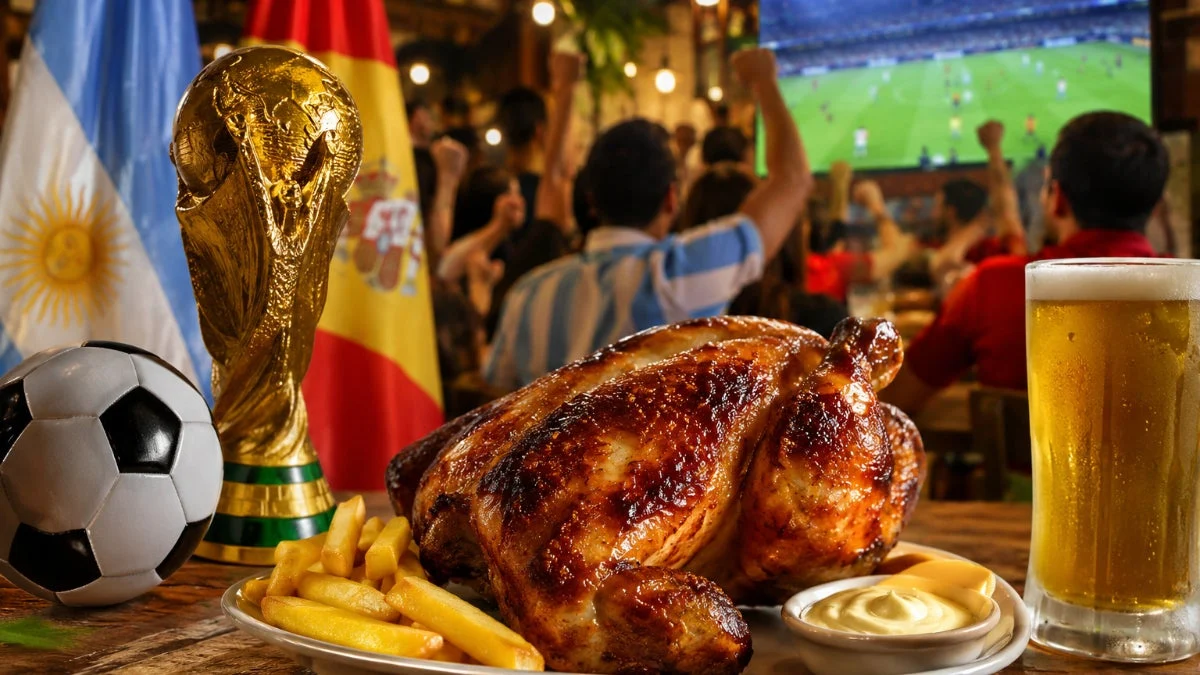
The convergence of the 2026 World Cup final between Argentina and Spain and the national celebration of "Día del Pollo a la Brasa" has created a historic economic opportunity for Peru’s restaurant industry. As fans prepare for the crowning moment of the football calendar, local eateries are bracing for an unprecedented surge in demand, transforming what would typically be a standard Sunday into one of the most lucrative days of the year for the gastronomic sector.
Main Facts: A Convergence of Passion and Tradition
For the Peruvian restaurant industry, this Sunday represents a "double celebration." The intersection of the global football spectacle and the country’s beloved Pollo a la Brasa (rotisserie chicken) day has created a rare confluence of events. Freddy Gamarra, general manager of Ahora Perú, the national association of hotels and restaurants, has indicated that the industry is anticipating a sales spike of between 50% and 60% compared to a typical Sunday.
The phenomenon is driven by a behavioral shift among Peruvian consumers. Football matches, particularly those of high global caliber, serve as social catalysts. When paired with a cultural institution like the rotisserie chicken—a dish that represents roughly 2% of the national GDP—the result is a significant influx of capital into the service sector. Establishments are not merely serving food; they are providing the venue for communal experiences, with many restaurants investing heavily in large-format displays and stadium-like atmosphere enhancements to capture the football-loving demographic.
Chronology of the 2026 World Cup Impact
The trajectory of the 2026 World Cup has been unique for the Peruvian market. Unlike previous iterations of the tournament, where time zone differences often hindered viewership during peak dining hours, the 2026 schedule has aligned perfectly with the rhythms of daily life in Peru.
The Group Stage and Early Knockouts
From the onset of the tournament, restaurants observed a steady increase in foot traffic. The scheduling of key matches during traditional lunch and dinner hours allowed venues to transform from dining spaces into vibrant hubs of activity. By the quarter-finals, many establishments reported that capacity was consistently reaching pre-pandemic levels.
The Mid-Tournament Surge
As the tournament progressed, the correlation between match intensity and revenue became increasingly clear. Restaurants that had upgraded their audiovisual infrastructure early in the year began to see a return on investment. The ability to retain customers for the duration of a 90-minute match (plus extra time and potential penalties) proved to be the winning strategy for revenue maximization.
The "Perfect Sunday" Finale
This weekend represents the culmination of that momentum. By placing the World Cup final on the same day as the national Pollo a la Brasa celebration, the calendar has inadvertently created a "perfect storm." Market analysts note that even if the Peruvian national team is not on the pitch, the cultural affinity for football in South America ensures that the final is treated with the same fervor as a domestic championship, fueling consumer spending.
Supporting Data: Economic Indicators and Consumer Behavior
The economic implications of this weekend are profound. Now, Peru has released data suggesting that the average ticket per person—typically ranging between S/ 45 and S/ 60—is expected to stabilize at the higher end of the spectrum, near S/ 60, due to additional beverage consumption and shareable side dishes common with rotisserie chicken orders.
The Rise of Delivery
Perhaps the most significant shift in the post-pandemic landscape is the reliance on delivery services. According to industry estimates, delivery is projected to account for 40% of total sales this Sunday. This shift is critical for the industry, as it decouples revenue from physical seating capacity. Restaurants are currently optimizing their logistics chains to ensure that the "last mile" delivery process remains efficient despite the massive volume of orders expected.
Infrastructure Investment
Data from Ahora Perú indicates a widespread capital expenditure across the sector. Many restaurants have opted to reinvest profits from the earlier stages of the tournament into:
- Technological Upgrades: Procurement of high-definition, large-screen televisions.
- Capacity Expansion: Temporary seating arrangements to maximize floor space.
- Promotional Bundles: Creating "Fan Kits" specifically designed for group dining.
Official Responses and Industry Perspectives
Freddy Gamarra, in an interview with RPP’s Economía para Todos, emphasized that while the short-term outlook is incredibly positive, the sector remains sensitive to broader economic headwinds.
"It is a special situation—a double celebration," Gamarra remarked. "We are seeing a synergy between sports enthusiasm and national pride that is providing a necessary buffer for our businesses."
However, the industry perspective is not entirely celebratory. Gamarra highlighted a stark dichotomy: while the weekend promises record numbers, the broader trajectory of the year has been characterized by "uncertainty." He pointed to the cooling effect of the current political climate on private consumption. When citizens feel uncertain about the national economy, discretionary spending on dining out is often the first category to be reduced.
Implications: Navigating Challenges Beyond the Match
While the World Cup final serves as a financial windfall, the structural challenges facing the Peruvian gastronomic sector remain a point of concern for industry leaders.
The Shadow of Insecurity
One of the most pressing issues identified by Ahora Perú is the escalation of crime, particularly the rise of extortion targeting small and medium-sized businesses. This "tax" on growth has forced many restaurant owners to increase their spending on private security, which in turn squeezes margins. Gamarra has called upon the incoming government to prioritize public safety as a pillar of economic recovery.
The Need for Institutional Support
The article underscores a glaring disparity in how the state treats different sectors of the tourism industry. While the hotel sector enjoys robust support and institutional backing from the Ministry of Foreign Trade and Tourism (Mincetur), the country’s more than 200,000 restaurants often feel neglected.
Gamarra’s plea to the government is clear: the restaurant industry, which is a massive employer and a cornerstone of the national identity, requires a specialized policy framework. The goal is not merely to handle the surge during events like the World Cup, but to create a stable, safe, and regulated environment that allows for consistent growth throughout the year.
Future Outlook
As the final whistle blows on the 2026 World Cup, the Peruvian restaurant sector will face a critical transition period. The revenue generated this Sunday will provide a much-needed liquidity injection for many businesses, potentially allowing them to weather the slower months that traditionally follow the high season.
However, the lasting legacy of this weekend will likely be the demonstration of the sector’s resilience. Despite political instability and security concerns, the Peruvian appetite for both world-class football and high-quality local cuisine remains a powerful economic engine. Whether the final result on the pitch favors Argentina or Spain, the real winner for the Peruvian economy is the continued vitality of its culinary tradition, proving once again that in Peru, food and culture are inextricably linked to the country’s broader prosperity.
As the country prepares for the influx of patrons this Sunday, the message from Ahora Perú is one of cautious optimism: enjoy the game, savor the chicken, and recognize that for the millions employed in this sector, every plate served is a testament to the enduring strength of the Peruvian spirit.