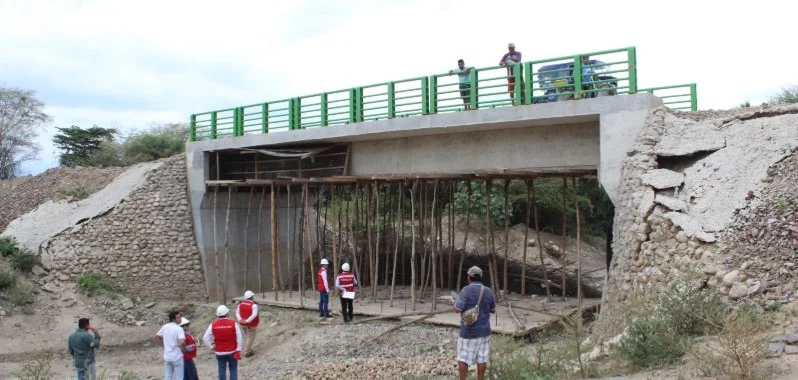
The construction of a critical transport link in the district of La Matanza, Morropón, has been thrust into the spotlight after a damning report from the Comptroller General of the Republic revealed severe technical flaws, jeopardizing the safety and longevity of a project valued at over 1.5 million soles.
Main Facts: A Project Under Scrutiny
The infrastructure project, situated along the vecinal road on the extension of Avenida San Martín de Porres in La Matanza, was intended to improve connectivity for local residents and facilitate the transport of goods in the Morropón province. However, a rigorous inspection conducted by the Comptroller’s Office between April 21 and April 30, 2026, has unearthed a series of structural vulnerabilities that raise serious questions regarding the execution of public works in the region.
According to the official Informe de Visita de Control n.° 006-2026-OCI/0452-SVC, the bridge suffers from fundamental design and construction errors. The most alarming findings include inadequate foundation depths, a lack of cohesive engineering design between the bridge and the existing road, and the use of unsupported fill material to compensate for massive height discrepancies. The project, which represents a significant investment of public funds, currently faces a precarious future, with auditors warning that the structural integrity of the bridge is compromised.
Chronology of the Oversight Process
The timeline of the oversight process highlights a systemic failure in project supervision and technical compliance:
- Pre-Construction Phase (Late 2025/Early 2026): The project moved forward despite a flawed technical dossier. Key geotechnical information, including a detailed profile of the terrain and an engineering design for the transition between the roadway and the bridge, was notably absent from the original plans.
- Execution Phase (Early 2026): Construction proceeded with significant deviations from the initial project scope. The bridge was built at an elevation significantly higher than originally planned. This "height error" forced contractors to perform makeshift adjustments to the approach ramps, leading to the use of soil fills that lacked structural engineering validation.
- Inspection Period (April 21–30, 2026): The Comptroller General initiated a targeted inspection as part of the National Multidisciplinary Territorial Control Operation 2026. During this period, field auditors verified that the bridge height exceeded the road level by 3.70 meters.
- Reporting Phase (May 2026): Following the collection of evidence, the Office of Institutional Control (OCI) formalized its findings in the aforementioned report. This document was transmitted to the District Municipality of La Matanza and published on the Comptroller’s official transparency portal to ensure public accountability.
Supporting Data and Technical Failures
The technical findings documented in the Comptroller’s report paint a picture of negligence and poor planning. The evidence suggests that the bridge is not only poorly designed but also built with disregard for standard geotechnical safety protocols.

1. The Height Discrepancy and Unstable Fills
The bridge stands 3.70 meters higher than the surrounding road network. In standard civil engineering, such a disparity requires a carefully engineered approach ramp with reinforced earth or retaining walls. Instead, the project utilized loose fill materials without a structural design to support them. This creates a significant risk of settlement or total collapse, especially under the weight of heavy vehicles or during seismic events.
2. Foundation Shortfalls
Perhaps the most critical finding is the depth of the foundations. Auditors discovered that the piles and footings were constructed at a shallower depth than what was explicitly recommended in the initial soil study. Foundations are the backbone of any bridge; by failing to meet the required depth, the structure is significantly more susceptible to soil erosion and scouring. Given the geography of the Morropón region, which is prone to intense rainfall and river swelling, the lack of deep anchoring poses an imminent threat to the structure’s stability.
3. Oversight and Topographic Neglect
The report also highlights an administrative failure. Field inspections revealed that construction activities were frequently conducted without the presence of a designated project inspector. Furthermore, the absence of topographical control points around the bridge suggests that the project lacked the necessary geodetic precision required for a structure of this scale. Without these benchmarks, there is no reliable way to monitor the movement, settling, or potential deformation of the bridge over time.
Official Responses and Administrative Implications
The Comptroller General’s report serves as a formal notification to the District Municipality of La Matanza. Under the current mandate, the municipality is required to acknowledge the report and implement corrective measures to mitigate the identified risks.
While the municipality has yet to issue a formal rebuttal or an action plan, the publication of this report on the national transparency portal carries significant weight. It mandates that local authorities must address the structural shortcomings—potentially requiring expensive retrofitting or partial reconstruction—to ensure the bridge does not become a "white elephant" or, worse, a hazard to the public.

For the taxpayers of La Matanza, the implications are twofold: the immediate loss of confidence in the quality of public infrastructure and the long-term economic burden of potential remediation. If the bridge fails, the cost of emergency repairs or complete replacement could far exceed the original 1.5 million sol investment, not to mention the lost productivity caused by the interruption of a key transport route.
Broader Implications for Regional Infrastructure
This case is a microcosm of a broader challenge facing regional governments in Peru. The "National Multidisciplinary Territorial Control Operation" was launched precisely because of recurring issues in decentralized project execution. When technical dossiers are incomplete and field supervision is lax, the result is almost always a waste of public resources and a compromise on public safety.
The failure in Morropón underscores the necessity of three critical reforms in municipal construction:
- Rigorous Dossier Verification: No project should receive the green light for construction until the technical dossier is audited for complete geotechnical and structural data.
- Continuous Field Supervision: The absence of an inspector on-site is a violation of basic project management. Accountability must be enforced for both contractors and the municipal staff responsible for monitoring them.
- Accountability for Design Deviations: The decision to change the bridge’s height during construction without revising the structural plans represents a failure of engineering governance. Moving forward, any deviation from the technical dossier must be subject to an independent peer review before work continues.
Conclusion: A Call to Action
The situation at the La Matanza bridge is critical. With the risk of structural failure exacerbated by environmental factors such as erosion and potential flooding, the municipal government is under immense pressure to act. The Comptroller’s report is not merely a bureaucratic requirement; it is a warning.
If the Municipality of La Matanza fails to address these deficiencies, they risk not only legal and administrative sanctions but also the catastrophic failure of a key piece of infrastructure. The public, the community of Morropón, and national oversight bodies will be watching closely as the local administration navigates the challenge of repairing a project that, in its current state, is fundamentally unfit for purpose. The priority must shift from "finishing the work" to "securing the work," ensuring that public funds are transformed into durable, safe assets that serve the people of Morropón for generations to come.