The strategic construction of the Muyuna Bridge in the Leoncio Prado province is advancing steadily, serving as a cornerstone for the regional government’s commitment to connectivity and economic development. With a completion target set for August 2026, the project is entering its most critical phase of structural engineering.
Executive Summary: Bridging the Gap in Leoncio Prado
The construction of the Muyuna Bridge, a pivotal infrastructure project in the district of Castillo Grande, Huánuco, has officially surpassed 42% physical progress. During a recent site inspection, Huánuco Regional Governor Antonio Pulgar confirmed that despite challenging weather conditions and seasonal rainfall, work on the site has continued without interruption.
This bridge is not merely a transport link; it represents a fundamental shift in the logistical capacity of the Leoncio Prado province. By connecting key urban areas and facilitating the flow of goods and people, the infrastructure project is designed to catalyze local commerce and reduce travel times for thousands of residents. As the regional government intensifies its oversight, the focus has shifted toward the installation of complex structural elements that will define the bridge’s final form.
Chronology and Current Status: A Technical Overview
The project has evolved significantly over the past several months, transitioning from foundational site preparation to the current phase of major structural assembly.
- Initial Phase: Site clearing, soil analysis, and the establishment of perimeter safety zones.
- Intermediate Phase: Completion of initial abutments and the stabilization of riverbank zones.
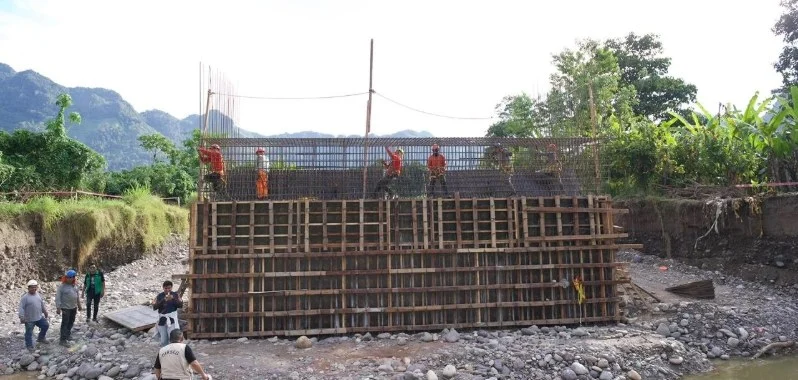
- Current Phase (May 2026): Reaching the 42% completion mark. The current focus is the construction of the central pier and the installation of two massive deep-water piles within the riverbed.
- Final Phase (Upcoming): The assembly and launching of the metallic modules (90 meters and 30 meters respectively), which are being supplied by the Ministry of Transport and Communications (MTC).
The technical complexity of the bridge lies in its interaction with the river’s hydrological behavior. The installation of the central pier is a precision task that requires high-grade materials and engineering oversight to ensure long-term resilience against seasonal flooding.

Supporting Data: Engineering and Connectivity
The Muyuna Bridge is part of a broader "connectivity package" promoted by the regional administration. The integration of this bridge with surrounding infrastructure is a key success factor. During his visit, Governor Pulgar inspected the progress of the paving project on the Jirón Víctor Raúl Haya de la Torre, which serves as a critical access route connecting the bridge to the main town center.
Strategic Projects List:
- Muyuna Bridge: 42% completion, scheduled for August 2026.
- Castillo Grande Bridge: Currently in its final stages of completion.
- Topa Bridge: Set to commence full operations alongside the Muyuna project in August.
- Corpac Bridge: Scheduled for comprehensive maintenance to ensure its continued safety and load-bearing capacity.
The synchronization of these four projects indicates a holistic approach to provincial infrastructure. By ensuring that access roads (like the Haya de la Torre paving) are finished in tandem with the bridge structures, the regional government aims to avoid the common pitfall of "disconnected infrastructure," where bridges are completed but remain inaccessible due to unfinished approach roads.
Official Responses and Strategic Vision
Governor Antonio Pulgar emphasized the resilience of the project teams, noting that the work schedule has been maintained despite the inclement weather that often plagues the Huánuco region during the rainy season.
"The Muyuna Bridge is not just a structure; it is a strategic necessity for the development of Leoncio Prado," Governor Pulgar stated during his address to the local community. "Despite the challenges posed by the rains, our contractors and engineering teams have maintained a consistent pace. We are committed to delivering these projects by August, providing the population with the safe and efficient transit they deserve."
The governor also highlighted the collaborative relationship with the Ministry of Transport and Communications (MTC). The provision of metallic modules by the national government represents a critical supply chain link that ensures the project remains on budget and on schedule.

Socio-Economic Implications
The completion of the Muyuna Bridge is expected to have a multiplier effect on the local economy.
1. Market Access for Farmers
Leoncio Prado is an area with significant agricultural potential. Improved bridge connectivity means that local farmers can transport perishable goods to regional markets more quickly, reducing post-harvest losses and increasing the profit margins for small-scale producers.
2. Urban Expansion and Safety
The current reliance on older, over-capacity bridges creates traffic bottlenecks and safety concerns. By distributing traffic load across the new Muyuna, Topa, and Castillo Grande bridges, the urban center will experience reduced congestion, lower carbon emissions from idling vehicles, and improved emergency response times for ambulances and firefighting equipment.
3. Investment in Social Infrastructure
Beyond transport, the regional government is diversifying its investment portfolio in the province. The announcement of new sports facilities in the sectors of Las Brisas and Supte San Jorge signals a commitment to social well-being that complements the "hard" infrastructure of the bridges. This creates a dual-track development model where economic connectivity is matched by the improvement of quality-of-life indicators for the youth and families of Huánuco.
Looking Ahead: The Tingo María Airport Milestone
The regional government’s infrastructure agenda extends beyond road and bridge networks. In a significant announcement for regional tourism and logistics, the Governor confirmed that operations and improvement works at the Tingo María Airport are slated to restart on May 18.

This restart is crucial. As the Muyuna and Topa bridges prepare to open in August, the restored connectivity of the airport will create an integrated transport hub. Visitors and business travelers will be able to arrive in Tingo María and utilize a modernized road network to reach the surrounding districts, effectively boosting the tourism potential of the Huánuco region.
Challenges and Future Outlook
While the 42% progress is a cause for optimism, the next three months represent a high-pressure environment for project managers. The installation of the 90-meter and 30-meter metallic modules requires perfect weather windows and precise crane logistics. Any significant geological shift or extreme weather event could potentially disrupt the August deadline.
However, the administration’s public confidence—reinforced by the visible progress on the Haya de la Torre paving—suggests that the government has contingency plans in place. For the residents of Leoncio Prado, the progress on the Muyuna Bridge is a tangible sign that years of lobbying for better infrastructure are finally yielding results.
As the region moves toward the August deadline, the eyes of the public and regional stakeholders will remain fixed on the riverbed. With the structural foundation nearing completion, the transition from concrete works to the metallic assembly phase will be the final hurdle before the bridge officially opens to traffic, marking a new era of connectivity for the people of Huánuco.
This report is based on current regional government updates and site inspection data provided by the Huánuco Regional Governor’s office as of May 2026.