The economic relationship between Peru and China has evolved from a simple trade partnership into a profound, multidimensional strategic alliance. As Peru continues to position itself as a global hub for mineral exports and infrastructure development, the synergy between Chinese capital and Peruvian operational expertise has become the backbone of the nation’s industrial trajectory.
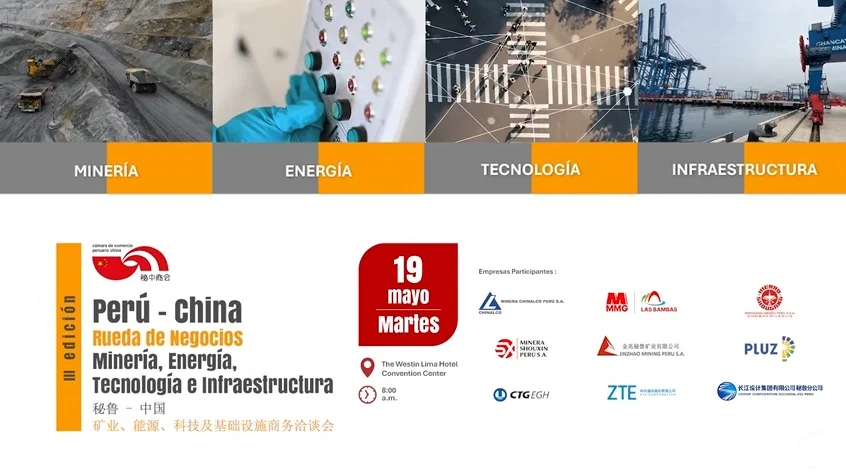
In this spirit of continued integration, the III Edition of the Peru–China Business Summit: Mining, Energy, Technology, and Infrastructure is set to convene on May 19, 2026, at The Westin Lima Hotel & Convention Center. Organized by the Peru-China Chamber of Commerce (CAPECHI), this event represents a critical milestone in fostering a more sophisticated, localized supply chain, inviting domestic providers to integrate directly into the massive projects spearheaded by Chinese multinational corporations.
Main Facts: The Summit’s Strategic Objective
The upcoming summit is not merely a networking event; it is a high-stakes arena designed to bridge the gap between large-scale international operators and the local service sector. The event’s core objective is to facilitate a "win-win" ecosystem where local companies can offer their goods and services to major Chinese enterprises, thereby increasing the domestic content of national projects.
Key Details:
- Date: May 19, 2026.
- Venue: The Westin Lima Hotel & Convention Center.
- Organizer: CAPECHI (Cámara de Comercio Peruano China).
- Focus Sectors: Mining, Energy, Infrastructure, and Technology.
- Target Audience: Suppliers of goods and services, industrial contractors, technology consultants, and logistics providers.
The summit aims to address the persistent challenge of "local integration," where large foreign investments often rely on imported goods. By hosting this summit, CAPECHI provides a platform for Peruvian firms to showcase their competitiveness, safety standards, and operational capacity directly to procurement decision-makers from industry giants.
Chronology: The Evolution of the Peru-China Partnership
To understand the significance of this third edition, one must examine the progression of the bilateral relationship over the past decade.
2010 – 2015: The Infrastructure Foundation
During this period, the focus was predominantly on large-scale raw material extraction. The entry of major Chinese state-owned enterprises into the Peruvian mining landscape marked the beginning of a massive influx of Foreign Direct Investment (FDI).
2016 – 2020: Diversification and Technology
The relationship began to shift toward energy and telecommunications. The entry of Chinese tech giants and renewable energy firms signaled that the bilateral relationship was expanding beyond traditional open-pit mining.
2021 – 2025: Consolidation and Local Integration
The post-pandemic era emphasized resilience and local content. CAPECHI launched the first and second editions of the Business Summit to institutionalize the meeting point between Chinese investment and Peruvian local supply chains.
2026: The Third Summit
The III Edition arrives at a time when Peru’s infrastructure needs—from the Port of Chancay to regional energy grid expansion—require more agile, locally integrated service providers. This summit represents the maturity of the bilateral trade framework, moving from "investment" to "co-development."
Supporting Data: The Industrial Titans in Attendance
The strength of the upcoming summit lies in the caliber of its participants. The event will host a "who’s who" of Chinese industrial powerhouses currently shaping the Peruvian landscape.
Mining Sector Leaders
- Minera Chinalco Perú S.A.: A cornerstone of the copper sector, focusing on the Toromocho operation.
- Minera Las Bambas S.A.: One of the largest copper producers in the world, integral to the regional economy of Apurímac.
- Shougang Hierro Perú S.A.A.: A leader in iron ore production, instrumental in the development of the Marcona region.
- Minera Shouxin Perú S.A. & Jinzhao Mining Perú S.A.: Representing the deepening investment in mineral processing and extraction efficiency.
Energy and Utility Providers
- Pluz Energía Perú S.A.: A key player in the transmission and distribution sector, crucial for the nation’s electrification efforts.
- Empresa de Generación Huallaga S.A. (CTG EGH): A representative of the shift toward sustainable and efficient hydroelectric energy generation.
Infrastructure and Technology
- ZTE Corporation Perú: A global leader in 5G and digital infrastructure, currently helping digitize Peruvian mining operations and urban centers.
- CISPDR Corporation: A major player in engineering, procurement, and construction (EPC), focusing on the technical backbone of modern infrastructure.
Official Perspectives: The Role of CAPECHI
The Peru-China Chamber of Commerce (CAPECHI) has consistently acted as the primary architect of this bilateral dialogue. Their institutional goal is to remove the "information asymmetry" that often keeps smaller Peruvian providers from bidding on large contracts.
According to preliminary briefings from the organizers, the summit will feature specialized workshops where procurement managers from these firms will outline their requirements for the next 24 to 36 months. This transparent exchange of information is designed to help local companies align their certifications and product offerings with international procurement standards.
"The objective," notes an industry analyst familiar with the summit, "is to ensure that the wealth generated by these massive projects is reinvested into the local economy through the hiring of local services, thereby creating a sustainable multiplier effect for Peruvian jobs and innovation."
Implications: The Macro-Economic Impact
The implications of this summit are far-reaching, affecting not just the companies involved, but the broader macroeconomic stability of Peru.
1. Strengthening the Local Supply Chain
By facilitating direct connections, the summit helps to reduce the logistical costs for Chinese firms, who currently have to source many specialized services from overseas. For local providers, it provides a "seal of quality" that can be leveraged to gain further contracts in other international mining markets.
2. Technology Transfer
As Chinese companies bring advanced AI-driven mining solutions and renewable energy technologies to Peru, local partners gain access to these cutting-edge methodologies. This accelerates the modernization of the Peruvian industrial base.
3. Economic Stability
Diversifying the supplier base reduces the risk of project delays. When a Chinese mining company partners with a local maintenance provider, they ensure faster response times and lower downtime, ultimately benefiting the GDP output of the mining sector.
Participation Information and Registration
The organizers have structured the event to ensure that both individual entrepreneurs and larger corporate entities can participate effectively.
Cost Structure (Excluding I.G.V.)
| Category | Individual | Corporate (Per Person, 2+ ppl) |
|---|---|---|
| CAPECHI Member | USD 400.00 | USD 380.00 |
| Non-Member | USD 580.00 | USD 500.00 |
Registration and Contact
For those interested in participating, it is recommended to secure spots early, as space is limited to ensure effective networking sessions.
- Phone: 422-8152 / 422-8358
- WhatsApp: 947 876 888 / 980 838 031
- Email: [email protected]
Conclusion: A Future Forged in Cooperation
The III Peru-China Business Summit is more than a commercial event; it is a manifestation of the deepening trust between two nations. As Peru looks toward 2026 and beyond, the ability to successfully integrate local innovation with global capital will define the success of its major industrial projects.
For the Peruvian supplier, the event is an invitation to scale up. For the Chinese investor, it is an opportunity to deepen roots within the Peruvian community. As both sides gather at the Westin this May, the discussions held will undoubtedly echo through the boardrooms and industrial sites that drive the heartbeat of the Peruvian economy.
By fostering these alliances, Peru and China are ensuring that their shared future is not just built on trade, but on a robust, integrated foundation that promises long-term growth and prosperity for both parties.