In a political development that has sent ripples across the international community, Luiz Inácio Lula da Silva has emerged victorious in Brazil’s high-stakes presidential runoff. The result, confirmed after a tense electoral process, marks an unprecedented milestone in South American political history. As the leader of the Partido dos Trabalhadores (PT) prepares to embark on his fourth presidential term, global leaders have begun to extend their formal congratulations, signaling the beginning of a new chapter in Brazil’s geopolitical trajectory. Among those acknowledging the result was Peruvian political figure Keiko Fujimori, who emphasized the importance of regional stability and shared environmental stewardship.
The Results: A Statistical Breakdown of the Runoff
The final results, confirmed with 100% of the votes counted, reflect a deeply polarized nation. Lula da Silva secured 51.79% of the electorate’s support, narrowly defeating his rival, Senator Flávio Bolsonaro, who garnered 48.21%.
This election is being hailed as a historic comeback. For the first time since the end of Brazil’s military dictatorship (1964–1985), a candidate who placed second in the initial round of voting managed to overcome their opponent in the final runoff. This statistical shift highlights not only the resilience of Lula’s political base but also the volatility of the contemporary Brazilian electorate.
Lula, who will turn 81 this coming Tuesday, is set to be inaugurated in January. His tenure will extend until January 2031, by which time he will be 85 years old. This victory cements his status as the first Brazilian head of state to be elected to four distinct mandates via direct universal suffrage, a testament to his enduring, albeit controversial, influence on the nation’s political fabric.
Chronology of a Political Titan
To understand the gravity of this election, one must look at the arc of Lula da Silva’s career:
- 2002: Lula is elected president for the first time, representing a massive shift toward progressive governance in Latin America.
- 2006: Following a successful first term defined by social programs that lifted millions out of poverty, he is re-elected for a second consecutive mandate.
- 2011–2022: A long hiatus from the presidency follows, characterized by intense legal battles, judicial scrutiny, and a significant period of political turmoil within Brazil.
- 2023: Lula returns to the presidency, marking a dramatic political resurrection.
- 2026: In a landmark achievement, Lula secures his fourth mandate, solidifying his role as the dominant figure in 21st-century Brazilian politics.
Official Responses: The Regional Perspective
The international community has closely monitored the Brazilian elections, recognizing that the nation’s leadership plays a pivotal role in the stability and economic integration of Latin America.
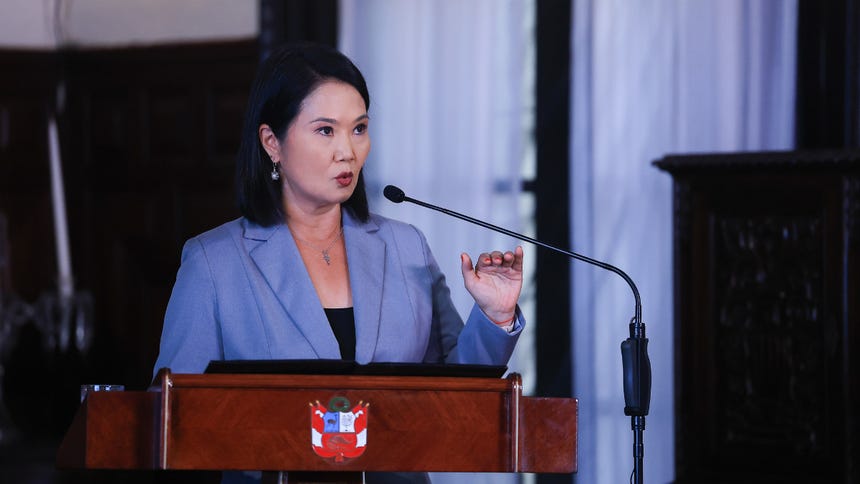
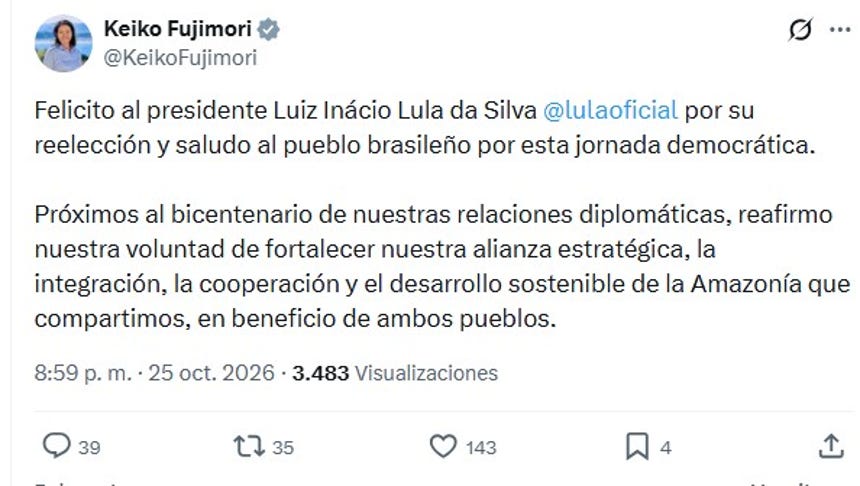
Keiko Fujimori Higuchi was among the prominent figures to publicly address the outcome. In a statement disseminated through her social media channels, she noted: "I congratulate President Luiz Inácio Lula da Silva on his re-election and salute the Brazilian people for this democratic exercise. As we approach the bicentennial of our diplomatic relations, I reaffirm our will to strengthen our strategic alliance, integration, cooperation, and the sustainable development of the Amazon that we share, for the benefit of both our peoples."
Fujimori’s message reflects a broader regional sentiment. Leaders from Chile, Bolivia, Mexico, Panama, Uruguay, Guatemala, Ecuador, and Paraguay have also issued official messages of congratulation. This wave of support from across the ideological spectrum underscores a collective desire for regional cooperation, particularly regarding the preservation of the Amazon rainforest—a topic that has moved to the center of global climate discussions.
The Implications of the Fourth Mandate
The return of Lula to the presidency for a fourth term carries profound implications for both domestic and foreign policy.
1. Environmental Stewardship and the Amazon
Perhaps the most significant international expectation surrounding this administration is the protection of the Amazon basin. With the global community increasingly focused on climate change, Lula’s commitment to sustainable development will be under the microscope. His previous administrations were marked by aggressive anti-deforestation efforts, and observers expect him to pivot back to these environmental protections to regain Brazil’s standing as a global ecological leader.
2. Economic Policy and Social Cohesion
Brazil faces the dual challenge of managing inflation and addressing deep-seated social inequality. The narrow margin of his victory—roughly 3.5 percentage points—suggests that Lula inherits a nation that is fractured. His primary task will be to govern not just for his base, but to bridge the divide between the progressive urban centers and the more conservative segments of the population. His past experience in coalition building will be tested as he attempts to navigate a legislature that may be deeply skeptical of his agenda.
3. Geopolitical Alignment
Lula has historically favored a "multipolar" world view. Analysts anticipate that his administration will seek to strengthen ties within the BRICS alliance (Brazil, Russia, India, China, and South Africa) while maintaining a balanced relationship with the United States and the European Union. His return is expected to inject a new sense of energy into South American integration blocs, such as Mercosur and UNASUR, as he seeks to position Brazil as the primary interlocutor for the region on the global stage.
Challenges Ahead: A Divided Nation
While the victory is historic, the road ahead is fraught with complexity. The electoral data reveals a clear demographic and geographic split in the country. The opposition, led by Flávio Bolsonaro, retains a significant block of voters who remain deeply suspicious of the PT’s long-term objectives.
For a leader entering his ninth decade, the physical and political demands of the office will be substantial. Lula must balance the need for radical social reform with the pragmatic realities of a global economy that is currently navigating high interest rates and supply chain uncertainties.
Furthermore, the integrity of the democratic process itself has been a point of contention throughout the campaign. The fact that the election resulted in a peaceful, if narrow, transfer of mandate is a victory for Brazilian institutions. However, the task of national reconciliation remains the most difficult challenge of all. Lula has promised a government of "all Brazilians," but he will need to move quickly to translate that rhetoric into tangible policy if he is to avoid the stagnation that has plagued his predecessors.
Conclusion: The Final Chapter
Luiz Inácio Lula da Silva’s fourth mandate is more than just a political victory; it is a profound testament to the resilience of his personal brand and the enduring legacy of the workers’ movement in Brazil. As the dust settles on the 2026 elections, the world watches with bated breath to see how this seasoned veteran will handle the responsibilities of leadership in an era defined by rapid technological change, environmental crisis, and shifting geopolitical alliances.
The congratulatory messages from across Latin America—including the pragmatic and forward-looking note from Keiko Fujimori—signal a regional consensus that Brazil remains the heartbeat of South America. Whether Lula can leverage this goodwill to foster a new era of prosperity remains to be seen. What is certain, however, is that history is being written in Brasilia, and the chapters ahead will be among the most consequential in the modern era of the Southern Hemisphere.
As the inauguration approaches in January, all eyes will be on the Cabinet appointments and the first legislative agenda, which will serve as the true litmus test for the direction of the fourth Lula administration.