In a significant development for the educational landscape of the Peruvian highlands, the construction of the High-Performance School (COAR) in Huancavelica is set to resume at full capacity. Following a period of temporary operational suspension, the project—a cornerstone of regional educational infrastructure—is back on track, promising to deliver a state-of-the-art facility for over 300 gifted students.
The confirmation came during a high-level oversight meeting attended by representatives from the Office of the Comptroller General of the Republic, the Public Ministry, the Regional Government of Huancavelica, and local legislative representatives. The meeting served as a pivotal platform for the concessionaire, Collana, to outline its recovery strategy and reaffirm its commitment to the project’s original delivery schedule.
The Significance of the COAR Huancavelica Project
The COAR Huancavelica is not merely a school; it is a flagship initiative designed to provide high-quality, specialized education to the region’s most academically talented students. As part of the broader "COAR Centro" package, this facility represents a significant investment in human capital. With a total budget of 106.47 million soles (106,479,478.54 PEN), the project is a testament to the government’s efforts to decentralize educational excellence.
Beyond its academic mission, the construction site serves as a vital economic engine for the region. Currently, the project employs over 200 workers, the vast majority of whom are residents of Huancavelica. The continuity of this project is, therefore, as much about local economic stability as it is about the future of the region’s youth.
Chronology: Navigating Challenges and Reaching Milestones
The path to building this modern educational hub has been characterized by complex engineering requirements and rigorous institutional oversight.
Phase 1: Planning and Implementation
The project commenced as the first educational facility in Peru to be developed under the Public-Private Partnership (APP) model. The Concessionaire Collana, backed by its parent company Marnhos, took on the responsibility of designing, financing, and constructing the complex, adhering to strict national standards for educational infrastructure.

Phase 2: Technical Hurdles
During the initial excavation and foundation phases, engineers encountered unforeseen geological challenges. The site, situated in a region with complex soil characteristics, presented issues related to high moisture content and an aggressive water table. These environmental factors necessitated a temporary slowdown in progress to ensure that the structural integrity of the future campus would not be compromised.
Phase 3: The Recent Suspension and Resolution
In recent months, the project experienced a tactical pause to allow for the reassessment of construction timelines and the procurement of specialized materials. This period of inactivity raised concerns among local stakeholders, prompting the intervention of the Comptroller General and regional authorities. The recent meeting served to bridge the gap between these concerns and the reality of the construction site, resulting in a clear path forward for the resumption of full-scale operations.
Engineering Excellence: Overcoming the Andean Landscape
The project’s technical narrative is a study in specialized civil engineering. The decision to address the site’s "swampy" soil conditions and the aggressive water table through robust, science-backed solutions has been the project’s primary engineering focus.
The Micropile Solution
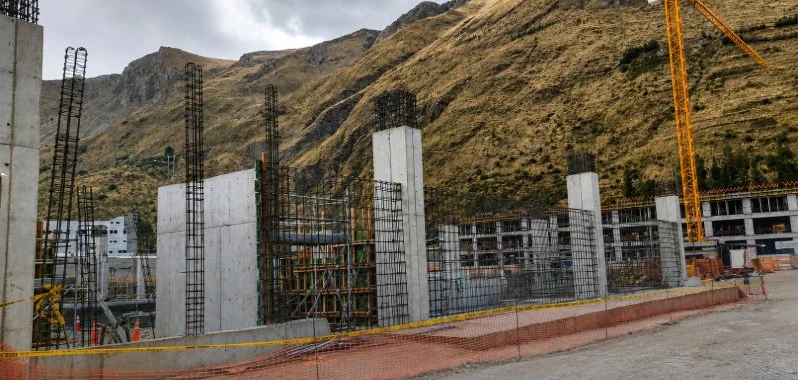
To ensure the long-term stability and seismic resilience of the buildings, the engineering team implemented a series of micropiles. These deep foundation elements penetrate the unstable strata to reach load-bearing layers, providing a secure base for the heavy structural loads of the school’s various pavilions.
Subdrenage and Perimeter Security
Beyond the foundation, the site has undergone extensive subdrenage works across all sectors—Education, Residence, Polideportivo (Sports Center), and Administrative/Service areas. These measures are designed to mitigate the risks of soil saturation. Additionally, the project features a massive perimeter fence spanning over 1,000 linear meters. This security structure is not merely a boundary but a reinforced engineering feat in itself, featuring deep foundations designed to withstand the region’s specific climatic and soil-related stresses.
Official Responses and Stakeholder Commitments
During the site visit and subsequent roundtable, the transparency of the process was underscored by the presence of multiple government entities.

The Concessionaire Collana and its parent firm, Marnhos, took full responsibility for the temporary reduction in labor intensity. They explained that the adjustments were part of an "exceptional technical realignment" intended to safeguard the quality of the finished product. In their official statement to the attending authorities, the company emphasized that they have already implemented the necessary technical protocols to accelerate progress, ensuring that the final handover will remain within the contractually mandated timeline.
The regional authorities and the Comptroller’s office expressed their satisfaction with the roadmap presented. The focus, they noted, remains on "zero tolerance" for project abandonment. The commitment from the private partner to maintain the current workforce—predominantly composed of local Huancavelicans—was identified as a critical success factor that must be protected throughout the remaining construction phases.
Socio-Economic Implications for Huancavelica
The completion of the COAR Huancavelica will have profound long-term implications for the department.
Educational Equity
By providing a facility that includes specialized classrooms, a comprehensive library, a modern sports complex, and boarding facilities, the project aims to bridge the educational divide between the capital and the provinces. It creates a space where meritocracy can flourish, allowing students from diverse economic backgrounds in Huancavelica to access international-standard curricula.
Local Economic Impact
The construction phase itself has acted as a catalyst for local employment and skill development. The 200+ workers on site have been engaged in highly technical construction tasks, from concrete works for the micropiles to specialized drainage installation. This creates a legacy of skilled labor in the region, as workers gain experience on a project of this scale and complexity.
The APP Model as a Precedent
As the first education-sector project under the Public-Private Partnership model, the COAR Huancavelica is being closely watched by the Ministry of Education. Its successful delivery is expected to serve as a blueprint for future infrastructure projects across Peru. The collaboration between the state, which provides the vision and oversight, and the private sector, which provides the technical expertise and project management, is being tested in real-time. If successful, this model could accelerate the construction of similar high-impact facilities nationwide.

Future Outlook
As the dust settles and the project enters its next phase of rapid development, the focus shifts toward the interior finishing and the installation of technical equipment. With the technical engineering challenges largely behind them, the construction team is now transitioning to the vertical expansion of the campus.
The stakeholders involved have agreed to maintain a monthly monitoring schedule to ensure that the progress remains consistent. For the residents of Huancavelica, the promise of the COAR represents more than just a new building; it is a promise of progress. As the walls rise and the structures take their final form, the project stands as a testament to the resilience of the community and the collaborative effort required to build a better future for the next generation of Peruvian leaders.
The successful navigation of these challenges proves that with rigorous oversight and engineering innovation, even the most difficult terrains can be transformed into centers of excellence. As construction resumes, all eyes remain on the site, waiting for the day when the gates finally open to welcome the first cohort of students to their new home of learning.