By Investigative Desk
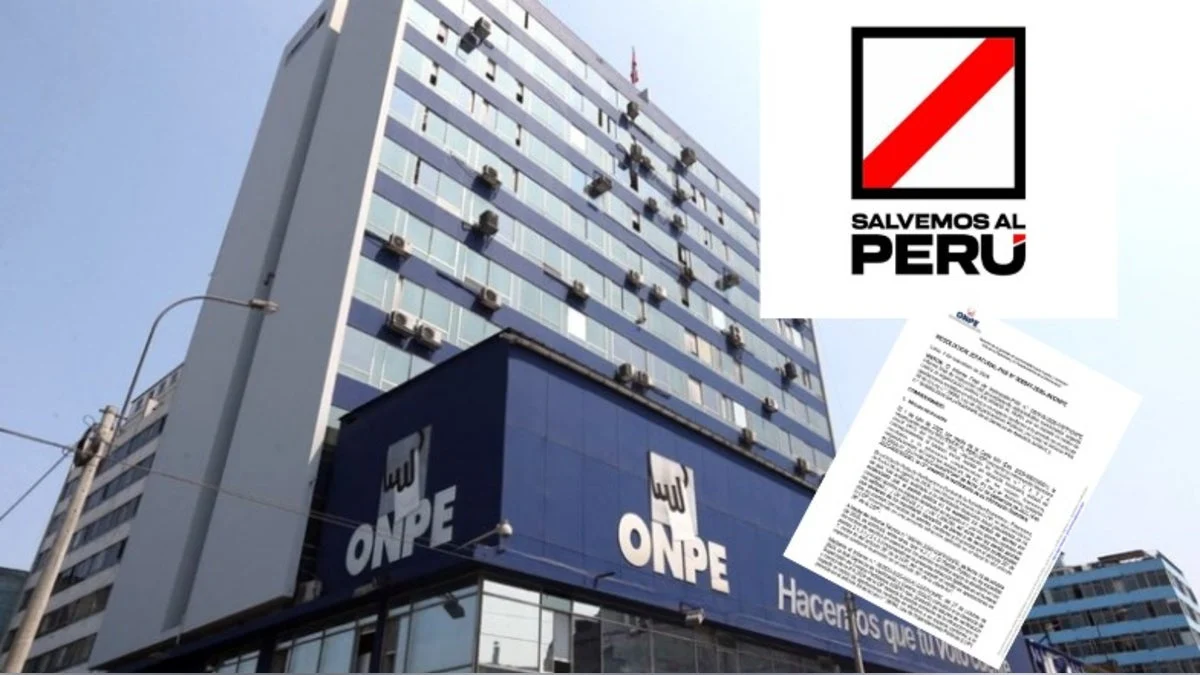
The Office of National Processes (ONPE), the electoral authority of Peru, has issued a significant financial penalty against the political organization "Salvemos al Perú." The sanction, totaling 16 Tax Units (UIT)—equivalent to S/82,400—stems from the party’s failure to comply with mandatory transparency regulations regarding the reporting of in-kind contributions.
This development, formalized in the Resolución Jefatural-PAS N° 000047-2026-JN/ONPE, dated September 7, 2026, and signed by the interim head of the ONPE, Bernardo Juan Pachas Serrano, highlights the ongoing struggles of emerging political parties to maintain rigorous financial oversight during non-election years.
Core Facts: The Transparency Failure
The core of the controversy lies in the party’s Annual Financial Information (IFA) for the fiscal year 2024, submitted to the electoral authority on July 1, 2025. Upon auditing the submission, the ONPE’s fiscalization unit identified a lack of proper documentation for three distinct in-kind contributions. Under the Law of Political Organizations, every contribution, whether monetary or in-kind, must be formally registered and accompanied by official receipts to ensure that political financing remains transparent and traceable.
The three specific observations cited by the ONPE include:
- A minor in-kind contribution valued at S/260.
- A larger in-kind contribution valued at S/1,200.
- The undocumented use of a party headquarters located in the Cercado district of Lima.
The third item is particularly significant. The ONPE determined that because the party could not produce a lease agreement or proof of payment for the use of the property, the occupation of the space constituted an in-kind donation from the owner of the premises to the political group. By failing to register this as an official contribution, the party violated the financial reporting standards set by law.
A Detailed Chronology of the Case
The timeline of this administrative process reflects a pattern of delayed compliance that ultimately led to the punitive measures currently in place:
- July 1, 2025: "Salvemos al Perú" submits its Annual Financial Information (IFA) for the 2024 period.
- Late 2025 – Early 2026: ONPE auditors flag the absence of receipts for three in-kind contributions, triggering an administrative investigation.
- March 6, 2026: In a reactive move, the party attempts to submit the missing receipts for the two smaller contributions (S/260 and S/1,200). However, the documentation for the headquarters remains missing.
- September 7, 2026: The ONPE issues Resolución Jefatural-PAS N° 000047-2026-JN/ONPE, officially imposing a fine of 16 UIT.
- Post-September 2026: The organization is granted a 30-day window to rectify the remaining documentation or face further, more severe legal consequences.
The Issue of "Tardy Subsanación"
A critical point of contention in the ONPE’s report is the concept of subsanación (rectification). While the party attempted to fix two of its three reporting errors in March 2026, the electoral authority rejected these efforts as sufficient grounds to waive the fine.
The ONPE’s Informe n.° 002296-2026-SGVC-GSFP/ONPE explicitly states that the submission of the two receipts occurred well after the start of the sanctioning process and the issuance of the final audit report. More importantly, the party failed to provide any documentation regarding the Cercado de Lima property.

"The organization’s claims regarding the rectification of the headquarters’ usage do not possess evidentiary support," the report notes. Consequently, the electoral authority deemed the entire filing process non-compliant, as a partial correction does not absolve the organization of its fundamental duty to present complete financial records.
Official Responses and Political Repercussions
When contacted by El Poder en tus Manos, the investigative unit of RPP, the President of "Salvemos al Perú," Guillermo Suárez, expressed surprise regarding the public disclosure of the sanction.
"I am unaware of the publication of this resolution," Suárez stated. When pressed on the substance of the fine, he remained evasive, remarking, "I do not agree with the sanction. It is a matter that we must discuss with the party’s accountant and the secretary-general."
The lack of a coherent response from the party leadership underscores a potential disconnect between the legal requirements of political participation and the administrative capabilities of the organization. For a party that has already faced public scrutiny—including controversies surrounding the selection of its presidential candidate—this financial penalty represents a significant blow to its credibility.
Broader Implications for Political Oversight
The imposition of this fine is not merely a bureaucratic formality; it serves as a litmus test for the ONPE’s current stance on party transparency. By choosing to apply the minimum penalty allowed by law (16 UIT), the ONPE has signaled that it is prioritizing the enforcement of transparency standards over the potential disruption of a party’s operations.
The Financial Burden
The fine of S/82,400, calculated based on the 2024 UIT value of S/5,150, is a substantial amount for a smaller political organization. The resolution provides a potential "carrot" for compliance: if the party chooses not to appeal the decision and pays the fine promptly, it may be eligible for a 25% reduction in the total amount. However, this is contingent on the party acknowledging its failure and settling the debt.
Escalation Risks
The ONPE has issued a formal warning: the party must resolve the remaining documentation issues regarding the Cercado de Lima office within 30 working days. Failure to comply with this new deadline could trigger a "very serious" infraction proceeding. Such a classification could lead to more severe penalties, potentially impacting the party’s ability to receive public funding or even jeopardizing its registration status ahead of upcoming election cycles.
Conclusion: The Transparency Standard
The case of "Salvemos al Perú" serves as a stark reminder to all political entities in the country that financial reporting is not a suggestion, but a prerequisite for democratic legitimacy. As Peru moves closer to the 2026 elections, the role of the ONPE as an auditor of private and in-kind contributions is becoming increasingly central.
For the electorate, these findings provide a glimpse into the internal governance of the parties vying for power. When an organization cannot manage the basic documentation of its own office space or small donations, it raises valid questions about how it might manage the broader, more complex finances of the state if elected. As the 30-day deadline looms, the public, and the electoral authority, will be watching to see if "Salvemos al Perú" can transform its administrative processes or if this incident is merely the beginning of a larger pattern of institutional neglect.