The administration of President Keiko Fujimori finds itself at a critical juncture. As the Ministry of Economy and Finance (MEF) unveils its latest Marco Macroeconómico Multianual (MMM)—the cornerstone document guiding the nation’s fiscal trajectory—a stark reality has emerged: the gap between political promise and technical projection. While the government has revised its growth outlook upward, the path to the "economic miracle" promised during the presidential campaign remains fraught with structural hurdles, skeptical fiscal watchdogs, and the lingering shadows of climate instability.
Main Facts: The Numbers Behind the Policy
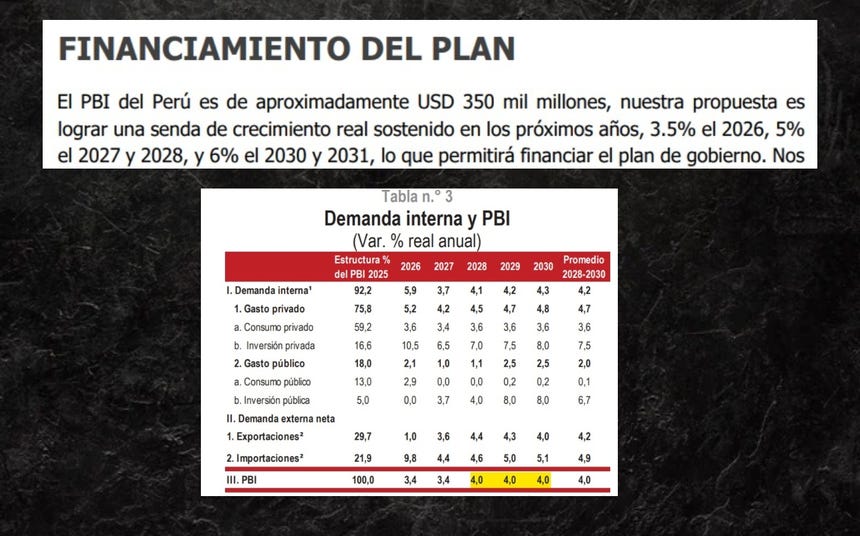
The MEF, under the leadership of Minister Elmer Cuba, has officially signaled a more optimistic outlook for the Peruvian economy. The latest projections place GDP growth at 3.4% for both 2026 and 2027, an improvement over the 3.2% estimated in the April update. By the close of the current presidential term, the ministry anticipates the economy to settle into a 4% annual growth rate.
However, these figures stand in contrast to the electoral promises that propelled the current administration into power. The campaign manifesto of Fuerza Popular explicitly pledged to restore Peru to a high-growth trajectory, targeting a 3.5% expansion in 2026, accelerating to 5% in 2027 and 2028, and ultimately hitting a "golden" 6% per annum by 2030 and 2031. This 6% target, a figure not seen consistently in over a decade, was the central pillar of the government’s economic credibility. As it stands, the official MMM leaves the country two percentage points short of that ambitious mark by the end of the decade.
Chronology of Economic Governance
The evolution of these projections reflects the volatile nature of the Peruvian political and economic landscape over the last year:
- Early 2026: The government takes office, inheriting a sluggish economy and a complex regulatory framework. The administration identifies the simplification of tax regimes for Micro and Small Enterprises (MYPEs) as a priority to boost formalization.
- April 2026: The Informe de Actualización de Proyecciones Macroeconómicas (IAPM) provides a conservative baseline of 3.2% growth, reflecting caution amidst regional instability and fears of climate-related disruptions.
- Mid-2026: Minister Elmer Cuba announces a radical overhaul of tax systems, specifically targeting the sunsetting of regimes like the RUS and RER, arguing that a more robust tax base is necessary to fund the state’s developmental agenda.
- August 2026: The official publication of the Multi-Annual Macroeconomic Framework (MMM). While growth is revised upward to 3.4%, the administration acknowledges that reaching the 6% target remains a long-term goal rather than a near-term certainty.
- Present Day: The government continues to lobby for private investment, while the Council Fiscal (CF) raises alarms regarding the sustainability of the current fiscal path and the optimism of the MEF’s revenue forecasts.
Supporting Data: The Drivers of Growth
The MEF’s optimism is primarily anchored in the performance of the private sector. The ministry projects a 10.5% growth in private investment for 2026, with a subsequent 6.5% increase in 2027. The narrative is clear: the administration believes that by unlocking key mining projects—such as Tía María, the replenishment of Ferrobamba, Pampa de Pongo, and Corani—the country can catalyze a broader economic revival.
Mining remains the lifeblood of the Peruvian export sector. With the current favorable prices for copper and gold, the government has experienced a temporary windfall in tax revenue. This, coupled with a successful campaign to incentivize tax regularization, has allowed the administration to present a more balanced fiscal sheet in the short term. However, the reliance on these volatile commodity cycles remains a point of contention for analysts who argue that long-term growth requires deeper structural reforms beyond just mining extraction.
Official Responses: Between Pragmatism and Ambition
Minister Elmer Cuba remains the government’s most vocal advocate for the 6% growth goal. Despite the conservative numbers in the formal MMM, Cuba maintains that these projections are a "floor" rather than a ceiling. In various public statements, he has emphasized that the "north star" of this administration is reaching that 6% mark during the second half of the term.
"These figures are the compass for this management," Cuba remarked, signaling that the administration is working on secondary policies designed to bridge the gap. His argument rests on the improvement of business confidence and employment figures. According to the Minister, once the initial structural adjustments—such as the reform of the MYPE tax regimes—are fully implemented, the resulting surge in investment will provide the necessary momentum to surpass the current 4% trajectory.
The Council Fiscal: A Voice of Caution
The Council Fiscal (CF), the autonomous body tasked with safeguarding the integrity of the nation’s public finances, has been far less enthusiastic. In their latest report, they explicitly characterized the government’s projections as "exigente" (demanding).
The CF highlights three primary risks that could derail the government’s plan:
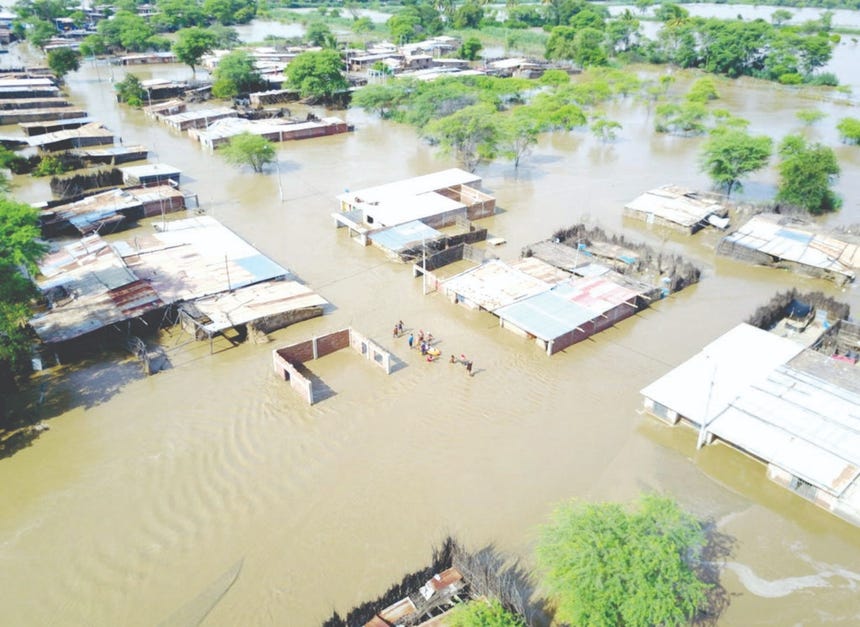
- Climate Instability: The MEF assumes a rapid dissipation of climatic shocks. However, the CF notes that the anomalous heating of the sea and the persistent hydrological deficit in the southern highlands pose a direct threat to the agricultural and fishing sectors. The fishing industry, in particular, is bracing for a projected contraction of nearly 26% in 2026, which acts as a drag on the overall national economy.
- Diminishing Mining Scale: The CF points out that the current pipeline of mining projects is significantly smaller in scale compared to the massive "super-cycle" projects like Quellaveco or Las Bambas. Relying on smaller-scale mining to generate the same level of macroeconomic impact is, in their view, mathematically challenging.
- Investment Translation: The CF warns that positive business sentiment is only half the battle. For the economy to grow at 4% or higher, this sentiment must immediately translate into "shovel-ready" investment decisions, a process that is often hindered by bureaucratic red tape and social conflicts.
Implications: The Road Ahead
The implications of this discrepancy between the 6% promise and the 4% reality are profound. For the Fujimori administration, the ability to deliver on its economic agenda is tied to its political survival. If growth remains stuck at 4%, the government may struggle to fund the ambitious social programs and infrastructure projects promised to the electorate.
Furthermore, the fiscal "relief" experienced in 2026 is, as the CF warns, likely transitory. The windfall from copper and gold prices masks underlying structural weaknesses in the tax base. If the government fails to broaden the tax net while simultaneously failing to hit the 6% growth target, the country could face a period of fiscal tightening, potentially leading to social unrest or a loss of investor confidence.
As Peru moves toward the end of the decade, the government is essentially betting on a "virtuous cycle": that current reforms will trigger enough private investment to overcome climate risks and fiscal limitations. Whether this strategy will yield the transformative results promised during the campaign or whether it will necessitate a recalibration of political expectations remains the defining economic question for the remainder of the quinquennium.
Ultimately, the administration is walking a tightrope. It must maintain the trust of international markets and the Council Fiscal by providing realistic projections, while simultaneously keeping the promise of a 6% growth rate to maintain domestic political support. For Minister Elmer Cuba, the coming months will be a test of whether his policy levers—tax reform, mining incentives, and business confidence—can defy the cautious consensus of economic experts.