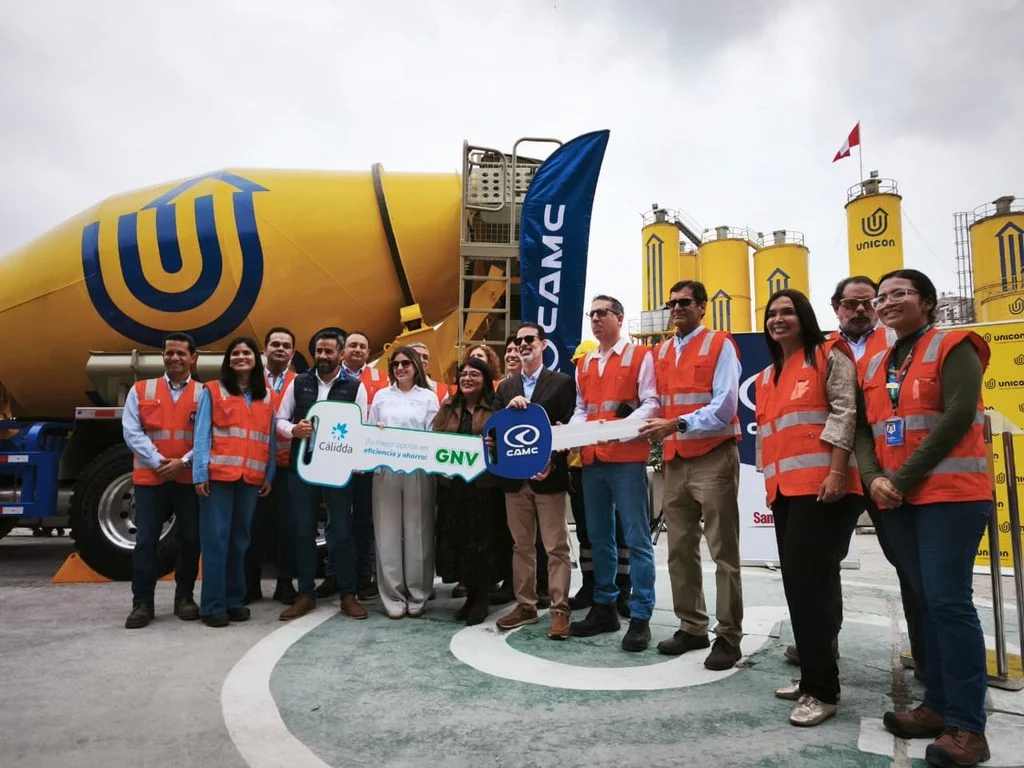
In a landmark achievement for the Peruvian transportation and energy sectors, the nation has officially reached a critical threshold: 10,000 heavy-duty vehicles now operate on Natural Gas for Vehicles (GNV). This milestone was punctuated by the delivery of 90 state-of-the-art GNV-powered mixer trucks to Unicon, a move spearheaded by San Bartolomé. This transition signals a decisive shift toward decarbonization in the construction and logistics industries, proving that environmental responsibility and operational efficiency are not mutually exclusive.
The ceremonial handover, held at Unicon’s San Juan plant, served as a gathering point for industry leaders, government officials, and energy stakeholders. As the fleet hits the road, it marks a triumphant chapter in an 18-year journey of technological adoption, validation, and national progress.
Main Facts: The Unicon-San Bartolomé Partnership
The core of this development lies in the strategic renewal of Unicon’s fleet. By integrating 90 new mixer trucks powered by GNV, Unicon is not merely upgrading its hardware; it is setting a new standard for the Peruvian construction sector.
The vehicles are equipped with Euro 6 technology—a global benchmark for low-emission engines. Compared to traditional diesel-powered counterparts, these units drastically reduce particulate matter and nitrogen oxide emissions, contributing significantly to the improvement of urban air quality. The collaboration between San Bartolomé, the provider of these heavy-duty assets, and Unicon, the operator, underscores a commitment to long-term sustainability that extends beyond immediate corporate gains.
A Chronology of Progress: 18 Years in the Making
The path to this 10,000-vehicle milestone was not paved overnight. It is the result of nearly two decades of persistent effort, research, and iterative improvement.
- The Early Years (2008–2012): The initial introduction of GNV engines into the Peruvian market was met with significant skepticism. During this period, industry operators harbored deep-seated doubts regarding the power, torque, and long-term durability of gas-powered engines in the demanding conditions of heavy construction work.
- The Validation Phase (2013–2018): Through pilot programs and incremental fleet additions, companies like Unicon and suppliers like San Bartolomé began gathering longitudinal data. These years were spent proving that GNV engines could handle the high-load demands of the concrete industry while maintaining engine integrity.
- The Maturity Stage (2019–2025): With the data confirming that GNV technology matched, and in some metrics exceeded, the performance of diesel units, the transition gained momentum. The industry moved from testing to widespread adoption.
- The Milestone Achievement (2026): With the delivery of the 90 new units, Peru solidifies its position as a regional leader in the transition to cleaner fuels for heavy logistics, reaching the 10,000-vehicle mark.
Supporting Data: Why GNV is Winning the Argument
The success of this transition is supported by compelling operational and economic arguments. Ernesto Zapata, General Manager of San Bartolomé, noted that the “myths” surrounding gas-powered engines have been thoroughly debunked.

Operational Efficiency
Modern GNV trucks, particularly those featuring Euro 6 standards, provide a performance profile that rivals traditional diesel engines. The torque curves and power delivery are now optimized for the stop-start nature of urban construction and the heavy load requirements of concrete transport.
Economic Viability
Beyond the environmental benefits, the transition is rooted in the economic reality of the Peruvian market. Peru possesses significant natural gas reserves, making GNV a stable, locally sourced, and cost-competitive fuel compared to imported, volatile-priced diesel. This energy independence creates a resilient supply chain for major industrial players.
Emission Reductions
The shift to Euro 6 technology is a significant jump in environmental performance. These engines are designed to capture and neutralize pollutants at the source. For a city like Lima, where traffic-related pollution is a primary concern, the widespread adoption of GNV by fleets as large as Unicon’s provides a measurable improvement in environmental health outcomes.
Official Responses: Aligning Public and Private Sectors
The event at the San Juan plant was more than a corporate ceremony; it was a testament to the synergy between the public and private sectors.
Ernesto Zapata, General Manager of San Bartolomé:
Zapata emphasized that the current success is the culmination of years of collaborative testing. He stated, "Today, those myths are completely shattered. Our units have demonstrated excellent operational efficiency and performance that is not only comparable to diesel but, in specific conditions, superior." He highlighted that the utilization of local natural gas benefits the entire national value chain, reinforcing the country’s energy sovereignty.
Raquel Soto, Vice Minister of Environmental Management:
Representing the Ministry of the Environment (Minam), Soto underscored the importance of this milestone for the national energy transition. She remarked that the collaboration between companies like Unicon and San Bartolomé serves as a roadmap for other sectors. "This is a prime example of how public-private articulation can drive the adoption of low-emission technologies, moving us closer to our national goals for sustainable development and improved air quality."

Representatives from Cálidda, the natural gas distributor, also played a crucial role, highlighting that the infrastructure for GNV is now robust enough to support not just small vehicles, but the backbone of the country’s industrial transport.
Implications: The Future of Peruvian Logistics
Reaching 10,000 GNV heavy-duty vehicles is a "proof of concept" that will likely trigger a ripple effect across the nation.
1. Market Confidence
With the "durability" question answered, smaller logistics companies and transport fleets are now more likely to transition to GNV. The risk-aversion that previously slowed adoption has been replaced by evidence-based confidence.
2. Infrastructure Expansion
The growth of the GNV fleet necessitates a continued expansion of refueling infrastructure. We can expect to see an increase in high-capacity, high-flow filling stations strategically located along major industrial corridors and near mining and construction hubs.
3. Regulatory Encouragement
This milestone gives the Ministry of the Environment and the Ministry of Energy and Mines a strong platform to advocate for further incentives, such as tax breaks for companies investing in Euro 6 or equivalent low-emission fleets, further accelerating the phase-out of older, higher-polluting diesel engines.
4. A Template for the Region
Peru is now setting a benchmark for other Latin American nations. The model of using an abundant, domestic energy resource (natural gas) to solve an industrial problem (logistics costs and carbon emissions) is a replicable strategy that can be adapted across the Andean region.

Conclusion: A Turning Point for Sustainability
The addition of 90 new GNV-powered mixers to the Unicon fleet is more than a routine equipment upgrade; it is a symbol of a changing industrial landscape. By moving past the initial skepticism that characterized the early 2000s, Peru has proven that it can effectively integrate cleaner, more efficient, and cost-effective energy solutions into its most demanding sectors.
As the nation moves toward a more sustainable future, the 10,000-vehicle milestone serves as a foundation. It proves that with long-term vision, public-private cooperation, and the courage to challenge established industrial myths, significant progress is possible. For San Bartolomé and Unicon, the mission now continues—scaling these successes and ensuring that the next 10,000 vehicles are brought into service with even greater efficiency and environmental awareness.
The message to the rest of the industry is clear: the transition to cleaner, more efficient transportation is not a distant future goal—it is a present-day reality, and the engines of progress are running on natural gas.