The Peruvian labor market is currently facing a silent crisis that threatens the economic mobility of its youngest generation. Recent data paints a stark picture: over 215,000 young people have exited the workforce in the last year alone, and for those who remain employed, a staggering 84% operate within the informal sector. Faced with a landscape defined by precariousness, unemployment, and a profound mismatch between academic training and industrial demand, the business movement Es Hoy and Apoyo Consultoría have unveiled a comprehensive four-pillar proposal aimed at catalyzing formal youth employment without compromising labor rights.
The Reality of the Modern Peruvian Workplace
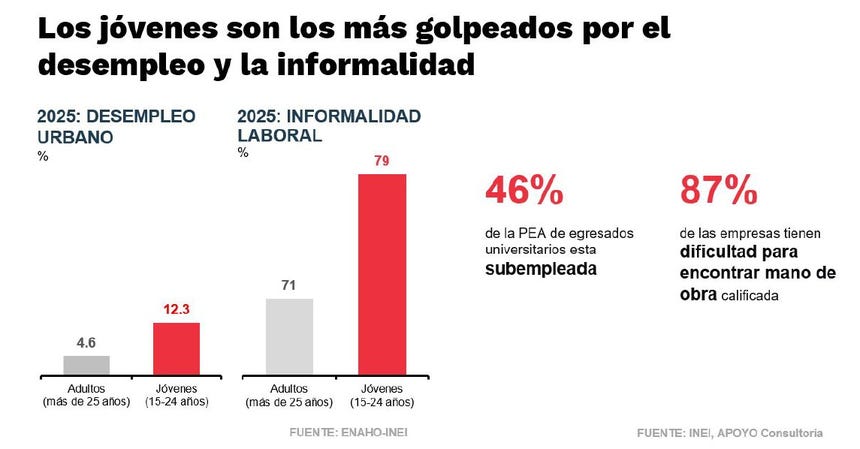
The situation for young professionals is increasingly untenable. Current statistics reveal that 46% of university graduates are underemployed. In practical terms, this means that one out of every two young people who has completed their higher education is working 35 hours or more per week, yet fails to earn enough to cover the basic consumption basket—a benchmark currently valued by the National Institute of Statistics and Informatics (INEI) at approximately S/462 per person monthly.
This is not merely a lack of opportunity, but a systemic failure of quality. While 87% of companies report significant difficulties in finding qualified personnel, a vast majority of the youth population remains trapped in low-productivity, informal roles. This paradox was the focal point of the recent forum, "The Minimum for the First 100 Days in Youth Employment: How to Boost Employment While Guaranteeing Rights," where industry leaders and economic experts gathered to diagnose the structural roots of the problem.
A Chronology of the Crisis and the Call for Reform
To understand the urgency of these proposals, one must look at the recent trajectory of the labor market:
- The Pre-Pandemic Baseline: Before 2020, youth unemployment was already disproportionately higher than that of older age groups, but the pandemic accelerated the shift toward informality.
- The "Pulpín Law" Legacy: Years ago, an attempt to reduce youth unemployment through the relaxation of labor rights—the so-called "Ley Pulpín"—was met with massive social unrest. The failure of this policy left a lasting stigma on the concept of "labor flexibility," making it politically difficult for subsequent administrations to address the cost of entry for new workers.
- The Current Stagnation (2023-2024): With inflation impacting the cost of living and the education system failing to pivot toward market needs, the gap between the classroom and the factory floor has reached a breaking point.
- The Present Day: The Es Hoy and Apoyo Consultoría initiative marks a shift in strategy. Instead of asking workers to sacrifice their rights to become "more attractive" to employers, the current proposal shifts the financial burden of the "learning curve" onto the State via targeted tax incentives.
Supporting Data: The Case for Targeted Intervention
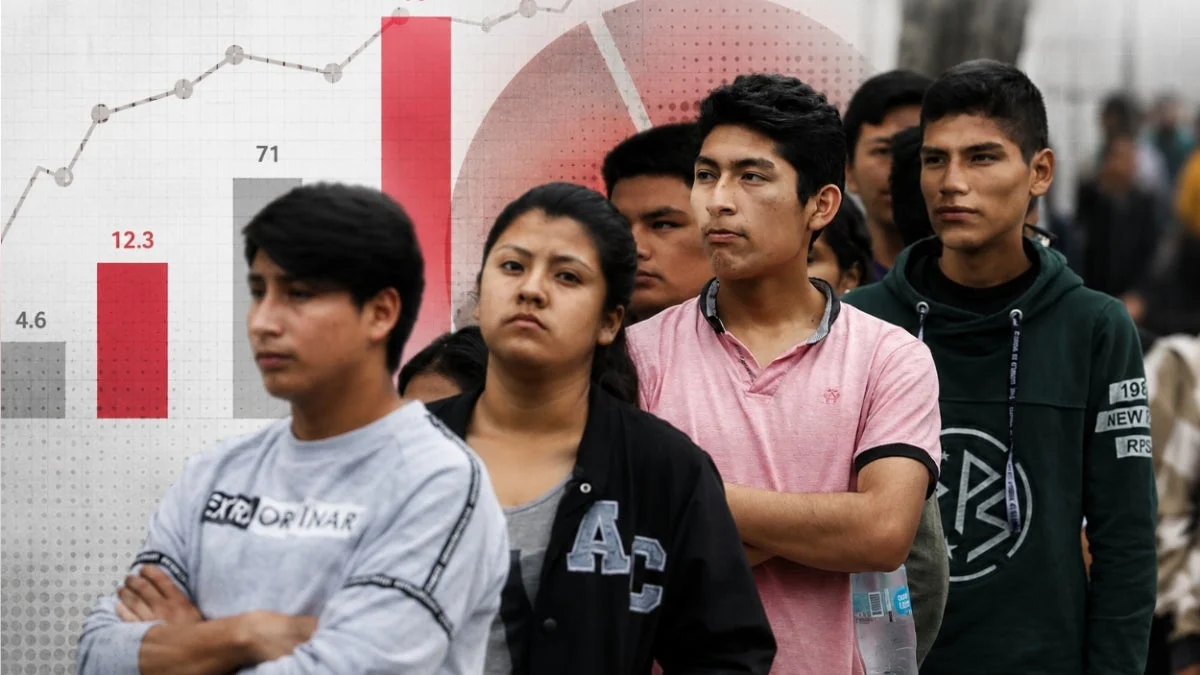
The data presented by Raúl Andrade, project manager at Apoyo Consultoría, underscores the severity of the demographic divide. The unemployment rate for those under 24 years old stands at 12.3%—nearly 2.6 times the rate of older cohorts. Even more alarming is the 80% informality rate among youth, which far exceeds the general national average of 70%.
The core issue, according to the report, is a misalignment. Young people are graduating with degrees that do not reflect the current needs of the productive sector. While there is high demand for technical and specialized skills in sectors such as computer science, mining engineering, and petroleum extraction, these fields struggle to attract sufficient enrollment, leading to a surplus of graduates in saturated sectors and a deficit in high-growth industries.
The Four-Pillar Strategic Proposal
The proposal outlines four specific, actionable mechanisms designed to integrate youth into the formal economy while respecting their fundamental rights.
1. Tax Incentives for the First Formal Job
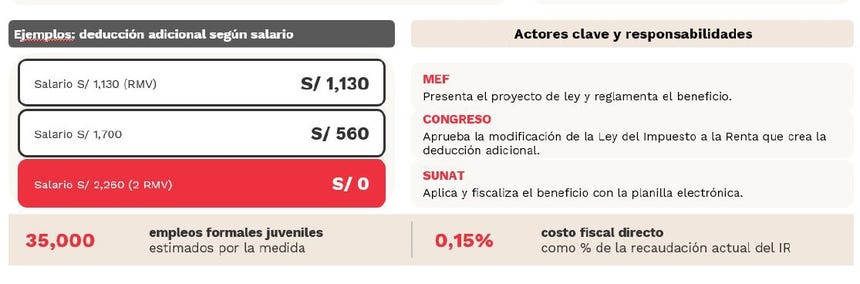
The primary proposal involves a temporary, gradual tax deduction on the Income Tax (IR) for companies that hire young people for their first formal job. The logic is simple: a novice employee costs more to train, and their initial productivity is lower. Instead of cutting salaries or benefits, the State would assume part of this "training cost" through a tax credit.
- Mechanism: For a minimum wage of S/1,130, a company could deduct that full amount from its taxable income. As the salary increases to two minimum wages (S/2,260), the deduction scales down and eventually vanishes.
- Impact: This measure is projected to generate 35,000 new formal jobs with a fiscal cost of only 0.15% of current income tax revenue.
2. Transforming the "Mi Carrera" Platform
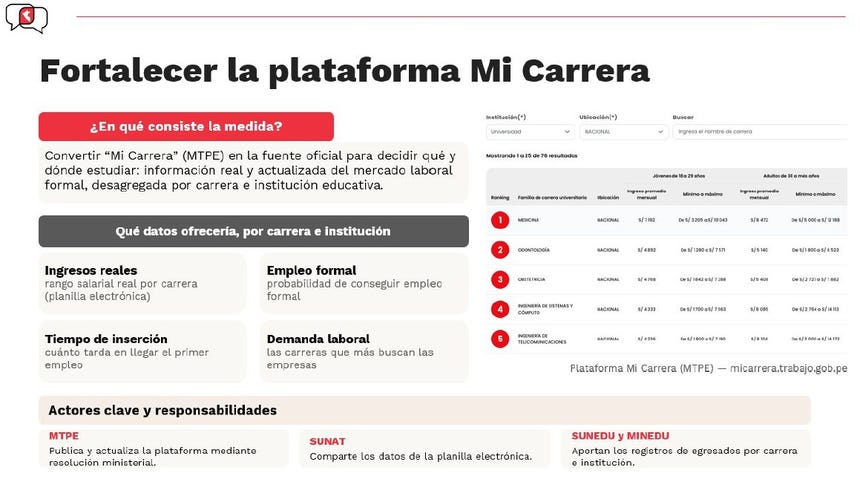
The Ministry of Labor and Employment Promotion (MTPE) currently hosts the Mi Carrera portal, but it is underutilized. The proposal suggests an overhaul to turn it into a high-utility dashboard. By integrating data from the Sunat (tax authority), Sunedu (higher education oversight), and the Ministry of Education, the platform could provide students with real-time, granular data on:
- Expected starting salaries by career and institution.
- Formal employment rates of recent graduates.
- Time required to secure the first job.
This transparency would allow students to make informed decisions about their academic future based on market realities rather than speculation.
3. "Scholarships for Taxes" (Becas por Impuestos)
Inspired by the successful "Works for Taxes" model, this pillar allows private companies to donate funds to PRONABEC (the national scholarship program) to finance degrees in high-demand fields.
- The Incentive: Companies could deduct 1.5 times the donated amount from their income tax.
- The Outcome: The State facilitates the education, while the private sector ensures the curriculum aligns with future industry needs. It creates a direct pipeline between corporate financing and the human capital required for the future.
4. Automated Authorization for Dual Training
Finally, the proposal addresses the bureaucratic bottleneck of "Dual Training," which combines classroom learning with paid on-the-job experience. Currently, every program requires a tedious, case-by-case permit. The proposal calls for an automatic authorization process for any institution that meets specific quality standards. This would allow schools and companies to partner rapidly, ensuring students gain experience while they study, significantly reducing the "no experience" barrier that haunts recent graduates.
Implications and Future Outlook
The implications of these measures go beyond simple job creation. If successful, this roadmap would address the "brain drain" and the persistent underemployment that has stagnated the Peruvian middle class. By leveraging the tax system to reward formalization and educational alignment, the proposal creates a "win-win-win" scenario: companies get the talent they need, the government increases formal tax collection, and young people gain the dignity of formal employment.
As the government evaluates these proposals, the message from the private sector is clear: the cost of inaction is far higher than the cost of these incentives. In a country where one-third of students drop out due to economic pressure, providing a bridge between study and work is not just a policy preference—it is an economic imperative. The focus remains on avoiding the mistakes of the past; by empowering the state to bridge the cost gap, the proposal ensures that the burden of economic progress does not fall on the shoulders of the vulnerable, but rather on a collaborative effort between the public and private sectors.