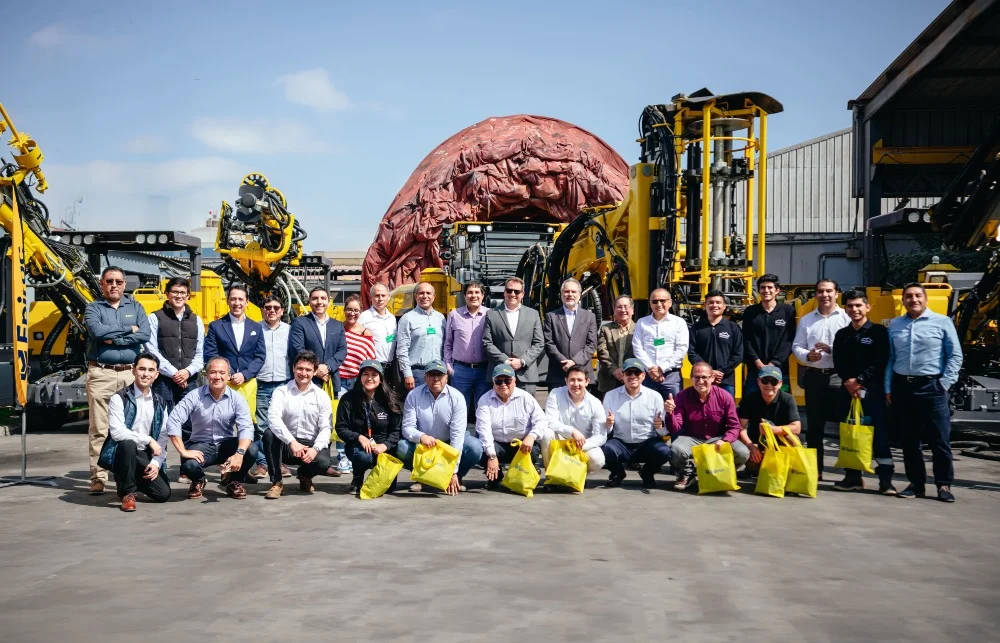
The landscape of Peruvian mining is undergoing a seismic shift. In a landmark collaboration that bridges the gap between traditional extraction and the future of industrial intelligence, Epiroc, the Swedish multinational leader in mining equipment, has delivered the first Simba E70 S automated drill rig to Volcan Compañía Minera. This deployment is not merely a purchase of hardware; it is the cornerstone of the "Romina 4.0" initiative, a project designed to position one of Peru’s most ambitious underground operations at the absolute vanguard of the global mining sector.
Main Facts: A New Standard for Underground Efficiency
The Simba E70 S is a high-precision, long-hole drill rig engineered specifically for the complexities of underground mining. By integrating advanced automation, teleoperation capabilities, and real-time data connectivity, the unit allows Volcan to redefine the safety and productivity benchmarks of their operations.
The core premise of the partnership is the "by design" approach. Unlike traditional mines that retrofit technology into legacy systems, the Romina project is being built from the ground up as a "Smart Mine." By installing the Simba E70 S in the earliest stages of the project, Volcan is ensuring that automation is not an afterthought, but the primary operating paradigm.
The immediate technical benefits of the Simba E70 S include:
- Precision Drilling: Automated navigation systems ensure that every hole is placed with extreme accuracy, reducing deviation and improving blasting efficiency.
- Remote Operation: By moving the operator from the face of the mine to a centralized control room in Lima, the risk of exposure to hazardous environments—such as rockfalls or poor ventilation zones—is virtually eliminated.
- Productivity Gains: Volcan estimates a 15% to 20% increase in operational productivity, achieved primarily by maximizing the effective utilization of the drill’s operational time without the need for additional machinery.
Chronology: The Road to Romina 4.0
The journey toward this technological milestone began with a strategic assessment by Volcan to address the dual challenges of safety and efficiency in high-altitude, complex underground environments.
- Strategic Conception: Recognizing that the future of mining lies in data-driven decision-making, Volcan executives conceptualized "Romina 4.0," a roadmap to digitize the entire life cycle of the project.
- Selection of Partner: Following a rigorous evaluation of global suppliers, Epiroc was selected as the strategic technology partner, noted for its expertise in automated systems and specialized technical support.
- The Demonstration Milestone: The partnership was solidified with a live technical demonstration. Epiroc orchestrated a real-time remote drilling event where the Simba E70 S, located at a test site, was controlled entirely by an operator based in the corporate offices in Lima. This successfully validated the low-latency connectivity required for safe, remote operations.
- Deployment: The physical delivery of the Simba E70 S marks the transition from conceptual planning to operational reality, setting the stage for the full-scale implementation of Romina’s automated fleet.
Supporting Data: Why Automation Matters
In the context of the Peruvian mining industry, where topography and geology often create significant challenges, the shift to automated equipment is a strategic necessity rather than a luxury.
Data from the project indicates that the primary driver for this investment is the "utilization of time." In conventional mining, shifts are often interrupted by safety protocols—such as the time required for smoke clearing after blasting or the time taken for personnel to travel to and from the work face. With the Simba E70 S, these "dead times" are dramatically reduced. Because the machine can be operated remotely, it can continue working during periods when human personnel might otherwise be restricted from entering the work zone.
Furthermore, the integration of data analytics allows for "predictive maintenance." The machine’s onboard systems provide continuous feedback on its health, allowing maintenance crews to address potential mechanical failures before they result in costly downtime. This proactive approach ensures that the project maintains a consistent output, crucial for the long-term economic viability of large-scale mining projects like Romina.

Official Perspectives: Transforming the Operational Culture
The leadership of both Epiroc and Volcan emphasizes that this transition is as much about human capital as it is about machinery.
Alfredo Bertrand, General Manager of Epiroc Andina Caribe, noted that the technology is a catalyst for cultural change:
"Automation goes far beyond incorporating technology. It is about transforming the way we operate, developing new capabilities, and creating safer, more productive work environments. The Simba E70 S is a symbol of a shared vision to move toward a modern, connected, and sustainable mining industry."
Miguel Sánchez, Deputy General Manager of Volcan Compañía Minera, echoed this sentiment, focusing on the strategic architecture of the project:
"Romina has been conceived as a mine that will integrate automation, connectivity, and data-based management from its initial stages. Our goal is to strengthen the safety of our collaborators while improving the precision of our processes. In this, Epiroc is not just a provider; they are a strategic ally providing the specialized knowledge necessary to navigate the complexities of Mining 4.0."
Comprehensive Training and Human Empowerment
A critical component of this partnership is the commitment to workforce development. Recognizing that automation creates a skills gap, Epiroc and Volcan have implemented a rigorous training program. This curriculum utilizes cutting-edge simulation technology, allowing operators to master the intricacies of the Simba E70 S in a virtual environment before stepping into the control center.
Perhaps the most progressive aspect of this training initiative is its focus on inclusivity. Both companies have prioritized the recruitment and training of women for these highly specialized roles. By breaking down barriers to entry for technical and automated positions, Volcan is not only addressing the labor shortage in the sector but is also fostering a more diverse and innovative corporate culture.
The training covers:

- System Oversight: Moving from physical manual control to supervising automated sequences.
- Diagnostic Skills: Interpreting data streams to make informed decisions on drilling parameters.
- Safety Protocols: Understanding the cyber-physical risks associated with remote operation.
Implications for the Future of Mining in Peru
The implications of the Romina 4.0 project extend far beyond the immediate gains of a single mine. It sets a national precedent for what is possible within the Peruvian mining sector. As the country looks to maintain its position as a global leader in copper, zinc, and silver production, the ability to operate safely and efficiently at greater depths will become increasingly important.
1. Safety as a Competitive Advantage
The ability to remove personnel from the "hot zone" (the area of active drilling) is the single most significant advancement in mining safety in the last decade. This reduces the risk of workplace accidents and significantly lowers the long-term health risks associated with working in dusty, noisy, and cramped underground environments.
2. Sustainability and Resource Efficiency
By increasing the precision of drilling, the project minimizes waste and energy consumption. More precise drilling leads to better fragmentation during blasting, which in turn reduces the energy required in the downstream crushing and grinding processes. This alignment with ESG (Environmental, Social, and Governance) goals is essential for modern mining operations to secure their "social license" to operate.
3. The Digital Backbone
Romina 4.0 serves as a blueprint for the "Connected Mine." By building a robust data infrastructure, Volcan is creating a foundation that can be expanded to include autonomous haulage, drone surveillance, and AI-driven mineral grade control in the future. This scalability is the hallmark of a truly modern operation.
Conclusion
The arrival of the Simba E70 S at the Romina project is a defining moment for the partnership between Epiroc and Volcan. It signifies a transition away from the labor-intensive, risky methods of the past toward an era of intelligent, automated, and human-centric mining.
As the project moves into its next phases, the data gathered from the Simba E70 S will likely serve as a case study for the entire industry. By prioritizing technological integration, continuous education, and the safety of their workforce, Volcan is demonstrating that the future of mining in Peru is not just about the minerals extracted from the earth, but about the innovation and intelligence applied to extract them.
The success of Romina 4.0 will undoubtedly encourage other players in the sector to accelerate their own digital transformations, ultimately elevating the standard of the entire Peruvian mining industry on the global stage.