Strategic Preventive Intervention in the Chancay-Lambayeque River
In a proactive effort to mitigate the catastrophic potential of the El Niño phenomenon, the Regional Government of Lambayeque, spearheaded by the Special Project Olmos Tinajones (PEOT), has officially launched a large-scale hydraulic engineering intervention. The project focuses on the vulnerable sector of El Rinconazo, located in the Tumán district, along the right bank of the Chancay-Lambayeque River.
As climate experts continue to monitor atmospheric conditions that could lead to increased rainfall and river surges, local authorities have shifted from reactive disaster management to a strategy of structural prevention. The current operation aims to secure the riverbank, prevent soil erosion, and protect the local population from the threat of flooding—a perennial danger that has historically disrupted the economic and social stability of the region.
The Scope of the Engineering Project
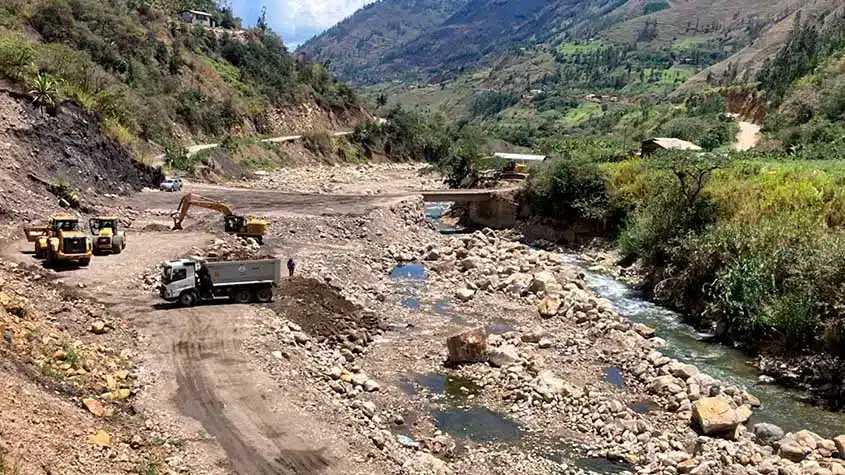
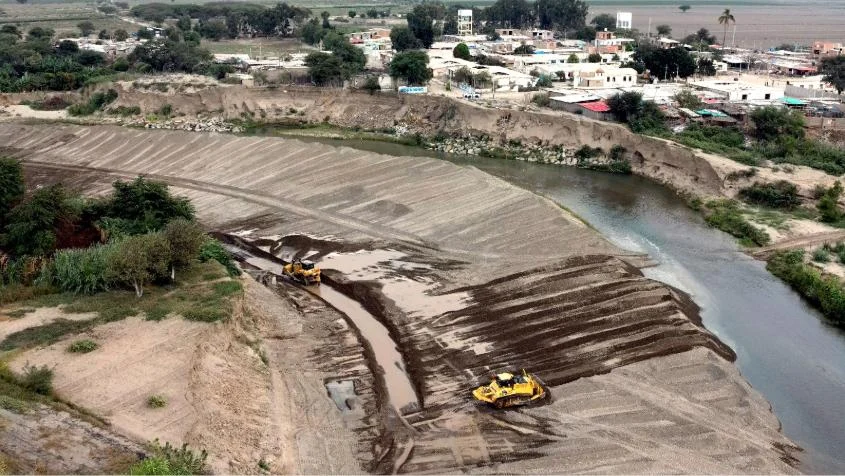
The primary objective of this intervention is the professional management of the river’s hydraulic box. Engineers are currently working on a 500-meter stretch of the riverbed, executing a dual strategy of channelization and desilting. By removing accumulated sediments that have narrowed the flow path, the project aims to restore the river’s natural capacity to transport water during high-flow seasons.
The sediment extracted through this process is not considered waste; rather, it is being repurposed to construct a robust dike along the right bank. This earthen embankment serves as the foundational support for the installation of geobolsas (geotextile sandbags). These specialized containment structures are highly resistant to water pressure and erosion, providing a durable defense mechanism that will shield the residential areas of El Rinconazo from the river’s encroaching force.
Chronology of the Deployment
The mobilization of resources for this project began in early August 2026, marking a swift response to the government’s mandate for regional preparedness.

- August 4, 2026: Official commencement of field operations. Three primary units of heavy machinery, including two D-8 tractors and one high-capacity excavator, were deployed to the site.
- Early August 2026: The initial phase focused on the clearing of the hydraulic channel and the systematic piling of sediment to establish the base for the protective dike.
- Upcoming Phase: Within the next few weeks, the project will see an expansion of its mechanical fleet, with an additional excavator and specialized equipment from the National Water Authority (ANA) scheduled to join the operation to accelerate the timeline.
- Projected Completion: The construction of the 400-meter dike, supported by three strategically placed spurs (espigones) and the installation of approximately 1,000 geobolsas, is expected to be finalized within a 60-day window, weather and logistical conditions permitting.
Institutional Collaboration and Official Responses
Governor Jorge Pérez Flores has framed this initiative as a model of inter-institutional synergy. Recognizing that the magnitude of El Niño requires a unified response, the project relies on a multi-agency funding and labor model.
"We are acting with foresight because we cannot afford to wait for a state of emergency to begin our work," Governor Pérez Flores stated. "Our objective is the protection of the residents of El Rinconazo. By coordinating the resources of the PEOT, the regional government, and the District Municipality of Tumán, we are maximizing the efficiency of every sol invested."
The fiscal architecture of the project is equally collaborative. With a total budget of S/ 1,520,000, the funding covers the critical supply of fuel, the procurement and installation of the high-durability geobolsas, and the operational costs of the heavy machinery. The PEOT provides the technical expertise and the equipment, while the regional government manages the financial resources, and the municipality provides the essential manual labor force. This partnership ensures that local needs are met with both central oversight and grassroots participation.
Technical Analysis: Managing the Hydraulic Risk
The General Manager of PEOT, Ing. Pastor Espinoza Chilón, provided a technical breakdown of why this specific site in Tumán was prioritized. "The erosion on the right bank is not a slow, uniform process; it is a dynamic threat," explained Espinoza Chilón. "If we do not restore the hydraulic capacity of this sector, any significant rise in the river’s discharge will result in further land loss. The river will literally consume the banks where these families live."
The strategy involves a two-pronged technical approach:

- Hydraulic Channelization: By re-aligning the river’s flow, the engineers ensure that the water velocity is better managed, reducing the force of impact against the most vulnerable segments of the embankment.
- Structural Reinforcement: The use of 1,000 geobolsas provides a flexible yet incredibly strong barrier. Unlike rigid concrete walls which can crack and fail under shifting soil pressures, geobolsas adapt to the riverbed, making them an ideal solution for the alluvial soils found in the Lambayeque region.
Socio-Economic Implications
The protection of El Rinconazo is not merely an engineering feat; it is a humanitarian necessity. The region of Lambayeque has long been the backbone of the local agricultural sector, and river flooding poses an existential threat to both livelihoods and infrastructure.
When the Chancay-Lambayeque River overflows, it destroys not only homes but also irrigation channels, access roads, and agricultural yields. By securing this specific stretch, the regional government is essentially creating a safety buffer for the broader agricultural supply chain in the district of Tumán.
Furthermore, the integration of the National Water Authority (ANA) into the project brings a layer of regulatory oversight that ensures the work adheres to national water management standards. This prevents the "quick-fix" culture that has historically plagued infrastructure projects, favoring long-term stability over temporary measures.
Looking Toward the Future
As the 60-day construction schedule progresses, the regional government remains in a state of high alert. The lessons learned from previous El Niño events have been synthesized into this current project, which prioritizes:
- Early Deployment: Acting months before the peak of the rainy season.
- Scalability: The ability to add more machinery as the project moves into its final phases.
- Transparency: Clearly defined roles between the PEOT, the regional government, and the district authorities.
The initiative in Tumán serves as a pilot for similar interventions planned across the Lambayeque region. As climate patterns continue to show increased volatility, the ability to protect vulnerable riverine populations through proactive, science-backed engineering will define the success of regional governance in the coming decade.

For the residents of El Rinconazo, the presence of heavy machinery on the riverbanks is a welcome sign of security. It represents a shift from living in fear of the river’s wrath to having a concrete, engineered defense that stands between them and the potential chaos of the coming months. As the 1,000 geobolsas are positioned and the dike takes its final form, the region moves one step closer to climate resilience, ensuring that when the rains arrive, the community remains standing.
The commitment of S/ 1.52 million is a testament to the fact that prevention is significantly more cost-effective—and infinitely more humane—than the cost of reconstruction after a disaster. The work in Tumán continues, with all stakeholders focused on the deadline and the shared goal of regional safety.