Executive Summary: A Gendered Burden
In Peru, the engine of the national economy relies heavily on a workforce that remains largely invisible, uncompensated, and increasingly overwhelmed: women performing unpaid domestic and care work. According to the latest report by the International Labour Organization (ILO), titled "Who Cares in Peru?", the time women dedicate to unpaid care has surged by 66% over the last 14 years. This growing responsibility is not merely a domestic issue; it is a structural barrier preventing gender equality, hindering female economic autonomy, and masking a colossal contribution to the country’s Gross Domestic Product (GDP).
While the global conversation regarding the "care economy" has gained momentum, the reality for Peruvian women is a "double burden" of increasing professional expectations coupled with an unrelenting escalation of household obligations.
Chronology of a Growing Gap (2010–2024)
The data provided by the ILO paints a stark picture of how the landscape of labor has shifted over the last decade and a half.
The Surge in Unpaid Hours
Between 2010 and 2024, the daily time women allocate to unpaid domestic and care tasks rose from 2 hours and 5 minutes to 3 hours and 28 minutes. This 83-minute increase represents a 66% jump in workload. Conversely, men saw their contribution rise from 1 hour and 1 minute to 1 hour and 43 minutes—an increase of only 42 minutes.
The Widening Disparity
The resulting gap is staggering. In 2010, the difference between women’s and men’s daily time spent on care was 64 minutes. By 2024, that gap has ballooned to 105 minutes. Essentially, the progress women have made in entering the professional sphere has been shadowed by a disproportionate expansion of their domestic responsibilities.
The "Double Work" Phenomenon
Crucially, this increase in care work has occurred in parallel with an increase in paid labor. Women’s time dedicated to paid employment rose from 6 hours and 6 minutes in 2010 to 7 hours and 11 minutes in 2024. Consequently, the total working day for the average Peruvian woman has grown significantly longer than that of her male counterpart, leading to systemic exhaustion and a reduction in time available for education, rest, or personal development.
Supporting Data: The Economic Weight of Care
One of the most revealing aspects of the ILO study is the quantification of this "invisible" work. Despite its lack of a paycheck, the care economy is a pillar of national stability.
Contribution to the GDP
The ILO estimates that unpaid domestic and care work accounts for between 21.7% and 25.4% of Peru’s annual GDP. This means that if this work were suddenly monetized, it would represent one of the largest sectors of the national economy, surpassing many traditional industries. More than 70% of this value is generated directly by women.
The Impact of Early Childhood
The gendered nature of this work is most pronounced in households with children under the age of three. In these settings, the division of labor becomes extreme:
- Women: Spend 6 hours and 6 minutes daily on unpaid care.
- Men: Spend 2 hours and 12 minutes on the same tasks.
This means women in households with infants spend nearly three times the amount of time on care as men. This period of life—often critical for career advancement—becomes a primary point of departure from the workforce for many women.
The Price of Inequality: Professional and Social Implications
The implications of this imbalance are profound, affecting not just individual households but the entire national economy.
Labor Market Exclusion
Inés Martens, an official of programs and projects at the ILO, emphasizes that the burden of care is a primary driver of female economic marginalization. "We are not just talking about entering the market; we are talking about the conditions under which we work," says Martens. "Because women are burdened with care, they are often pushed into the informal sector. They have less time for professional development, fewer hours to offer employers, and consequently, lower wages."
According to data from the National Institute of Statistics and Informatics (INEI), in 2022, approximately 2.6 million women were neither employed nor seeking employment—not by choice, but because the demands of household and care tasks made external labor impossible.
The "Care" Demographic Shift
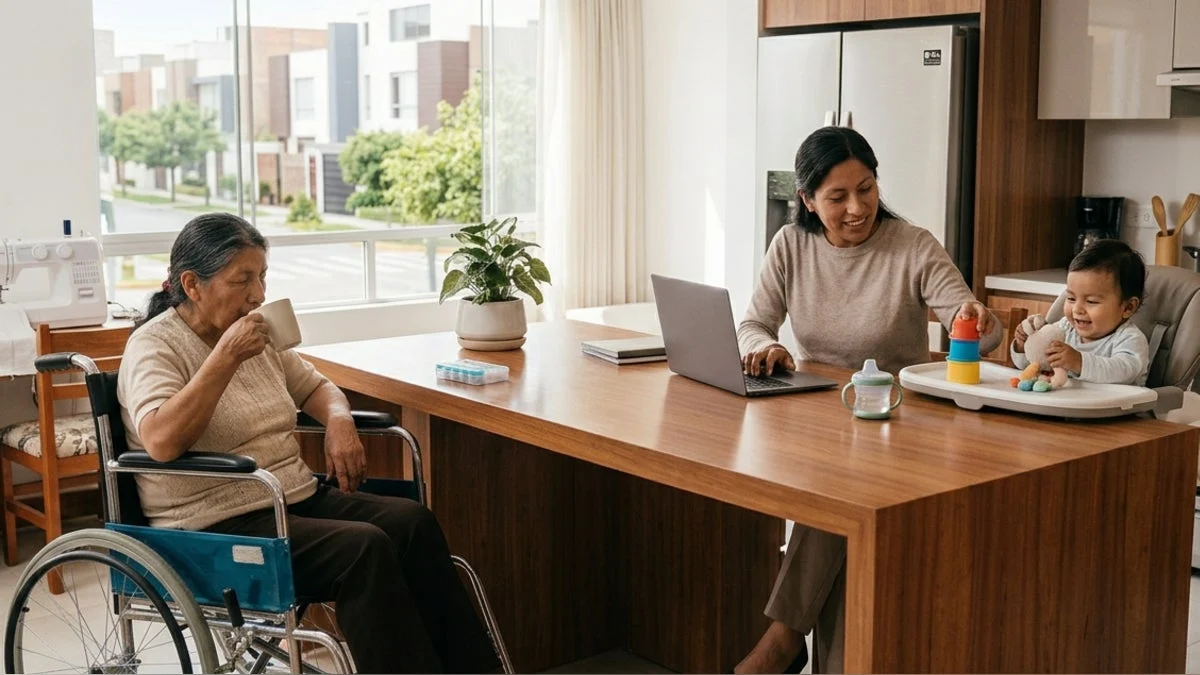
The rise in unpaid work is not solely attributable to child-rearing. As life expectancy in Peru increases, the demand for elderly care has skyrocketed. "We are caring for children, but we are also increasingly responsible for aging parents and relatives," notes Martens. Without a robust social support system, this demographic shift falls squarely on the shoulders of women, trapping generations in a cycle of limited economic autonomy.
Official Responses and the Policy Gap
The ILO’s report highlights a critical failure in the public infrastructure of Peru: the lack of a comprehensive National Care System.
The State of Public Services
While the government has implemented various programs, they remain fragmented and insufficient. The study “Care in Peru: Map of Public Offer and Profile of Caregivers” analyzed 12 public programs, finding that only seven provide tangible care services.
Coverage remains alarmingly low relative to the population:
- Early Childhood: Programs like Cuna Más and PRONOEI reach approximately 219,000 children. While valuable, this is a fraction of the total need.
- Elderly and Disability Care: Public programs like Programa Gratitud serve only 1,501 seniors, and residential centers for individuals with disabilities cater to fewer than 500 people.
The "Volunteer" Trap
Perhaps the most concerning discovery is the reliance on precarious labor to provide these limited services. Of the nearly 30,000 caregivers identified in public programs, 88% are women. More alarmingly, nine out of ten operate as volunteers, lacking formal employment contracts, social security, or pension contributions. The state, in effect, is replicating the same model of unpaid or underpaid female labor within its own social programs.
Conclusion: A Path Toward Structural Reform
The data presented by the ILO serves as a wake-up call. Peru’s economic growth is currently subsidized by the unpaid labor of women, a model that is inherently unsustainable.
To achieve true economic equality, the country must move toward a National Care System that:
- Professionalizes Care: Transitioning away from volunteer-based models toward formal, paid, and protected caregiving roles.
- Expands Infrastructure: Investing in public childcare and eldercare facilities to relieve the burden on individual households.
- Redistributes Responsibility: Implementing policy changes that encourage men to participate equally in domestic duties, breaking the social norms that designate care as an exclusively "female" domain.
The "invisible" economy is no longer invisible. The question remains whether policymakers will act to value this work or continue to rely on the sacrifice of millions of women to hold the social fabric together. As the population continues to age and the demands of the modern economy evolve, the cost of inaction will only continue to rise.