HUANCAYO – The political landscape of the Junín region was brought into sharp focus this week as the Jurado Nacional de Elecciones (JNE) inaugurated its national schedule of regional debates. With the October 4th Regional and Municipal Elections looming, the event in Huancayo served as a crucial litmus test for the seven candidates vying for the regional governorship, offering voters a glimpse into the platforms, priorities, and temperament of those hoping to lead the department for the next four years.
The Main Facts: A Forum for Policy and Public Scrutiny
The debate, held in the regional capital of Huancayo, was designed to provide a transparent platform for candidates to address the pressing social and economic challenges facing Junín. Over the course of three hours, the participants navigated a rigorous four-block thematic structure. These segments covered critical areas such as regional economic development, public infrastructure, social welfare, and the governance strategies intended to propel the region forward through 2026.
While the primary focus remained on policy proposals, the event also incorporated direct citizen participation, with candidates tasked with answering questions formulated by the public. This segment aimed to bridge the gap between abstract political discourse and the lived realities of Junín’s residents, who have recently grappled with issues ranging from regional seismic recovery efforts to long-standing infrastructure deficits.
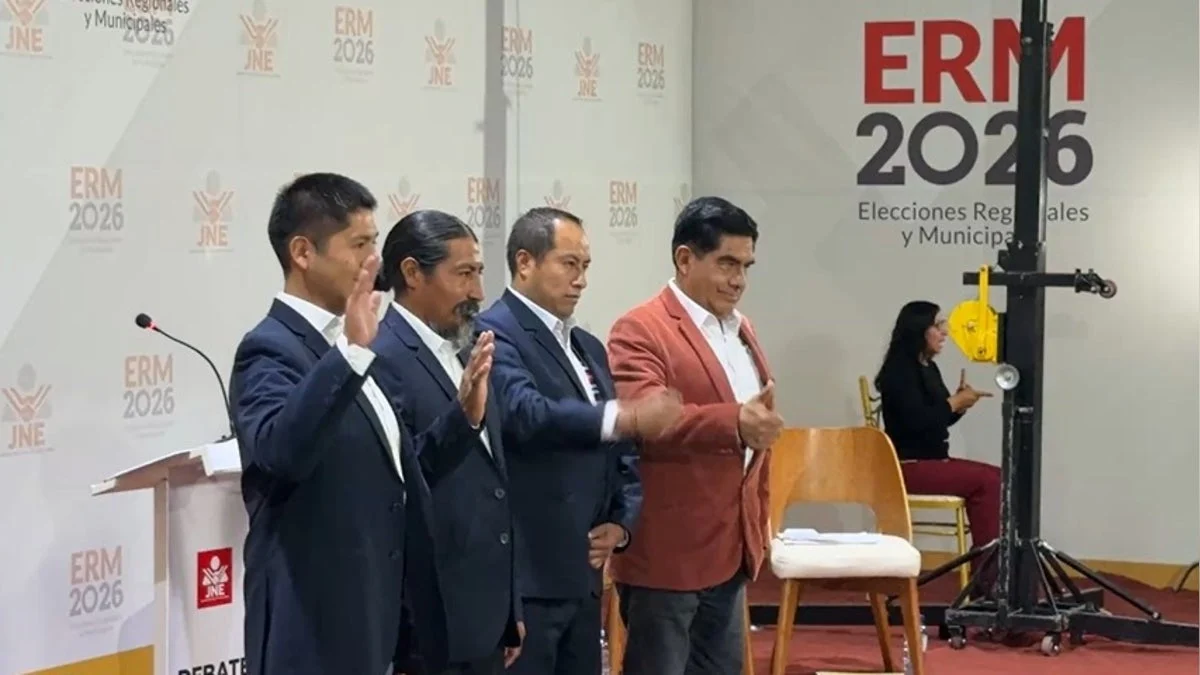
The event, which concluded with a ceremonial photograph of the seven candidates, officially set the standard for the JNE’s national tour of regional debates, reinforcing the institution’s role as the arbiter of electoral transparency and democratic engagement in Peru.
A Chronology of the Evening: Delays and Adjustments
The event, originally scheduled to commence at 6:00 p.m., faced an unexpected delay that tested the patience of the organizers and the assembled audience. The start time was pushed back to 7:10 p.m. as officials held out hope for the arrival of Julia Camavilca, the candidate for Fuerza Popular.
Camavilca’s absence was not a political maneuver, but rather the result of a physical injury sustained during a campaign visit to the district of Sapallanga. The candidate reportedly suffered a foot injury that rendered her unable to participate in the proceedings. Her absence triggered a significant logistical pivot for the JNE moderators.
Under the original format, the candidates were grouped into pre-arranged duplas (pairs) to facilitate structured exchanges. With Camavilca missing, the JNE was forced to reorganize the stage dynamics on the fly. Dimas Aliaga (Renovación Popular), who had been slated to engage directly with Camavilca, was reassigned to a three-person group alongside Arnoldo Mallma (Alianza para el Progreso) and César Merea (Batalla Perú).
The remainder of the event proceeded according to the revised schedule, featuring the following pairings:
- Group 1: Fernando Orihuela (Podemos Perú) and Adolfo Rojas (Frepap).
- Group 2: Juan Palomino (Juntos por el Perú) and José Álvarez (Acción Popular).
- Group 3: Dimas Aliaga (Renovación Popular), Arnoldo Mallma (Alianza para el Progreso), and César Merea (Batalla Perú).
The event concluded shortly before 10:00 p.m., leaving a lasting impression on the approximately 600 supporters who had gathered outside the venue to cheer on their respective candidates, creating a vibrant, albeit tense, atmosphere in the streets of Huancayo.
Supporting Data and Context: The State of the Race
The significance of this debate cannot be overstated. Junín is currently at a critical juncture, characterized by a complex mix of economic potential and social vulnerability. The JNE has emphasized that these debates are not merely ceremonial; they are essential instruments for informed voting.
Key Thematic Pillars
During the debate, candidates were pressed on several key areas that define the region’s current state:
- Economic Development: Proposals focused on the agricultural sector—a cornerstone of Junín’s economy—and the need for modernization to improve competitiveness in national and international markets.
- Social Infrastructure: Discussions centered on the ongoing need for housing and reconstruction, particularly for families affected by recent seismic activity in areas like Pumpunya.
- Governance and Transparency: In light of the JNE’s ongoing efforts to oversee campaign spending, candidates were reminded of the September 11th deadline to report all campaign contributions and expenditures. This requirement is part of a larger national push to curb the influence of illicit funding in regional politics.
The atmosphere outside the venue, populated by roughly 600 vocal supporters, highlighted the high stakes of this election. The presence of these crowds underscores the deeply entrenched party loyalties in the region and the high level of public engagement expected as the October 4th polling date approaches.
Official Responses and Institutional Oversight
The JNE has positioned these debates as the "gold standard" for electoral information. By organizing these encounters, the JNE seeks to mitigate the spread of misinformation and ensure that voters have direct access to the candidates’ visions for the future.
In his remarks following the event, a representative from the JNE noted that the flexibility shown by the organizers during the delay and the subsequent restructuring of the debate groups demonstrated the institution’s commitment to ensuring that the electoral process continues regardless of individual setbacks. The JNE also reiterated its stance on campaign finance, noting that the deadline for reporting expenses is not merely a formality but a legal necessity for all participating organizations.
The candidates themselves, while largely adhering to the formal structure, used their time to emphasize their unique visions. Those who participated in the triple-grouping—Aliaga, Mallma, and Merea—were particularly noted for their ability to navigate a more crowded field of dialogue, often having to condense their policy points to fit the time constraints imposed by the larger group.
Implications: What This Means for Junín
As the dust settles from the Huancayo debate, the implications for the region’s political future are beginning to take shape.
1. The Impact of the "Absentee Factor"
The absence of Julia Camavilca has introduced a new variable into the campaign. While her injury is a personal matter, it disrupts the momentum of her campaign at a crucial time. Political analysts suggest that the reorganization of the debate groups may have inadvertently shifted the focus toward the candidates who were present and able to articulate their platforms without interruption.
2. The Shift Toward Policy-Centric Campaigning
By forcing candidates to address specific thematic blocks, the JNE has effectively moved the conversation away from populist rhetoric and toward concrete governance. For voters in Junín, this is a positive development, as it allows for a more substantive comparison of the candidates’ actual plans for the next four years.
3. The Role of the Citizen Question
The inclusion of questions from the public is perhaps the most vital component of these debates. By forcing candidates to address concerns about the lack of housing modules for displaced families or the slow pace of reconstruction, the JNE has ensured that the candidates cannot ignore the immediate, urgent needs of the constituency.
4. Setting the National Tone
As the first in the JNE’s national series, the Junín debate serves as a blueprint for upcoming regional events. The lessons learned in Huancayo—regarding timing, candidate management, and thematic structure—will likely influence the organization of subsequent debates across the country.
Conclusion: A Path Forward
The path to October 4th is now well-defined. The candidates have made their pitches, the public has posed their questions, and the JNE has fulfilled its mandate to provide a venue for democratic exchange. For the people of Junín, the next several weeks will be a period of reflection as they weigh the proposals presented on the debate stage.
Whether the candidates can move beyond the soundbites and address the structural challenges of the region remains to be seen. However, by participating in this process, the candidates have acknowledged that the road to the regional governorship runs through the public square, where transparency, debate, and accountability are the only currencies that matter. As the region moves closer to election day, the focus will undoubtedly shift from the theater of the debate to the reality of the ballots, where the citizens of Junín will ultimately decide the trajectory of their future.