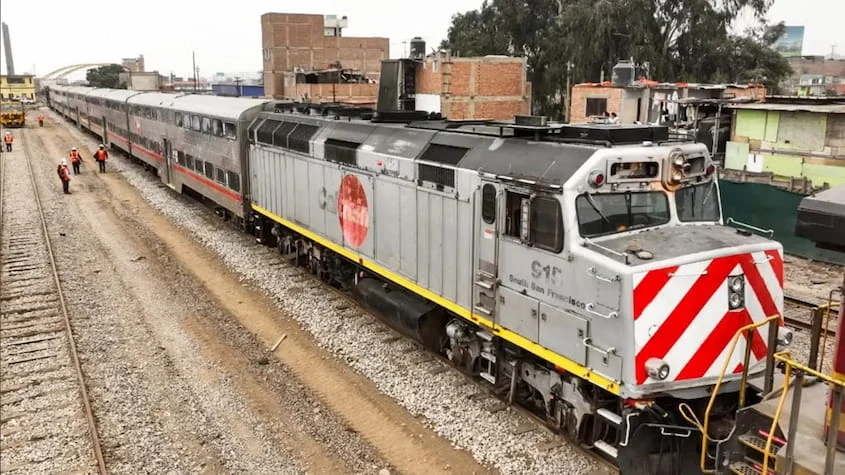
In a decisive move to overhaul the urban mobility landscape of Peru’s capital, the Ministry of Transport and Communications (MTC) has officially delegated the execution management of the Ferrocarril del Centro (Central Railway) concession to the Private Investment Promotion Agency (ProInversión). This strategic realignment marks a critical milestone in the long-awaited project to establish a high-capacity passenger rail service linking Lima with the district of Chosica, a vital transit artery for thousands of daily commuters.
The formalization of this agreement, codified through Addendum No. 1 to the existing delegation of competencies, signals a shift in how the state handles complex infrastructure concessions. By concentrating technical, legal, and financial expertise within ProInversión, the government aims to accelerate the deployment of a modernized rail system that promises to alleviate the chronic congestion characterizing the Carretera Central.
The Mandate: A Strategic Delegation of Power
The agreement, signed on August 28, 2026, by Transport Minister Rafael Rey Rey and ProInversión’s Executive President, Luis Natal Del Carpio Castro, expands the mandate established in May 2026. Under this new framework, ProInversión acts as the Public Entity Holder of the Project (EPTP) during the execution phase.
This is not merely a bureaucratic shift; it is a structural empowerment. ProInversión is now tasked with steering the negotiations for the upcoming Addendum No. 11 of the original 1999 concession contract. The objective of this specific addendum is to integrate the necessary infrastructure modifications to transition the freight-heavy Central Railway into a dual-purpose system that safely and efficiently handles passenger traffic.
ProInversión’s authority encompasses the comprehensive administration of the contract. However, the mandate comes with clear boundaries: the agency will not inherit the ownership of physical assets, nor will it manage state-level financial guarantees, insurance policies, or other functions deemed legally "non-delegable" by the MTC. The MTC has been granted a 60-business-day window to transfer the vast archive of technical and legal documentation to ProInversión to ensure a seamless transition of oversight.

Chronology: From Freight Corridor to Passenger Corridor
The evolution of the Ferrocarril del Centro from a colonial-era mining logistics route to a potential modern transit hub has been a multi-decade journey.
- September 1999: The original concession contract for the Ferrocarril del Centro is signed between the Peruvian State and the private concessionaire, Ferrovías Central Andina S.A., primarily focusing on mineral transport.
- August 2025: Ferrovías Central Andina S.A. submits a formal proposal to the MTC, outlining the necessary capital investments to retrofit the existing tracks and stations for passenger service between Lima and Chosica.
- May 19, 2026: The MTC and ProInversión sign the initial agreement to collaborate on the project’s development, setting the stage for the current delegation of powers.
- August 28, 2026: The signing of Addendum No. 1, which officially elevates ProInversión to the role of project manager for the contract’s execution phase.
The Economic and Social Necessity: Why Lima-Chosica Matters
The Lima-Chosica rail corridor is more than just a transportation project; it is an economic imperative. The Carretera Central, the primary road connecting Lima to the central highlands, is frequently paralyzed by traffic, landslides, and an overabundance of heavy-duty vehicles. For the hundreds of thousands of residents living in Lima East, the commute to the city center is often a multi-hour ordeal.
By utilizing the existing railway right-of-way, the project promises to offer a predictable, safer, and significantly faster alternative. The potential for the rail line to serve as a backbone for transit-oriented development (TOD) is immense. As ProInversión takes charge, the agency faces the challenge of ensuring that the infrastructure—ranging from signaling systems to station accessibility—meets modern international safety standards for passenger transit.
ProInversión’s Strategic Vision
Luis Del Carpio, Executive President of ProInversión, underscored the agency’s commitment to the project during the signing ceremony. "Our objective is to contribute to making a reality a mass transit alternative that is both safe and efficient," Del Carpio stated. "We are responding to a concrete necessity for thousands of citizens whose quality of life is currently hindered by the limitations of our existing transport network."
ProInversión’s approach is expected to be data-driven. By leveraging its experience in structuring public-private partnerships (PPPs), the agency intends to ensure that the modifications to the concession contract are fiscally responsible while maximizing the social return on investment. The focus will be on "de-risking" the project for both the state and the concessionaire, ensuring that the financial architecture is robust enough to withstand the complexities of long-term infrastructure maintenance.

Technical and Operational Implications
The transition to passenger service on a track shared with freight trains presents significant operational hurdles. These include:
- Track Capacity and Scheduling: Developing a precise timetable that allows for passenger "windows" without disrupting the crucial flow of minerals from the Andes to the Port of Callao.
- Rolling Stock Requirements: Determining the type of railcars best suited for the steep gradients and the unique altitude profiles of the Central Railway.
- Safety Infrastructure: Upgrading grade crossings and pedestrian barriers to prevent accidents in densely populated urban zones where the rail currently runs at street level.
- Station Intermodality: Ensuring that the proposed train stations are integrated with Lima’s existing bus rapid transit (BRT) and metro systems, creating a unified network.
The project team will likely need to conduct extensive feasibility studies and impact assessments as part of the Addendum No. 11 negotiations to address these challenges.
The Road Ahead: Challenges and Oversight
While the delegation of power to ProInversión is a positive step, the project is not without its critics and skeptics. Historical delays in Peruvian infrastructure projects have often been attributed to complex bureaucratic layers and shifting political priorities. By delegating the execution management, the government is attempting to streamline the decision-making process, but it must also ensure rigorous transparency.
The MTC’s retention of certain "non-delegable" functions acts as a system of checks and balances. However, the next 60 days—the period allotted for the transfer of documentation—will be a critical stress test for the inter-institutional coordination between the MTC and ProInversión.
Furthermore, the involvement of the original concessionaire, Ferrovías Central Andina S.A., requires a delicate balance of negotiation. The project must provide fair compensation for the additional capital expenditure required to upgrade the tracks, while simultaneously protecting the public interest and ensuring that ticket prices remain accessible to the demographic the project aims to serve.

A Catalyst for Regional Development
Beyond the immediate relief for commuters, the successful implementation of the Lima-Chosica train could serve as a pilot program for further rail expansion in Peru. If the model proves effective, it could pave the way for similar suburban rail projects in other parts of the country, reducing the nation’s reliance on road-based transport and lowering the carbon footprint of regional transit.
As ProInversión assumes its new responsibilities, the public and private sectors alike will be watching closely. The project represents a fundamental shift in how the state manages its infrastructure assets, moving away from fragmented, department-led oversight toward a centralized, professionalized management model.
For the citizens of Lima East, the promise of a reliable, modern train is a beacon of progress. If the timeline holds and the negotiations proceed efficiently, the Lima-Chosica railway could become the crown jewel of urban transport, transforming a daily struggle into a streamlined, dignified experience. The journey from the drawing board to the tracks is still long, but with ProInversión now firmly in the driver’s seat, the path forward is clearer than it has been in years.